
I have just arrived in Boston, Massachusetts, after nearly two weeks of travelling. I left Calais on the 5th of November, boarded the ship Europa on the 7th, arrived in New York on the 17th, and reached Boston late in the evening on the 18th. I settled into a small hotel not far from the building where William LE PETIT works as concierge. I immersed myself in a very hot bath to soothe my body, worn out by such a long journey. The city is immense and noisy. I am afraid of losing myself in it, so I shall rest. My armchair is missing me ; my apartment is missing me. In this era, the furniture is angular and uncomfortable, and the colours are dreadfully bright. I go downstairs for my meal. In the restaurant, a pianist is playing a piece of jazz. The maître d’hôtel keeps a close eye on him. The musician lives through his music and pours his mood of the day into the piano. The menu offers enough variety that I do not have to taste this new so-called “fast food.” I struggle a little to understand the waiter. His accent and expressions are worlds away from the English language I know. I remain for a while in the small adjoining lounge to listen to the musician. Fatigue overtakes me, and I return upstairs to bed. Tomorrow, I am to meet William and Marguerite LE PETIT at half past one.
It is 1:20 p.m. as I make my way towards this eighteenth-century building where families of good society reside. Upon the doorstep, a woman of around forty stands waiting anxiously. I approach her ; she smiles and says, in French that delights me :
“Mademoiselle Rose?”
“Yes, that is indeed me. Good afternoon, Madame LE PETIT. How are you?”
“Very well, thank you.”
“Do you not struggle too much with the language?”
“No. Thanks to my daughter Marguerite, who works as an interpreter, I learned English. Please come in ; my husband will join us shortly.”
The concierge’s lodge is small but comfortably furnished.
“Marguerite, prepare the coffee.”
A young woman emerges from another room, greets me quickly, kisses her mother’s forehead, and hurries away.
“That is my eldest daughter, Raymonde! She works in a large department store as a sales assistant. She is a free spirit — unmarried, determined to live her life as she chooses. In this country, that is much easier.”
Marguerite serves me a large cup of steaming coffee. That distinctive taste of chicory instantly carries us back to our native region. Marguerite is nostalgic ; she misses her family, yet she made this choice for her husband’s happiness. At that very moment, he walks through the door. His wife serves him his coffee and leaves for the upper floors. Work is waiting for her.
“Good afternoon, Mademoiselle Rose. Did you have a pleasant journey?”
“Good afternoon, Monsieur LE PETIT. Yes, I was fortunate ; there was no rough weather. Out of curiosity, while in New York, I visited the address where your father was born.”
“I scarcely knew my grandparents ; I was still a child when they died.”
“Then where does this love for the United States come from?”
“I served in the navy. I enlisted at eighteen and was stationed in Toulon. Between 1918 and 1921, we repatriated American soldiers. I therefore had the pleasure of visiting this country several times. One of those soldiers, a few years older than myself, showed me around this region, which immediately appealed to me. I loved — and still love — the dynamism of this city and its people. I settled in Calais in 1921 with my wife and daughter. I was a chief petty officer electrician in the navy and later became a train inspector after returning to civilian life. I had two more daughters, Susan in 1922 and Marguerite in 1924. I quietly continued along my path, but I was unhappy. Marguerite soon realised it. I had already spoken to her about my travels and about America, though without too much detail. Then I told her about my attachment to this country, and especially to Massachusetts.”
“How did she react?”
“At first, she said nothing. She was thinking. She knew I still corresponded with Carl, my friend in Boston, and she wanted to know more about the city, about Americans, and about their way of life. I watched her disappear for entire days without knowing where she had gone. Whenever I asked, she simply smiled and said : ‘Patience.’”
“And what was she planning?”
“One evening, after putting the girls to bed, she asked me to join her in the dining room. Papers were spread across the table : documentation about Massachusetts and Boston, along with her correspondence with Carl.”
“Your wife already spoke English?”
“No. As you know, many English people live in Calais. It was easy enough for her to have her letters translated into English and Carl’s replies translated into French. In those letters, she asked about schools, the cost of education, and so forth. There was also, upon a large sheet of paper, a terrifying list of expenses : the cost of passports, the journey for five people, the rent for an apartment, the girls’ school fees. The list seemed endless. I thought my dream would remain only a dream.”
“You must have been disappointed.”
“Not for long! There was another sheet of paper beside it, listing the savings we could make each year. Nearly twenty years of waiting. But during those twenty years, the girls would complete their schooling ; they might even marry. Raymonde and Susan learned the trade of sales assistants, while Marguerite, more gifted for studies, became an interpreter.”
“And your dream finally came true. How did your final year in France go?”
“We moved into Marguerite’s family home in Valenciennes to save on rent. We arrived in New York on the 22nd of August last year with Raymonde. Carl found this position for us. My daughter Marguerite has already been living in Boston for four years, though she travels frequently between France, England, and America. She is in demand everywhere.”
“Susan and her husband, Jean ROGUZAC, will join us next year.”
“Are you happy, Monsieur LE PETIT?”
“Yes! And not only me. We intend to apply for American citizenship.”
“Thank you for sharing your story with me. As soon as I return to the hotel, I shall begin writing it.”
“Take your time, Mademoiselle Rose. Visit this city and its surroundings. I have found you a guide. My friend Carl will accompany you with great pleasure.”
“Thank you, Monsieur LE PETIT. I am delighted to have met you. I wish you a long and happy life in this country.”
“Thank you, Mademoiselle Rose. We shall meet again before your departure.”
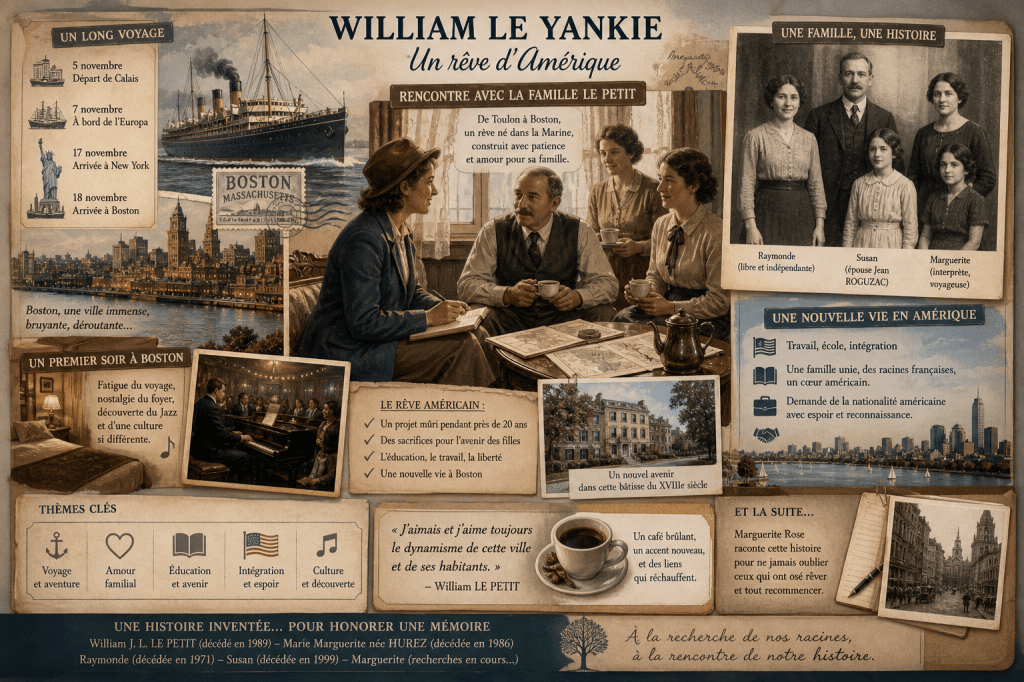
I returned to my hotel. Strangely enough, the noise and bustle no longer seemed so unbearable. I shall await with impatience the gentleman who is to show me this great metropolis.
This story was born from my imagination, inspired by real lives and my family history.
At the time I wrote it, I possessed very few documents about the American journey of William LE PETIT and his family. I therefore chose to imagine what their departure for America may have represented : doubt, hope, sacrifice, and the determination to begin a new life far from Calais.
Since then, new archival discoveries have shed light on this family story.
I found the passenger manifest of the Mauretania, which arrived in New York in October 1948 and lists Marguerite LE PETIT, née HUREZ, and her daughter Raymonde travelling to Boston.
The 1950 United States Census also confirms the presence of William LE PETIT and his family in Massachusetts, where William worked as a caretaker.
William Jérémy Léon LE PETIT died in 1989.
His wife, Marie Marguerite HUREZ, died in 1986.
Their daughter Raymonde died in 1971, and Susan in 1999.
I am still continuing my research concerning their youngest daughter, Marguerite.

