I retrace, step by step, Catherine’s genealogy. Among the documents spread out before me, the image of a painting catches my attention. It is an oil painting from the late eighteenth century, created by Philip Wickstead around 1780. It is now held at the National Gallery of Jamaica in Kingston.
Benjamin Pusey was a wealthy sugar planter in eighteenth-century Jamaica. The Pusey family established the Pusey Hall estate in the parish of Vere. Benjamin Pusey also owned the Cherry Garden and Cherry Hill plantations, near Old Harbour, in the parish of Saint Dorothy. He married Mary Butler. He also served as a representative for Saint Dorothy in the Jamaican House of Assembly from 1738 to 1751.
The identity of the figures depicted in this portrait has long been debated, as Benjamin and Mary Pusey are believed to have died well before it was painted. It is therefore possible that the painting was commissioned by their son, Colonel William Pusey (1741–1783), of Pusey Hall Estate, as a commemorative work.
Benjamin and Mary are the grandparents of John Pusey Wint. Very interesting…
The pile of documents written in Shakespeare’s language overwhelms me. I have lived alongside English speakers for so long that their language has become familiar, but now… I am saturated. I lie down for a moment, just long enough for my mood to shift. Morpheus is already there, waiting for me.
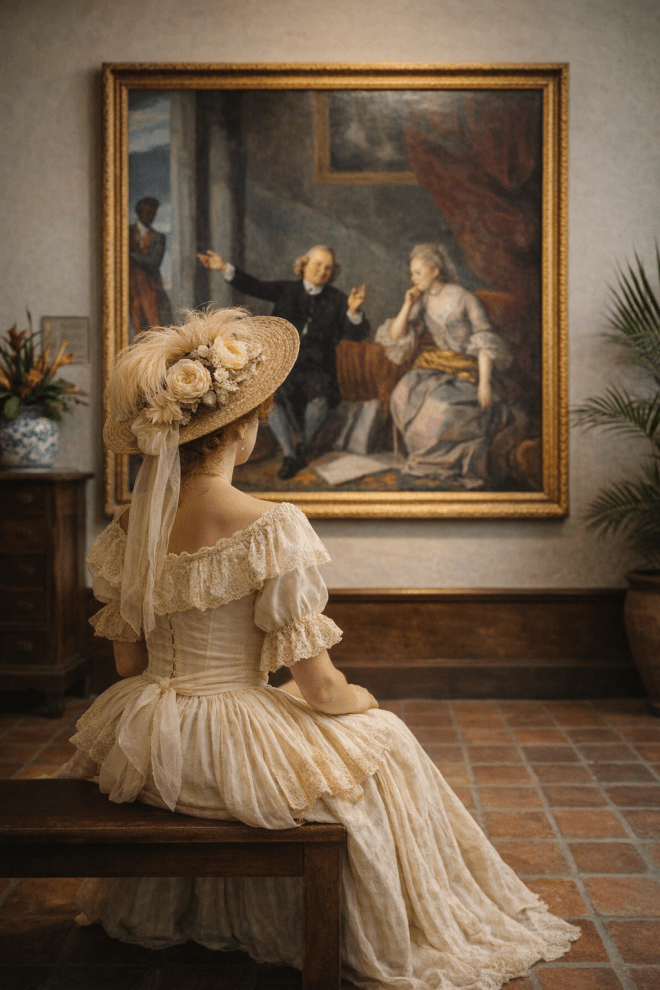
I am dressed in a soft ecru gown, light, almost alive. My straw hat is adorned with flowers and tulle that barely tremble in the breeze.
I find myself in Jamaica, standing before the portrait of Catherine’s ancestors.
Quietly, I step closer to the painting.
Certain details strike me.
Mary is seated, thoughtful. I do not believe she is truly listening to Benjamin. From time to time, she inclines her head — neither yes nor no… she simply complies.
Benjamin, on the other hand, gestures broadly. Is he speaking of his estates, his concerns, or does that sweeping gesture point to everything he has accumulated?
At their feet lie documents, a book. Did he drop them, or cast them aside? I think I can make out a globe… as if he were measuring the distance that separates them from England.
In the shadows stands a young enslaved man. Still. Silent. Ready to respond at the slightest wish.
The draperies, the carpets, the partially hidden painting behind the curtain all speak clearly of the family’s wealth.
I look at them… and I see what their fortune refuses to say: slavery.
In 1670, Jamaica was officially ceded by the Spanish. The English settled permanently and began importing enslaved people on a massive scale to cultivate sugar cane, which became the island’s primary source of wealth.
When Benjamin Pusey married his first wife, Barbary, around 1690, he was only twenty-two. Perhaps he was a soldier then, perhaps already drawn to these lands. A few years later, he married Charity Butler. On his in-laws’ side, however, the roots ran deeper: the Butler family had already been present in Jamaica for more than a generation.
And suddenly, the painting takes on another meaning. It is no longer simply a portrait.
It is the culmination of a success built on a people torn from their land, forced into obedience, and stripped even of their identity.
This truth, felt like a blow, wakes me. I rise, my mind overwhelmed by what I have just understood. I put on my coat and shoes and hurry to catch the tram to the seafront.
The sound of the waves, the cries of the gulls, the salty air bring me back down. I take a deep breath and lose myself in the contemplation of this ever-changing horizon. A streak of light traces across the water, only to be broken an instant later by a wave.
I will eat by the sea. My chronicle can wait until tomorrow.
 A rebrousse temps généalogie