
I look through the window of my apartment. A pale sun gently caresses the skeletal branches of the trees. They twist and stretch as though trying to enjoy the fleeting gift of its warmth. It is high tide ; the wind will soon rise and bring its procession of clouds back with it. For the past few days, an old man, bent beneath the weight of years and hard labour, has been entering the park. He walks with slow and measured steps, leaning upon a pilgrim’s staff.
Once, he lifted his head. Did he sense that I was watching him? The street is wide ; I do not think he could have seen me. Beneath his cap, I glimpsed his very pale eyes, his rather prominent nose, his mouth so thin it almost disappeared beneath his thick, bushy moustache, and his jutting chin. He shrugged his shoulders and continued on his quiet way.
Shoes, coat, hat — I hurry downstairs, step outside, cross the street, and enter the park.
I turn right and follow the longest path, enjoying the invigorating air, the sound of my footsteps upon the packed earth, the horses passing a few metres away behind the curtain of trees, and the gentle splashing of the fountain.
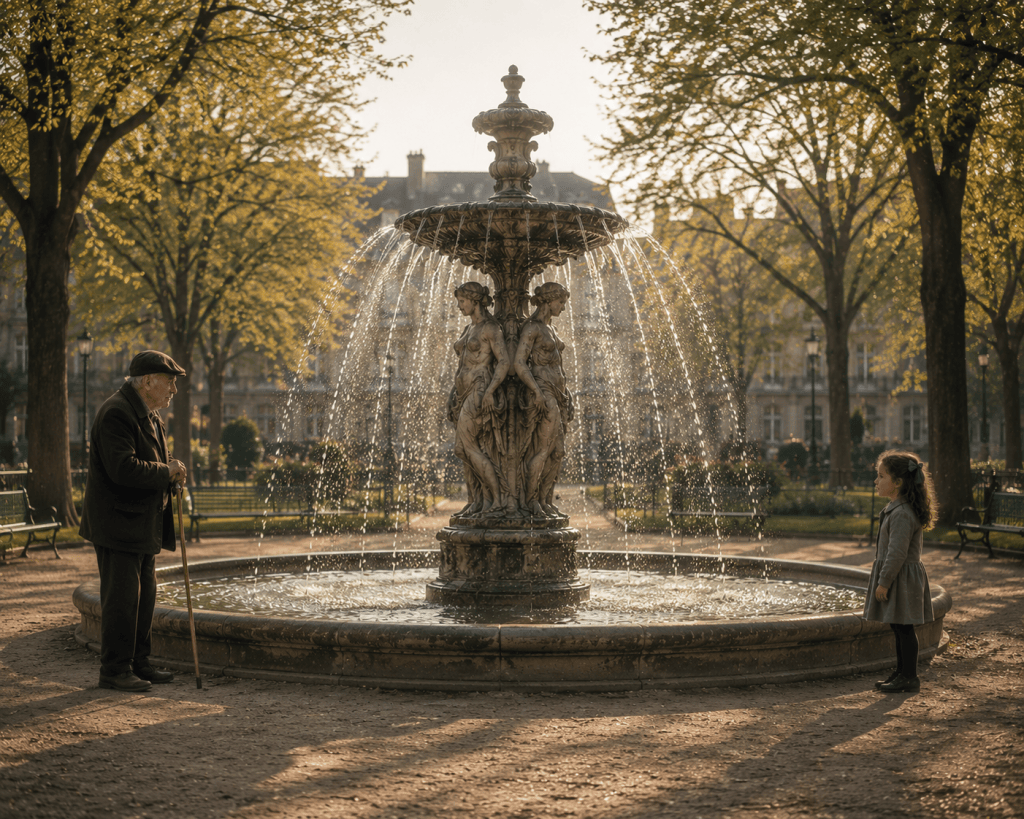
There he is, seated before the fountain of the “Three Graces.” His eyes are half closed ; he breathes deeply, savouring the peace surrounding him. He is old ; he has worked his entire life, and he has earned the right to rest.
On the opposite bench, a young woman of around thirty sits with a lovely little girl beside her, reading aloud. The child is far more interested in the old man than in the story her mother — or perhaps governess — has read to her countless times before. She plays with the image she sees through the sprays of water. Depending on the force of the fountain, the old gentleman seems to change shape, even disappear.
The reader closes her book, slips it into her bag, takes the little girl by the hand, and leaves. The old man rises and slowly makes his way home again, his walking stick setting the rhythm of his measured pace.
Is it the pleasure of seeing this charming scene that draws him here every day?
In turn, I return home with my head full of questions.
For three days now, torrents of rain accompanied by violent winds have drenched the region — not uncommon in a coastal city such as Calais. Thick mud runs through the streets and makes the paving stones dangerously slippery. As for the park, the pathways have dissolved into what once was lawn.
One must wait patiently.
I should have gone to speak to one or the other. No… too hasty! Let us remain calm and occupy ourselves with something else.
Calm, yes, calm!
I stir the embers in the fireplace, add another log, prepare myself a cup of tea, place a record on the gramophone — Chopin’s Nocturnes — and settle into my armchair. I drink slowly, savouring the tea I have imported from England ; this delicious nectar warms me, and the music soothes me.
I set down my cup.
But who is this man? He comes from the far end of the street with his tiny measured steps, leaning on his stick ; perhaps he lives in the neighbourhood?!!
I cannot stop thinking about these people, and I grow angry with myself for knowing nothing.
An entire week passes in waiting, pacing, and going out only when absolutely necessary.
Since yesterday, the sun has returned and is drying the ground. The gardeners have removed the fallen branches and tried to restore the pathways.
My little old man is there at the entrance. If he hopes to see our two young ladies today, he is mistaken ; no respectable woman would risk ruining one of her dresses in this mud… except perhaps me!
I hurry down the stairs rather too quickly and end up sliding down the last few steps on my backside.
Frightened by the noise, my dear Sidonie comes rushing out of her apartment and helps me back to my feet. My heel had become caught in the hem of my skirt.
More fright than harm.
I thank her and leave.
I find the old man seated once more upon his bench near the fountain. One glance around me shows that all the other benches are still covered with debris.
With a gesture of his hand, he invites me to sit beside him.
He must have been blond — or perhaps red-haired — in his youth. No, blond ; there are no freckles, and his skin is very pale, almost translucent. In truth, his chin is not quite as prominent as I first thought.
When he speaks, when he swallows, his lips seem to disappear into his toothless mouth, and his chin rises almost to meet his nose.
He realises I am staring at him.
He smiles.
“I am going to tell you my story, Mademoiselle Rose.”
He knows me!?
“Everyone in the neighbourhood knows you ; you are quite a personality.”
I blush furiously.
Recovering myself, I return his smile and listen.
His father had been born in Holland and fought at the Battle of Fontenoy in 1745. He never returned to his homeland ; instead, he followed the coast and eventually settled in Calais. There he married a beautiful blonde woman with blue eyes, and together they had a whole brood of children. Only three survived childhood : his sisters Ingrid and Bente, and himself, Andreas.
Like his father, he became a stonecutter.
With a mischievous look in his eyes, he tells me that some of the stones he carved were used to build the houses around us.
He gestures towards my own street.
He had married a beautiful Irishwoman with long red hair. She was delicate, too delicate. She died giving birth to a tiny doll-like child with Venetian-blond hair.
His little Angélique lived for five years.
Five years of happiness.
Five years during which he tried to fill his daughter’s life with joy.
She inherited her mother’s fragility. A fever carried her away to the land of angels.
He rises and disappears once more in tiny measured steps, supported by his stick, vanishing into the far end of the avenue.
I let him go.
A flood of painful memories had risen from the depths of his heart.
I return home with a heavy weight upon my own.
The rain and wind have returned once more.
It is depressing ; I far prefer frost and bitter cold.
It is close to two o’clock when someone knocks at the door. As always, our dear Sidonie hurries to answer it.
“Mademoiselle Rose, this is for you.”
Monsieur Andreas — I never asked for his surname!
He stands framed in the doorway, a parcel from the pastry shop in his hands.
“An old gentleman such as myself may still pay a visit to a young lady without giving the gossips reason to talk.”
I welcome him warmly.
He climbs the stairs in slow measured steps and enters.
I settle him into the armchair opposite the fireplace ; he prefers coffee to tea.
With great care, he unwraps his parcel and notices the dessert plates inside the cabinet. I hurry to place the dishes, the cake server, and spoons upon the table.
He places a slice of cake on each plate, adds the little spoon, smiles at me, clears the small table carefully, and arranges the plates while ensuring there is still room for the coffee cups.
He folds the wrapping neatly and slips it into his pocket.
He is about to sit in my armchair when he notices the shawl draped across the backrest, understands immediately, and settles himself in the other chair instead.
The two cups of coffee soon join the plates.
First of all, he apologises for leaving so abruptly the other day and introduces himself properly : Andreas Derycke.
We savour our slices of tart and our freshly made coffee.
He eats with obvious delight ; his gums crush the food without difficulty. He drinks in tiny sips, as though trying to prolong the pleasure, accompanied by a faint sucking sound.
We speak for a very long time while listening to music.
At last, he rises, puts on his coat, and takes hold of the walking stick he carved himself from chestnut wood when his right hip first began to trouble him.
Upon the handle, he sculpted thick, wavy hair.
He descends the stairs in tiny measured steps.
He smiles at me.
Then he disappears once more beneath the pouring rain.
He never remarried.
To survive, he carves not stone but wood.
At the markets, he sells his creations : small figurines, toys, kitchen utensils.
He has enough to provide for his needs.
For more than forty years, he has searched for the face of his child in every little girl he encounters.
I offer to help him speak to the child by the fountain, but he refuses ; the magic would be broken.
For many years, I joined him upon that bench.
The little blond and red-haired girls passing by in the avenues of the park kept the memory of his little Angélique alive.
One morning, a woman came to join me upon the bench.
Andreas had died the day before.
He had gone to join her in tiny measured steps, leaning upon his stick.
She handed me a parcel : a small statuette of about twenty centimetres in height, sculpted in my likeness.

