
The rain has just stopped, and I return to my seat beneath the veranda. The storm has not soaked the ground, far too dry to absorb all that water. The wind has calmed, yet it still allows the trees to shake themselves free of the downpour. The sun has returned, drying everything in its path.
One of its rays illuminates a spider’s web hanging from one of the beams that supports the roof. Tiny fleeting diamonds make the work of this lace-maker shimmer. The spider busies herself, dropping one by one the droplets that weigh down her fragile dwelling.
On one of the lowest branches of the ancient oak, a swallow spreads its wings and offers itself to the heavenly star. The deluge caught it in mid-flight.
A cart approaches, scattering the small creatures that were also drying themselves in the sun. My landlord, Mr. Edgar Dubonnet, climbs down, calms his horse and walks up the few steps.
“Not too frightened, Miss Rose?”
“Do not worry, Mr. Dubonnet, I have known worse.”
“How so?”
“Do not forget that I have crossed the sea several times, and the sea is not always calm. There I experienced the greatest fear of my life.”
“Indeed! Any damage inside the house?”
“I do not think so, but you should inspect the attic.”
“A good idea, Miss Rose.”
He goes to fetch the ladder from the storage room and climbs first to the upper floor and then to the attic. Soon I hear him shouting; there must be leaks in the roof. I gather every container I can find and bring them to him.
“You are very kind, Miss Rose. I shall return tomorrow with what is needed to patch the roof.”
He climbs down, bids me farewell with a wave of his hand, climbs back onto his cart, snaps the reins and departs while cursing the weather.
I am staying near Ardres, a charming little village. I left Calais, with its rapidly growing population and its foul smell caused by inadequate sanitation, to seek refuge in the countryside.
The year is 1873, and it has been exceptionally dry. Storms are rare and too violent to truly nourish the land. Even northern France suffers from the whims of the weather.
Every morning I walk to the Parmentier farm to buy my provisions. Fruit, vegetables, eggs, milk and even poultry—I purchase them in small quantities, as do the other occasional residents of Ardres. This allows us to avoid waste and enjoy fresh food each day.
After supper, I take a book and settle into my armchair. The full moon and my oil lamp allow me to read for several more hours. For the first time in many nights, the air feels easier to breathe.
I turn page after page. The story grows more confusing. I find myself rereading passages. My eyes begin to sting…
Suddenly, screams and the thunder of galloping horses awaken me. My book has slipped onto the floor. I raise my eyes.
The horizon is ablaze.
Driven by the wind, the fire devours forests, fields and homes.
What am I to do?
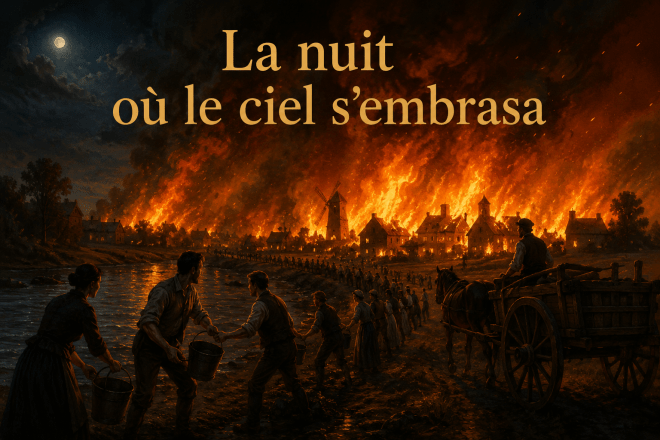
I seize two buckets from the shed and climb onto a cart. The lake lies only a few hundred yards away. Two human chains have already formed between the water and the blaze. Bucket after bucket is filled and passed from hand to hand. The inhabitants of the neighboring hamlets rush to help.
The Lombart farm and its wheat field, brittle from weeks of drought, have already gone up in flames!
And old Jeanne, the hunchback? She lives only a shout away from the Lombarts! Where is she?
And Simon and Berthe Duterron, and their little Amélie?
The third house belongs to an old market gardener and his son. Have they escaped?
What are human courage and goodwill worth against such a monster?
Aeolus shows no mercy. The gusts grow stronger and stronger, driving the inferno forward at the pace of a galloping horse. There is no longer any hope of extinguishing it; all we can do is protect the houses still standing.
At dawn, firefighters arrive from towns across the entire department. The exhausted horses are given rest while fresh teams replace them in the harnesses. The men drive as close to the flames as they dare.
The elderly and the children, too young to carry buckets, bring us water to drink.
Soot covers our skin. Sweat glues our hair to our foreheads. Our arms and backs burn with pain. Yet we continue passing the buckets.
A fresh team takes our place. At last we leave the line while the buckets continue their endless journey toward the glowing embers.
An elderly couple helps me walk the last few yards to a chair. I look at my hands. They are covered in blood. The bucket handles have cut deeply into my flesh.
The apothecary treats the lighter injuries. Those who have been badly burned are taken to the doctors.
I must sleep if I am to return later.
Mr. Dubonnet has spread straw mattresses across the floor of the ground level. I climb upstairs and lie down upon the quilt.
A firefighter wakes me. The wind has changed direction. The house is now threatened. We must leave.
My clothes, my books, everything I brought with me!
I grab my satchel.
I want to return and fight beside the others, but it is impossible. The monster has become uncontrollable. Only the lake now stands in its way.
Like many others, I am given shelter at the village inn. I share my room with two young women.
Makeshift beds have been laid out in the corridors and across the floor of the great hall.
In this hell, solidarity takes on its fullest meaning.
My hands are too badly damaged to be of any use. I sit idle, watching the hours pass.
The sky is grey—not with rain clouds, but with smoke and ashes.
This is the third night I have spent in the tavern. I sleep poorly there; the building is never truly quiet.
At last I begin to feel the first signs of sleep when a faint sound makes me start.
I sit upright and listen.
One drop.
Then another.
Then another.
And suddenly a torrential rain crashes down upon the countryside, drowning the fire.
The village constable counts six dead: Jeanne the hunchback, the old market gardener and his son, Simon and his wife, and a firefighter from Saint-Omer.
The little girl had been staying with her grandparents.
A few weeks later, Big Jean would succumb to his burns.
As for the others…
Pierre Gaillard would forever be known as “Bald Pierre,” Raymond as “the Lame,” and Marguerite as “Will-o’-the-Wisp.” Her skirt had caught fire, and she had run wildly in every direction.
Now, all that remains is to let time heal the wounds of both men and nature.
I returned to the ruins of that charming little house.
Nothing remains except the enormous chimney.
Mr. Dubonnet hands me a small object with no recognizable shape.
I examine it more closely.
It is gold.
Surely one of my pieces of jewelry, melted by the intensity of the heat.
I return to the comfort of my apartment in Calais.
I still suffer from nightmares.
My hands have healed, but a scar on my left hand will remind me forever of that dreadful night.
“The location and the year of drought are real; everything else belongs to my imagination.”

