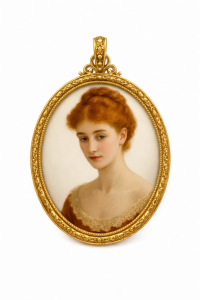
Through telegrams, Mr. John Pusey WINT Junior and I had discussed the state of the River Thames at the beginning of July 1858. Since I am someone who believes only what I can see with my own eyes, I decided to take the first steamship bound for England.
In Calais, the heat is overwhelming, the sun beats down with its scorching rays. Meadows, crops, and plants are burning under the relentless weather. Water carriers are close to exhaustion; they cannot satisfy everyone’s needs. The beach is crowded as people seek a little relief from the heat, but the gentle breeze changes very little. Only the children seem comforted, bathing fully clothed in the sea. I will not even speak of the odors trapped within the narrow streets of Calais. London lies farther north; John Pusey must surely be exaggerating.
Deck chairs have been arranged on the ship’s deck so passengers may enjoy the sea breeze. I remain standing, leaning against the railing. The sea is perfectly calm, and the rising sun is surrounded by a golden aura reflected upon the mirror-like water, broken only by the wake of a fishing boat. I enjoy this relative coolness. Yet as time passes, the heat steadily grows.
We arrive in Dover, where the coach for London waits at the station. I am surprised by the small number of travelers. In a few hours, I shall be there.
As I step down from the coach, the stench that hangs over the city seizes my throat. John Pusey had not lied. A closed carriage is waiting for me at the station; I quickly climb in, holding a handkerchief over my nose. We go directly to 12 Kensington Square.
A maid hurries us into the house and immediately shuts the door behind us. Every window has been sealed to keep the foul air outside. We gather in the small drawing room: John Pusey Senior, who celebrated his seventy-seventh birthday in March; John Pusey Junior; his wife Sarah Ann, née Hele; and their son John Pusey, a young man of sixteen.
After the customary greetings, John Pusey Senior retires to his quarters. His son, who has connections in political circles, will be able to explain the state of the river to me.
Ann, the maid, leads me to my room so that I may freshen up before dinner. In my honor, the household has prepared dishes from distant Jamaica. Adjoining the room is a bathroom equipped with a toilet and a flushing system. I refresh myself there, but the fumes rising from the pipes encourage me to remain as little as possible in that room.
The bell announcing dinner rings, and I go downstairs. Sarah seats me between her husband and her father-in-law. The conversation is delightful. John Pusey Senior speaks of his beloved wife, who died four years earlier, of his years spent in Jamaica and France, and of his return to England.
Sarah reveals that they are about to spend the summer months with Eliza and Napoleon MARESCAUX in Saint-Omer. Their son smiles at the thought; confinement has become unbearable for him.
John Pusey Junior invites me to have coffee in the small drawing room while the other members of the family return to their own activities.
Comfortably seated far from the window and drinking a coffee recognizable only by its name, I watch this aristocrat perch himself on the edge of his armchair, cast me a superior glance, clear his throat, and begin his account despite the obvious discomfort the subject causes him.
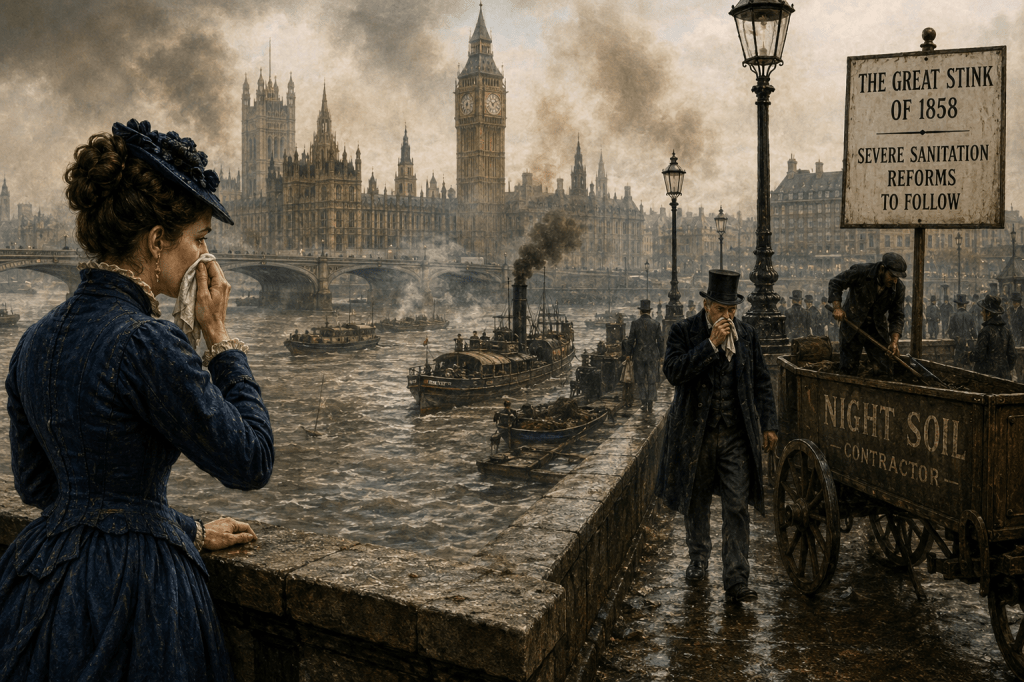
“Since the beginning of the nineteenth century,” he explains, “households have gradually replaced chamber pots with flushing toilets… »
“Since the beginning of the nineteenth century,” he explained to me, “households have gradually begun replacing chamber pots with flushing toilets. In 1810, the city of London had a population of one million and around 200,000 cesspits.
These cesspits were usually emptied at night by the nightmen, who then sold the waste as fertilizer for the fields surrounding London. Thus, the major housing developments of the 1820s were among the first to include toilets in every home. They provided much greater comfort and helped prevent unpleasant odors within the house.
However, they also consumed much more water and produced larger quantities of wastewater, which still ended up in the cesspits beneath gardens and cellars.
Beginning in the 1840s, toilets became a standard feature in upper-class homes and gradually started being adopted by other social classes as well.
From 1847 onward, guano began to be used as fertilizer. Imported from South America, it was cheaper and far easier to handle, and the market for human waste as fertilizer gradually collapsed.
Without an organized system for emptying cesspits, their contents began to be dumped into the street channels. These had originally been intended only for rainwater, but they also carried waste from factories, slaughterhouses, and other sources, contaminating the city before eventually emptying into the Thames.
During this particularly hot summer, much of the water has evaporated, leaving behind only foul-smelling filth with a burnt and nauseating stench. Miasmas bring disease. Workers are going on strike; Parliament and the courts of justice have had to relocate.
During her last journey along the Thames, our dear Queen Victoria reportedly kept her nose buried in a bouquet of roses. In the corridors of Parliament, it is said that several million pounds may soon be allocated to improve the sewer system.”
John Pusey wiped his forehead nervously. The subject had clearly made him deeply uncomfortable. He hurriedly excused himself and rushed back to his quarters.
I returned to the grand drawing room where Sarah awaited me. She had invited several curious ladies eager to meet a young female journalist.
These ladies described the situation through adjectives, superlatives, suggestive imagery, and the most extravagant comparisons imaginable. All of them were preparing to leave for holiday retreats as far away as possible from this cesspool. Each wished the others better air and departed to rejoin her family.
A letter invited me to accompany the WINT family to Salperwick Castle, rented for the occasion.
After an enjoyable evening over an excellent dinner, it was decided that we would leave the following day.
Young John Pusey offered to accompany me to the river while the luggage was being packed, but I refused with a smile.
Ann, the housemaid, was to accompany us as well; Eliza and Napoleon’s servants would surely appreciate an extra pair of hands.
Very early the next morning, I awoke to excitement throughout the house. On every floor, servants hired for the occasion were packing clothing and essential belongings for two months in France.
We enjoyed a hearty British breakfast.
Two carriages awaited us to take us to the port of Dover.
No sooner had we boarded than we were invited to retire to a small private lounge reserved for distinguished guests.
There was no wind, the sea was perfectly calm, and the sun stood high overhead. The crossing could not have gone more smoothly.
The gentlemen relaxed, stepping outside and breathing deeply the fresh sea air.
The coast of France appeared in the distance; we would soon arrive.
The reunion would be stiff, yet sincere.
But that is another story : Holidaying in the countryside

