Tic, tock, tic, tock! How hot it is! Tic, tock, tic, tock, my shoulder is making me suffer. Tic, tock, tic, tock, I need paper and pencil, I shall write. Tic, tock, tic, tock, no idea comes to me, tic, tock, tic, tock, and that clock!
The door opens, a swirl of fabric sweeps in, Miss BONNET enters in a flood of words. In only a few trips back and forth, she has tidied the apartment and prepared a cold meal. She exasperates me but, thanks to her, time passes much more quickly. She tells me about her day, complains once again about the poor girl she hired during my convalescence, glances around her with satisfaction and leaves. I have not been able to utter a single word. I had the chaise longue moved near the window so I could enjoy the view outside, but the stench from the street forces me to keep it closed. I wander from one room to another, splash water on my face, retrace my steps and I can bear it no longer. My bedroom is the coolest room, I climb onto my bed. It is not very late but this heat has exhausted me. Sharp pains in my shoulder bring back memories of my attack.
I am not likely to forget that 6th of August, 1840. I arrive in Boulogne-sur-Mer on the first stagecoach, intending to stroll along the ramparts, visit the town, eat at a tavern near the harbour and laze on the beach. Not at all!
Having arrived from Wimereux, where he landed from England during the night of the 5th to the 6th of August, Louis-Napoléon BONAPARTE, accompanied by a handful of insurgents, crosses the town. On this beautiful summer morning the streets are crowded and tempers are rising; fights break out. A middle-aged man is being roughly handled by an individual. I see the knife in his hand, I do not hesitate for a moment and throw myself at the scoundrel. He turns around, his face twisted with rage, and in a swift movement he tries to drive his weapon into my chest. Another person’s intervention causes his blade to miss and strike my shoulder instead. I collapse, the pain is indescribable. I am taken to hospital.
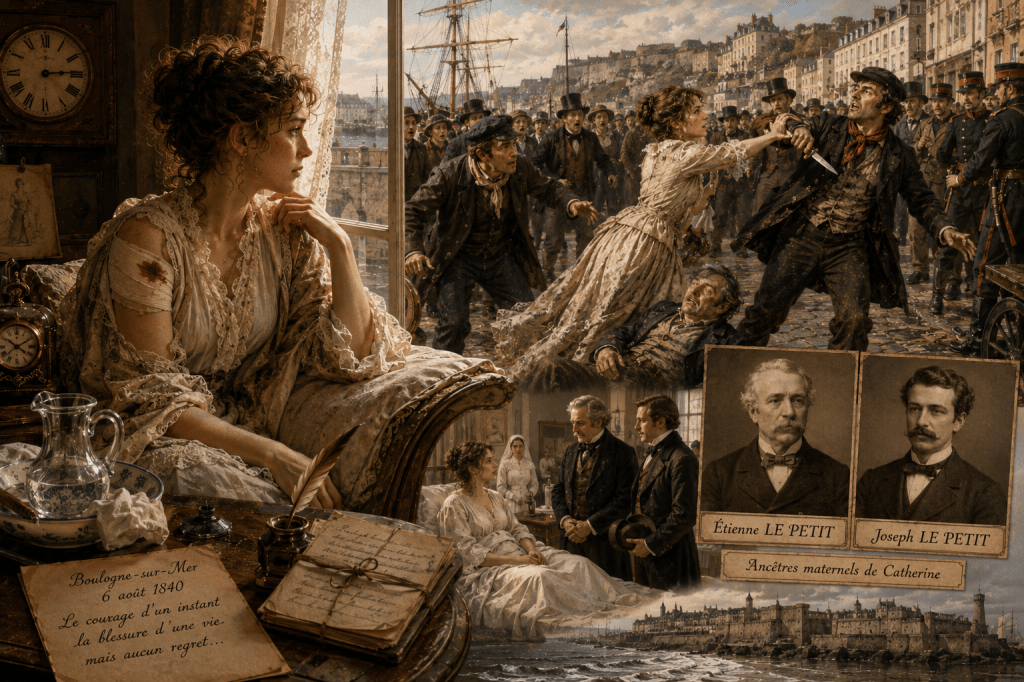
The next day, two gentlemen come to see me. They are Monsieur Étienne LE PETIT and his son Joseph. Étienne thanks me for my heroic behaviour. No, not heroic, foolish, reckless perhaps, but something I do not regret. In turn, I thank Joseph for stepping in; without him I might perhaps have been dead by now. They explain that Louis-Napoléon intended to rally the army to his cause, but things did not happen that way. Alerted, the police and the military intervened. They were driven back towards the beach; some drowned, while others were arrested and imprisoned, like Louis-Napoléon. They take their leave, promising to return the next day.
The nurses and doctors speak with great respect to these two gentlemen. I wonder why and ask the first nurse who passes by. She needs no encouragement and explains that Étienne, the father, contributed to the expansion of the harbour in his capacity as a military engineer’s draughtsman under Emperor Napoleon Bonaparte, and that his son is a notable figure in the town. I thank her warmly. She settles me as comfortably as possible in my bed and advises me to rest.
Étienne’s face, his bearing, remind me of someone?!! Yes! I interviewed him in 1805. He cannot recognise me, I am a shadow passing through time…
The doctors authorise me to return home. Étienne and Joseph organise my return to my dear town of Calais. Étienne looks at me: « You remind me of a young lady who, like you, was never afraid to speak her mind. » He turns away and grumbles: « No, it cannot be her, she would be my age now, perhaps even a little older. » I smile discreetly.
These last days of August, so warm, make us long for autumn. Before long I shall have recovered and I will once again return to my work and my writing desk.
Étienne LE PETIT, Joseph LE PETIT : Catherine’s maternal ancestors
Who knows, perhaps they really were there among the crowd? When fiction walks hand in hand with reality!
 A rebrousse temps généalogie