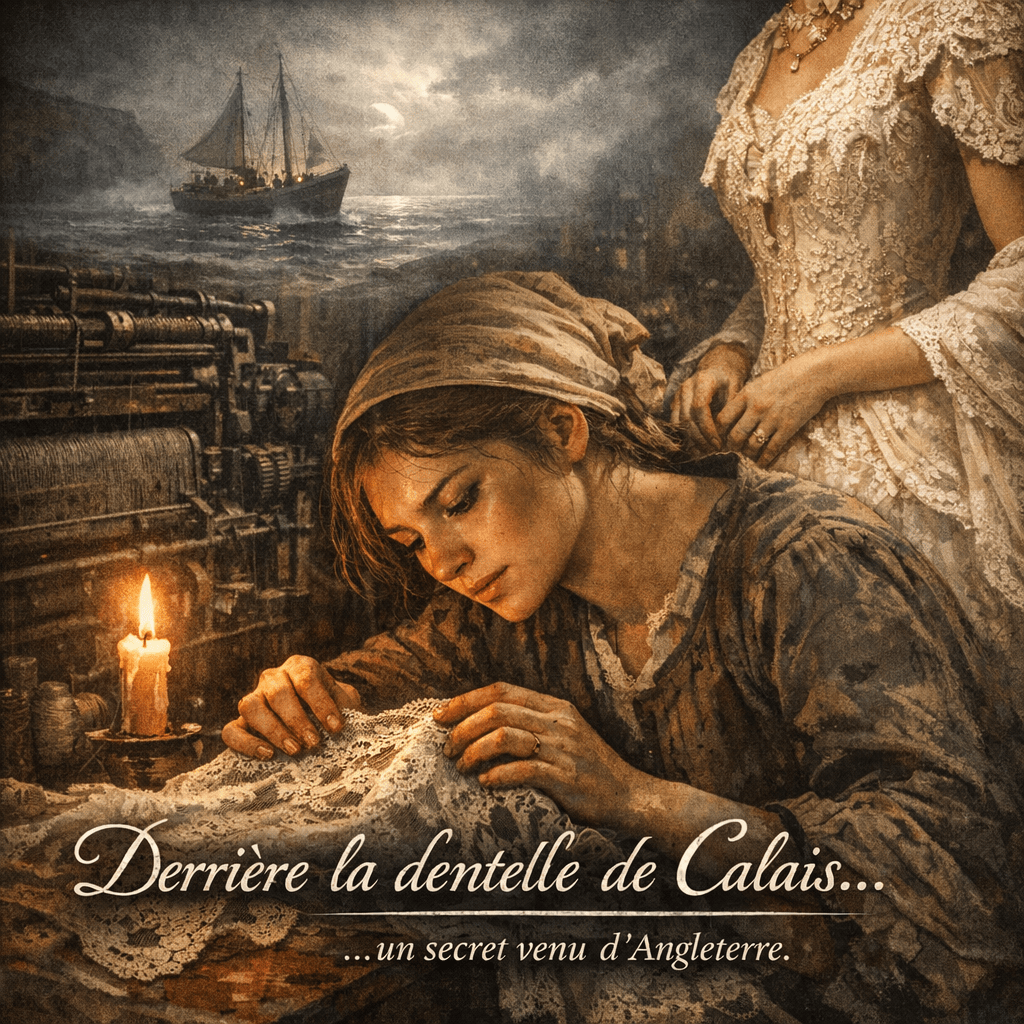
I – Luddism in Nottingham
It is May 12, 1812. Yesterday, the British Prime Minister, Spencer Perceval, was assassinated by a Luddite from Liverpool. This morning, beneath pouring rain, I boarded the first steamship departing from Calais. The heavy swell made the vessel pitch violently, and clinging to my seat, I could do nothing but reflect.
I am travelling neither to London nor to Liverpool, but to Nottingham, where workers are celebrating the Prime Minister’s death with songs and dancing. Why such hatred? I have read that England is suffering from a severe economic crisis, but what are the true causes and consequences?
Upon arriving in Dover, I head towards the stagecoach stop. The weather remains dreadful; spring is certainly playing cruel tricks on us. Inside the carriage taking me to Nottingham, I leaf through various newspapers. Unfortunately, my knowledge of the English language does not allow me to understand everything. I shall see for myself once there.
From my hotel room, I can hear the workers’ songs and cries of joy. I go downstairs and mingle with the crowd. Fortune smiles upon me: this man’s accent suggests that he may be French by birth. And indeed he is. Georges Martin followed his beloved Hannah to the outskirts of Nottingham.
I gladly accept their invitation to share a meal with them, having brought along a few French delicacies that I am pleased to offer.
While Hannah busies herself at the stove, Georges explains that the riots did not begin yesterday. They started twelve years earlier, when the price of food became unbearably high. Famine inflamed tempers, and for four days the reserves were pillaged while the soldiers remained powerless.
Last year, the Luddite movement, named after its leader Ned Ludd, began in Nottingham following the death of John Westley on November 10. The craftsmen accuse the factory owners of encouraging unemployment. Hooded and moving under cover of darkness, the Luddites destroy machines, raw materials, and finished goods in an attempt to eradicate the industrialisation that is stealing their livelihoods.
The repression is merciless: prison sentences, transportation to penal colonies, and even death penalties are pronounced. Rewards are even offered to those who hand over a Luddite. The assassination of the Prime Minister is the result.
Georges and Hannah work in a tulle factory, one of those targeted by the Luddites. They are desperately poor. Overproduction has devalued their wages, and the foodstuffs offered by my so-called French relatives to a fellow Frenchman are greatly appreciated.
After a hearty meal, Georges finally confides in me. Certain tulle manufacturers are secretly preparing to cross the Channel and settle in France.
Ever gallant, Georges insists on escorting me back to my hotel. I readily accept, for the streets are unsafe for a woman. At the entrance to my hotel, we exchange addresses and promise to write to one another.
After a good night’s sleep and a hearty English breakfast, I decide to visit Nottingham. I hail a carriage. The driver takes me to see the city’s attractions: churches, the castle, picturesque streets. Yet what I truly wish to see are the workers’ districts.
After intense bargaining and the promise of solid payment, he finally agrees to drive me towards the outskirts. The farther we move from the city centre, the more dilapidated the houses become.
At last, the coachman stops. He refuses to go any farther. He helps me down and gestures towards the scene before us. We stand upon a small rise, and as far as the eye can see, makeshift shacks built from odds and ends stretch into a vast slum.
These poor people have nothing left. They have nothing left to lose, and we would make easy prey.
The coachman safely returns me to my hotel. I offer him a small trinket, a souvenir from France, before climbing back to my room with a heavy heart.
Tomorrow I shall return home, but I will not forget to write to Georges and Hannah.
II – Correspondence from 1813–1814
Georges and I maintain a steady correspondence. We write about a little of everything: the weather, the changing seasons, and above all the events unfolding on either side of the Channel.
On the first of July, 1813, I paid a visit to his parents, elderly market gardeners settled in the marshes of Saint-Omer. In a flat-bottomed boat, they carried me gently along the waterways. For the occasion, they had dressed in their Sunday best, and so had I. Marie and I proudly carried our parasols trimmed with bobbin lace.
The weather was glorious. The sun shone brightly, while a soft breeze rippled the surface of the water. Plots of land covered with vegetables followed one another through this labyrinth of canals. The houses, nestled among the greenery, were well kept, yet it was plain to see that money was scarce.
Hector and Marie are now too old to tend their parcel of land. They lease it to little Jean, a local boy, in exchange for the vegetables necessary for their survival. Young Jean is still too young to be conscripted into the Emperor’s army. Besides, with his clubfoot, he would never make a good soldier.
No sooner had I returned home than I wrote Georges a long letter describing my journey among the people of the Audomarois region, along with his parents’ recommendations and Napoleon Bonaparte’s endless war against “the rest of the world.”
I told him of our Emperor’s victories and defeats, of Calais and its smell of fish, of Saint-Pierre-lès-Calais with its fields and vegetable gardens. I spoke of the lack of work, of the poverty that also exists in France, of my employment as a saleswoman for Mademoiselle Bonnet, a corset maker, and of my articles which good morals and the uncompromising supremacy of men prevent me from publishing.
Months passed without a letter from Georges. At every visit of the postman, I waited anxiously.
At last, the long-awaited dispatch finally arrived. After the customary apologies, Georges explains that, following a difficult pregnancy, Hannah has given birth to a handsome baby boy named Michel Hector Georges.
I am moved to tears — Michelle is my middle name…
But enough sentimentality.
Tensions in Nottingham have eased. The factory owners have increased wages. Naturally, there are still diehards continuing the struggle throughout the country, but the repression remains just as merciless.
As for Georges, now highly skilled in operating the Heathcoat loom, he is currently working on the Leavers loom. This machine produces a finer quality of tulle. His wages are worthy of his expertise, and he may even hope to move to a better home.
His employer, Robert Webster, holds him in high esteem. He has even asked Georges to teach him French.
These good tidings reassure me. Georges, Hannah, and little Michel are well, their lives are improving, and danger seems to be fading away.
That is all very good… but why is this Englishman suddenly so interested in the French language?
III – The Letter That Changes Everything
Throughout the year 1814, our letters spoke mostly of little Michel, of Georges’ elderly parents, of my employer who granted me greater freedom to devote time to my articles, and only a little about the events unfolding in our respective countries.
Hannah wished to be able to converse with me during our next meeting. She was learning French with difficulty, yet with remarkable perseverance. We had become true friends.
On this fifteenth day of October, 1815, Georges’ letter brings news that may well change everything. His complete trust in me touches me deeply.
This year has been especially harsh for the workers in the tulle factories. Overproduction, protectionism, and customs duties are causing the industry to collapse. Unemployment is rising, and poverty is returning at full gallop.
Georges’ employer, Robert Webster, together with his associates James Clarck and Richard Bonnington, intends to smuggle a dismantled lace loom across the Channel.
Calais is the closest town to England, and it is there they wish to establish themselves.
Georges is due to arrive in Calais at the beginning of November. His mission is to purchase a building on behalf of his employers.
Snow has fallen throughout most of the night. The wind is icy. Standing before the maritime station, I wait for Georges. I am freezing. I stamp my feet to keep warm, while my hands, buried deep inside my muff, have turned blue with cold.
It is November 10.
Within the crowd, I recognise Georges’ woollen cap, lovingly knitted by Hannah.
After the customary greetings, I lead him to a reputable boarding house. This evening, we are to dine at the home of my employer, Mademoiselle Bonnet. She occupies a small apartment above her shop.
In the main room stands a large fireplace where dry logs crackle brightly. Two comfortable armchairs sit on either side, alongside an ageless sideboard, a table with four chairs, knick-knacks, and lace doilies that lend warmth and comfort to the room. A kitchen scarcely larger than a handkerchief and a pleasantly furnished bedroom complete the setting.
With Georges’ permission, I have already confided everything to Mademoiselle Bonnet.
As she cooks, she listens carefully to our conversation. The mechanisation of tulle production would allow her to sell lace goods at far lower prices.
I explain that during the past few days I have been inquiring about buildings for sale. I have found a large property located on the main thoroughfare of Calais, Rue Royale. Tomorrow, I shall accompany him to meet the owner.
Mademoiselle Bonnet is an excellent cook. With only two potatoes and a small piece of bacon, she creates a feast.
Throughout the evening, the conversation revolves around little Michel, his employers’ project, and life in Calais. Georges’ accent makes us laugh heartily.
It is growing late. We bid farewell to Mademoiselle Bonnet. Georges escorts me back to my apartment before returning to his boarding house. We agree to meet again at eleven o’clock.
I struggle to fall asleep. Too many thoughts overwhelm me.
At precisely eleven o’clock, we stand before the building for sale. Yet after visiting it, Georges prefers another property situated on the outskirts of town. He does not wish to attract attention.
By carriage, I show him the town and its monuments. He is rather gloomy. The roads are impassable because of the snow, making it impossible for him to visit his parents. I promise that I shall go to see them as soon as the weather allows.
Once again, we dine in the company of the kind Mademoiselle Bonnet. This time, it is I who take charge of the cooking. She is delighted and begins questioning Georges at length. He explains to her the workings of the lace loom, as well as the quality and price of this highly coveted fabric.
The evening passes most pleasantly.
Georges takes his leave early, for he is boarding the first steamship tomorrow morning. I accompany him to the door, where he promises to inform me of the date of their arrival.
I return upstairs to help my employer tidy away the dishes before finally heading home.
How many sleepless nights I shall spend waiting for news from my friends.
IV – The Day Has Come
After months of waiting, Georges finally sends me a message — an invitation to Michel’s birthday. Yet my little Michel will only turn four in the autumn. The message immediately arouses my suspicion: this is the date chosen for the English landing.
I live only ten minutes from the beach. After a week of relentless rain, the dampness clings to the skin and the wind feels bitterly cold at this hour of the night. It must be around three o’clock in the morning.
I walk through the dark alleyways, but I know every pothole in these streets by heart. The closer I draw to the sea, the darker the moonless night becomes, black as ink.
They are supposed to land near the jetty. The lighthouse casts a powerful beam across the water — will it be enough to guide them?
I lie down upon the damp sand, sparing a thought for Mademoiselle Bonnet and the long black coat she lent me. Hidden within the darkness, I wait.
At a quarter to four, I hear the sound of oars cutting through the water and the rasping breath of a man exhausted by effort. A few moments later, they reach the shore.
The lighthouse allows me to distinguish the beach and the activity unfolding there. Four men leap from the boat. Coins change hands. Wooden pieces and large sacks are unloaded and set upon the sand.
One final wave of the hand, and the fisherman turns his boat around before vanishing into the dark mass of the sea.
The fourth man is Georges.
He knows I am only a few yards away. He searches for me, finds me, and helps me to my feet. My coat, soaked with moisture, feels unbearably heavy.
We approach the three Englishmen. Georges introduces me to the gentlemen with great respect. Ever courteous, they thank me warmly for my assistance.
I am to guide them to the building Georges purchased.
Suddenly, footsteps upon the sand make us turn around. Another man joins us — little Jean, who has come to help. He has changed greatly, broader and stronger now. His clubfoot spared him from military service.
Georges and Jean carry the machinery upon their backs, while the employers take charge of the sacks. We set off, and I lead the way. I try to warn them of the dangers along the road, yet the occasional curse proves my directions were not always sufficient.
At last, we arrive before the building.
Georges had entrusted me with a key, allowing me to place oil lamps and various tools inside beforehand. Despite my protests, Mr. Robert Webster slips several coins into my hand to repay the expenses.
I leave them there and return home.
After a cup of steaming tea, I finally crawl into bed. In only a few hours, Georges will come to fetch me again.
Naturally, our dear Mademoiselle Bonnet accompanies us.
When we arrive at the building, Georges proudly withdraws a large key from his pocket. After two turns in the lock, the door opens with a groan.
The rooms are small. The Leavers loom that Georges assembled throughout the night occupies nearly all the space. Against the walls, tools and raw materials lie directly upon the floor.
On the first floor, straw mattresses have been spread over the packed earth. Georges and the workers expected to arrive soon will sleep there.
On the second floor, they have arranged an office, while the third floor has become sleeping quarters for these distinguished gentlemen.
Mr. Webster sends Georges off to rest and leads us toward the office.
He speaks remarkably good French.
I allow Mademoiselle Bonnet to discuss purchase prices and selling prices with him. She even offers her shop for their first sales.
I leave them to their negotiations and let my thoughts wander.
What will become of these enterprising men? Will they succeed?
The bells of Notre-Dame Church of Calais strike eleven o’clock. It is time for us to take our leave.
Mademoiselle Bonnet multiplies her gestures of courtesy, while I secure a promise from these gentlemen: another meeting, during which I may learn how their project progresses.
One final farewell, one final wave of the hand, and we return to the shop.
Notebook and pencil in hand, Mademoiselle Bonnet begins calculating figures. Page after page, she dreams of her future life.
As for me, within a few weeks I shall return to interview them.
Customers stream into the shop throughout the entire afternoon. By evening, I return home utterly exhausted, yet happier than I have been in a long while.
I slip beneath the blankets, but sleep refuses to come.
My mind teems with a thousand thoughts.
What questions shall I ask these gentlemen?
V – WEBSTER, CLARK and BONINGTON
It has now been six months since our gentlemen settled in Calais, and many things have happened during that time. Other Englishmen from Nottinghamshire and Kent have arrived in secret, their arms laden with raw materials, spare parts, and tools. The mounted police turn a blind eye to this trafficking. Louis XVIII has restored free trade, customs duties have once again become reasonable, and England has renounced the death penalty for smugglers.
This morning, a carriage arrives to collect me. I have been granted an exclusive interview. My hands are full: my parasol, a bag entrusted to me by Mademoiselle Bonnet, and my notebooks. The coachman relieves me of part of my burden so that I may climb into the carriage. He places dear Mademoiselle Bonnet’s bag beside me, takes his seat, cracks the whip through the air, and the two horses move forward.
Instead of heading towards the gentlemen’s building, we make for Saint-Pierre-lès-Calais. I call out to the driver, but he reassures me that these are the orders of the “Milords.” We leave Calais through the Richelieu Gate. Fields still dominate the landscape, yet more and more houses are being built there. At last, we stop before a modest dwelling. Beside it stands a large building under construction — far too wide to be a simple house.
It is Mr. Richard Bonington who waits for me upon the threshold. He greets me with a cheerful “Bonjour Mademoiselle,” though his accent is dreadful. We enter a single room furnished with taste. With a gesture of his hand, he offers me an armchair before joining his associates upon the sofa.
“Good afternoon, gentlemen. How are you?”
It is Mr. Robert Webster who answers, for he alone truly masters our difficult language.
“Much better now. We intended to settle in a larger place where several lace looms could be assembled. The noise forced us to move to Saint-Pierre-lès-Calais sooner than expected. English investors believe in our establishment here and are helping us financially.”
“I had not imagined that this machine produced so much noise.”
“In the middle of the night, when the town is asleep, its sound becomes unbearable, and the vibrations spread to neighbouring buildings. Besides, we have installed one loom on each floor. Three looms operate day and night.”
“Indeed, Georges never mentioned it to me. But where is he, by the way?”
“He has gone to fetch his wife and child. They should return shortly.”
“Could you tell me about the factory? How many machines will it contain? Do you have plans to show me?”
“Twelve Leavers loom looms will be installed on the ground floor, finishing workshops on the first floor, and storage beneath the roof. In France, it is easy to protect our work through patents. We have filed several ourselves, as have Messrs. John Heathcoat and John Leavers. Our plans form part of those patents.”
“How do you see the future?”
“Skilled tullists are joining us and will later create their own businesses. The French are eager to learn and to work. We hire Companions, members of guilds that train workers of remarkable quality. Our wives have joined us as well, and they too are passing on their knowledge to French women. Yes, this industry has a future.”
“I am delighted to hear it. By the way, Mademoiselle Bonnet asked me to bring you this bag.”
Mr. Bonington takes the bag and empties it onto the armchair beside mine. A cascade of frills tumbles across the velvet. With a mischievous grin, he lifts corsets, bloomers, handkerchiefs, and doilies adorned with tulle. I no longer know where to look. I seize a fan from the chair, fan myself vigorously, and regain some composure.
Mr. Webster rises and comes to admire the seamstresses’ handiwork from Mademoiselle Bonnet’s workshop. The jokes exchanged in English between Mr. Bonington and Mr. James Clark leave Mr. Webster completely unmoved.
“Beautiful work! Please congratulate these skilful ladies on my behalf. I shall contact Mademoiselle Bonnet during the week. It is already four o’clock. Would you care to take tea with us?”
“With great pleasure, gentlemen.”
Rebecca Webster and Mary Bonington soon join us, while a servant brings in the tea. The porcelain is of astonishing delicacy, the spoons are silver, and small cakes are served upon a silver tray. I am filled with admiration for such craftsmanship.
More than an hour passes. These ladies also attempt to speak French, while for my part I have made genuine progress thanks to Georges. I understand far better than I speak, which allows me to learn a great deal more. Rebecca calls for a carriage, wishing to shop at Mademoiselle Bonnet’s boutique. I bid farewell to the gentlemen and to Mary.
Rebecca remains silent throughout the journey, which pleases me greatly. The future of Calais and its lace is already being written. Calais and its lace-making destiny now seem inseparable.
We return to the shop. Within minutes, the counters are buried beneath piles of lingerie. I signal discreetly to the ladies and slip away.
Back home, I collapse onto the chaise longue and allow my thoughts to drift toward tomorrow…
VII – Dream or Reality
It is Sunday. Four o’clock strikes upon the clock.
I cast a glance around my apartment. Dust has gathered everywhere, and the floor is covered with dirt carried in from the street. Quickly, I fetch the feather duster, the bucket, and the broom. Within less than an hour, everything shines once more.
During the week, I must choose between cleaning and writing after my long days at the shop. My choice is easily made — I write.
A few errands remain, followed by a light supper and then bed. Heavy sleep overtakes me the moment my head touches the pillow.
By morning, I awake with nothing new to recount.
I swallow my coffee absentmindedly before making my way to the boutique. Customers come and go, unable to decide, and most leave empty-handed. Piles of frills and undergarments accumulate upon the counters, leaving me no time to tidy them away.
As always, Mademoiselle Bonnet chatters endlessly. She speaks merely for the sake of speaking. From one counter to another, from the shop to the storeroom, she scurries about in quick little steps, talking constantly.
She exhausts me.
At last, it is time to close the shop. I pull on my coat while heading towards the door, call out a farewell from the threshold, and finally step into the street.
My feet carry me instinctively towards the seafront. The cool fresh air and the sound of the waves crashing against the jetty soothe me. Autumn is only days away, and the air and wind have grown colder at this hour of the evening.
I return home.
Writing materials in one hand and a steaming cup of tea in the other, I settle comfortably upon the chaise longue. My eyes begin to close. I gently place my cup upon the small table and allow Morpheus to carry me away.
A carriage deposits me before the premises of Webster and Pearson.
As always, Robert Webster himself comes to greet me.
His hair is grey, almost white. Deep wrinkles line his face.
He must be at least sixty years old!
In what year am I?
Following my host, I enter the immense building. The noise is deafening. Dozens of looms operate simultaneously, while a multitude of workers bustle around these monsters driven by powerful steam engines.
We must be around 1840 or 1842.
We make our way to the office. Once the door is closed, conversation once again becomes possible.
Mr. Pearson comes to greet me. His French is more than respectable. He also introduces one of their finest tullists, Robert West.
In only a few words, he explains how greatly the modernisation of the machinery has increased their efficiency.
I have so many questions to ask that I scarcely know where to begin.
“Could you tell me about the lace-making professions?”
“Certainly. There are three stages: preparation, production, and finishing. The preparation of both the raw materials and the loom itself is carried out by the reeler, the thread extractor, the wheeleuse, the bobbin presser, and the warper…”
“The pattern designer, the draftsman, the punch-card maker, the tullist, and the mechanics are responsible for the manufacturing stage itself.”
“The inspectors, embroiderers, dyers, menders, fringe workers, and scallopers are responsible for the finishing stage.
Dye houses and laundries have opened throughout the entire region, while the other trades are carried out by women working from their homes. The embroiderers, however, work in factories.”
“The sample makers, folders, and packers prepare the lace for shipment.”
The faces of these gentlemen become increasingly blurred. The deafening noise fades away, replaced by the crackling of the logs in the fireplace.
I awaken with a smile upon my lips.
I now have something to write about!
Over the years, this industry will continue to evolve and provide livelihoods for thousands of people and, like all things upon this earth, it too will eventually decline.
This story is a work of historical fiction. While the characters, dialogues, and certain events have been imagined and romanticized for the sake of storytelling, the historical information woven throughout the narrative is based on research gathered from various sources dedicated to the history of Calais lace and its remarkable industrial heritage.
The evolution of the lace industry, the arrival of English manufacturers in Calais, the development of the Leavers loom, and the many professions linked to lace-making are all inspired by documented historical facts.
Through this tale, the author wished to pay tribute to the men and women whose knowledge, labour, courage, and creativity shaped the history of Calais lace across the centuries.