My Maternal Grandmother
My grandmother, Marguerite BOURGEOIS, was born on August 28th, 1902. She was the youngest of a family of ten children. Eight years separated her from her brother Gaston. She was what people called “the staff of old age” for her parents — the child born later in life to support them in their old age.
Family photograph around 1910: Léonie, Alice, Berthe, one unknown person, Catherine, Marguerite and Samuel. The two boys, Fernand and Gaston, are missing.
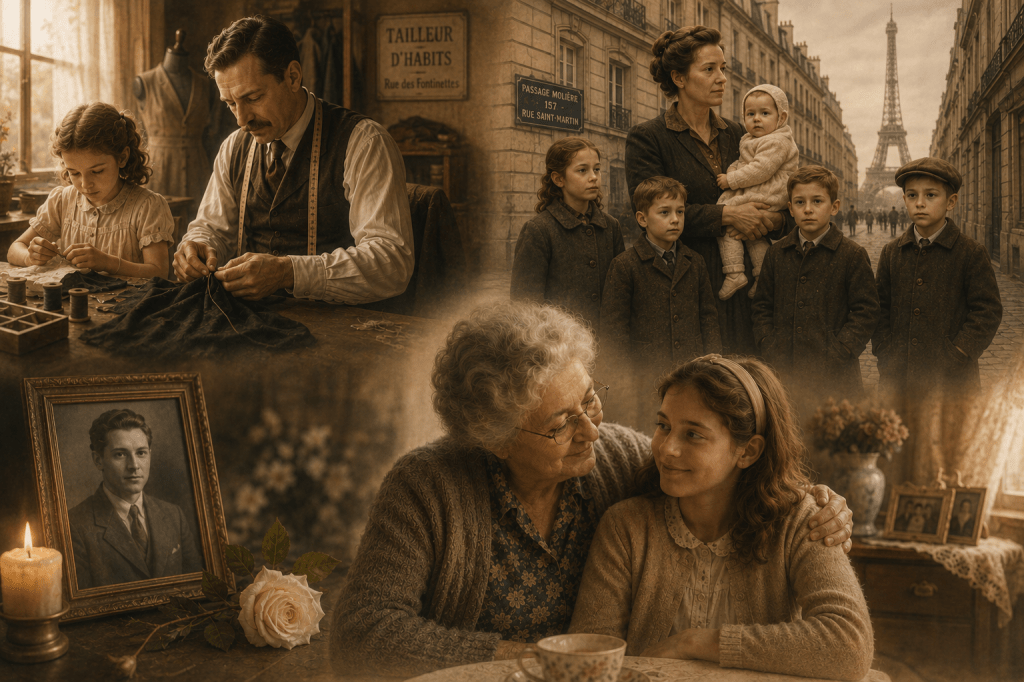
Her father, a tailor, worked in a shop on Rue des Fontinettes near the railway crossing. She told me about the patience he showed while teaching her to sew, the countless times he made her redo a hem or embroidery that was not good enough for him. She described herself sitting beneath the window, working carefully on her sewing. Her father sat cross-legged on the workbench in the middle of the workshop, sewing with narrowed eyes focused on his work. She smiled when she spoke of him — she was so proud of her father.
She also explained that every evening her mother made ringlets for her. She dampened each lock of hair, wrapped it around strips of fabric, and tied everything as high on her head as possible. Grandma once tried doing the same for me, but the result lasted only a few hours, and I looked rather ridiculous. At that time my hair was thick, straight, and long, and accepted no hairstyle except ponytails.
Her first truly painful memory was the death of her older sister Berthe in 1914 (the third girl in the family photograph). I never learned the reason for her death at such a young age. Grandma said that after working in a flooded cellar, her sister “became ill in the stomach” and passed away. What exactly did that expression mean? She was only twelve years old at the time, and back then such matters were never discussed. She remembered only her sister’s beauty and elegance and how much she adored her.
At that time, in every family, at least one member worked in the Calais lace industry. My grandmother arranged lace strips on cardboard before they were sent to designers and seamstresses. It was meticulous work, but she remembered the bursts of laughter with her workshop friends, the disapproving smile of the supervisor, and the Sunday picnics at Lake Ardres a few miles from Calais, always with those same friends.
About this part of her life, her confidences became rarer and much shorter. I was able to reconstruct her story thanks to my mother.
She met her future husband in this environment. Georges LE PETIT was much older than she was, but he had presence and always wore a hat, which did not leave her indifferent. He was a designer who created patterns according to customer demands and the limits of the machines.
My little Grandma’s parents were forty-four and fifty when she was born, so she had been raised by people already of a certain age. Because of this, life beside someone thirty-one years older than herself did not seem strange.
The problem was that he was married and the father of many children, some older than she was. Did she know this at the beginning of their relationship? I never dared ask her.
My uncle Georges was born on March 20th, 1928, and carried his mother’s surname. My grandparents married on October 5th, 1929. The children from Georges’ first marriage refused to allow young Georges to be recognized by his father, out of respect for the memory of their mother Elise.
They lived together from 1929 to 1939. My grandfather was quite a womanizer — something everyone in the Petit Courgain district of Calais knew well. He died in May 1939 while my grandmother was pregnant for the eighth time, not counting miscarriages.
Widowed with six children, she had to fight to survive. The youngest child did not survive the beginning of the war. She took her family to Paris to protect them from the bombings and lived at 157 Rue Saint-Martin, Passage Molière, in the third arrondissement.
Thanks to Orphelins d’Auteuil, she sent her children to Nièvre, again to protect them from the war. To provide for her family she worked as a laundress from home. One of her customers was a very large and heavy man; at only four feet nine inches tall, she struggled with washing such enormous laundry.
In 1951 she returned to Calais with her three youngest children while the two eldest had settled in Paris. They lived in housing lent by one of her stepsons. Furniture was gathered from here and there, and a crate served as a table.
Little by little she rebuilt her life in the city where she had been born. She returned to folding lace. By then the folding was no longer done entirely by hand but with a machine using spools and cardboard. Two of her children, Roger and Marguerite, married brother and sister Germaine and Emile COURAGEUX.
In 1958 she moved to Lumigny in the Paris region with her son Pierre.
I remember the holidays spent with her in 1964: our walks, her vegetable garden, the village constable making sure everyone respected the rules, and the grocer opening the double doors leading into her living room so that village children could watch Rin Tin Tin on television.
When I returned to Calais, my mother sat me down and told me to close my eyes. She placed something on my knees. I opened my eyes, looked at Véronique, her sixth child — my little sister — and exclaimed:
I do not remember ever seeing my mother pregnant. The last child was born a year later; I was eight and a half and still had noticed nothing.
In 1968, my godfather Pierre died following a road accident. Grandma came back to Calais and never left again. We surrounded her with all our love, as we did my mother, devastated by the loss of her brother.
In September 1969 I entered Jeanne d’Arc school in Calais. Grandma lived only five hundred meters away. Every lunchtime I ate at her house. She lived in a small house at the back of a courtyard.
I was twelve, a big girl now, and Grandma had given me a key to the street door. I tried to make as little noise as possible when arriving. I even carried a treat for the neighbor’s dog so he would not bark.
I loved surprising my grandmother.
Standing in front of the stove, she sang operetta tunes, beat time with her spoon and swayed to the music. I quietly closed the door and sat down. As soon as she saw me, she stopped.
Quickly, we had to eat so there would be time to digest before classes resumed.
She stayed at home as long as possible, but Alzheimer’s disease gradually occupied too much space in her life and daily routine. After a longer and more difficult absence, she agreed to enter a nursing home. Neither her son nor her daughter could take her in. Roger had nine children, Marguerite seven.
Grandma died on March 31st, 1993. She joined her son Pierre and her sister Léonie in the family vault at the southern cemetery of Calais. Alice rests only a few yards away from her sisters and nephew, and my brother and father later joined them there.

