
In this month of February 1917, war is still very much present across the world. In the Pas-de-Calais region, villages and towns are being retaken by the Allies while others are falling into German hands. I arranged to meet Hélène near a place where we could seek shelter in the event of an air raid. On the 17th, a Zeppelin had once again bombed Calais, claiming new victims.
It was cold. The pale sky perfectly matched the atmosphere — a mixture of fear and resignation. Civilians could do only one thing: hope for better days.
A young woman wrapped in a worn, timeless coat walked toward me and smiled.
“Are you Miss Rose?”
“Yes, that’s me. Pleased to meet you, Miss Hélène. I believe you have good news for me?!”
“Oh yes, I have officially been recognized as a woman!”
“How so?”
“Well, when I was born, I was declared male and given the name Benoît. I once asked my mother why, but she never answered. As for my father, he simply said: ‘We made a mistake. It happens.’”
“How did you live through that?”
“As a child, without too many problems, or almost. I liked to play, fool around, and run with the other boys in the neighborhood, but whenever chores had to be done, I was considered weak, incapable of carrying even the smallest load. It was as I grew older that real problems began.”
“I can imagine… feminine characteristics beginning to appear.”
“Yes. I didn’t understand. I was lost, terrified. My friends no longer wanted me around. In their eyes, I was a monster.”
“When did you realize that you were a girl and not some abhorrent creature, some abomination?”
“With my first period. I was horrified. I thought I was dying. I ran into my parents’ bedroom where my mother was putting away laundry. She placed the pile of sheets on the bed and listened to me. I told her everything. She asked me to undress, examined me, explained how to take care of myself, and then went to speak with my father.”
“Your parents must have been shocked and angry with the midwife who had made the mistake.”
“No. She was well respected, and the error partly came from the shape of my body.”
“What decision did your parents make?”
“To have the mistake corrected at the town hall. The civil registry employee explained the procedures needed to have my gender officially recognized.”
“How long did it take?”
“Ten years! Ten long years during which I had to prove that I truly was a girl! Doctor Clément wrote a long report for the medical examiner. Yes, even the living may need his expertise. My complete file was sent to Lille, but the war delayed its processing. I have just received my birth certificate with the notation added in the margin and my new names.”
“You must feel relieved and ready to embrace life to the fullest.”
“Mama began dressing me as a girl as soon as she knew. She explained my situation to anyone who cared to listen, so I was able to dress as I wished. Still, I was very careful in the streets.”
“How do you see your future?”
“A husband and children. A family of my own. That’s all.”
“That is all I wish for you, Hélène.”
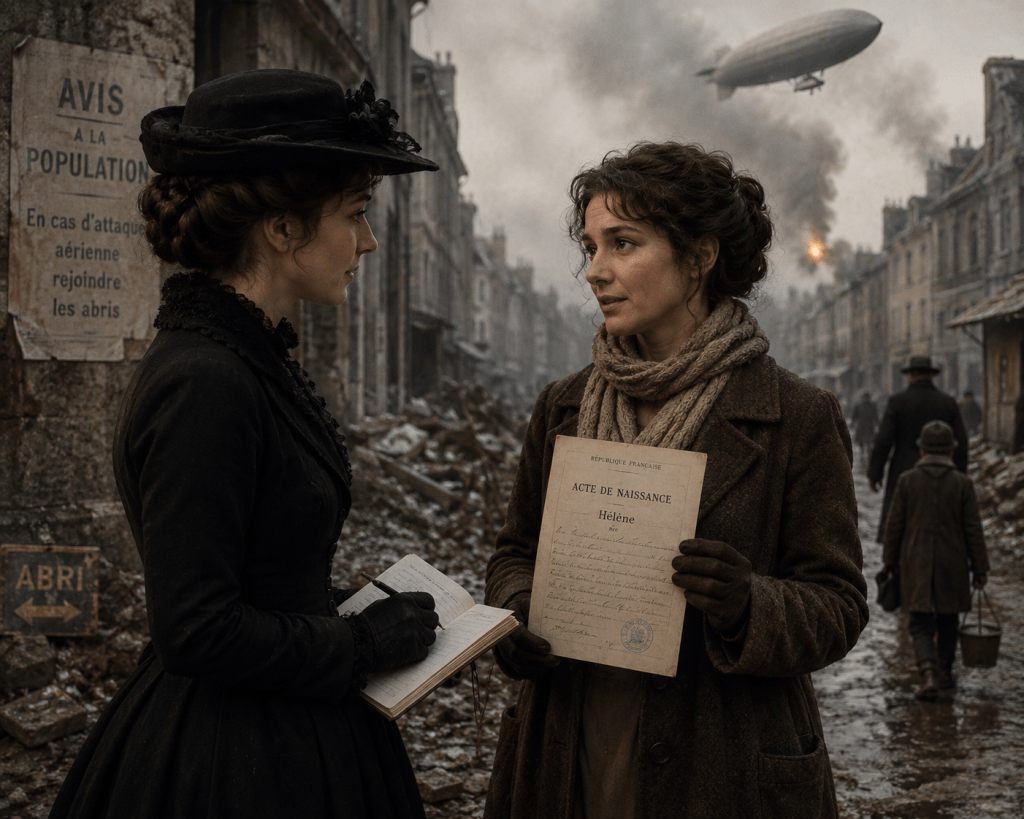
We walked away, each heading in a different direction.
The wind was growing stronger, gusts carrying away the finest rubble from the ruins. I shielded my eyes and quickened my pace. Passersby walked close to the walls with sadness etched upon their faces. Money was scarce, food even more so. Thin, hungry figures made their way toward the soup kitchen. Holding a bowl of soup and a piece of dark bread, they headed toward the slums they called home.
They waited for the war to end and for better days to return.
Children clung to the hems of their mothers’ skirts.
Such misery broke my heart.
I gave away a few coins and returned home. I hung my coat on the rack, drank a hot cup of tea, and sat down at my typewriter.
I thought about that woman who had already fought so hard simply to exist.
Hélène married after the war in 1920. She had four children. She died in 1975 — a woman, a wife, a mother, and a happy grandmother.

