The Last Days of the Boulogne Camp

On the first day of September 1805, standing before the sea, I contemplate the vast expanse where the first rays of sunlight shimmer upon the water. A few ships cut through the still-dark mass, while the shrill cries of the seagulls bring me back to reality and to my duties. Instinctively, I raise my collar; autumn is approaching, and the wind grows colder.
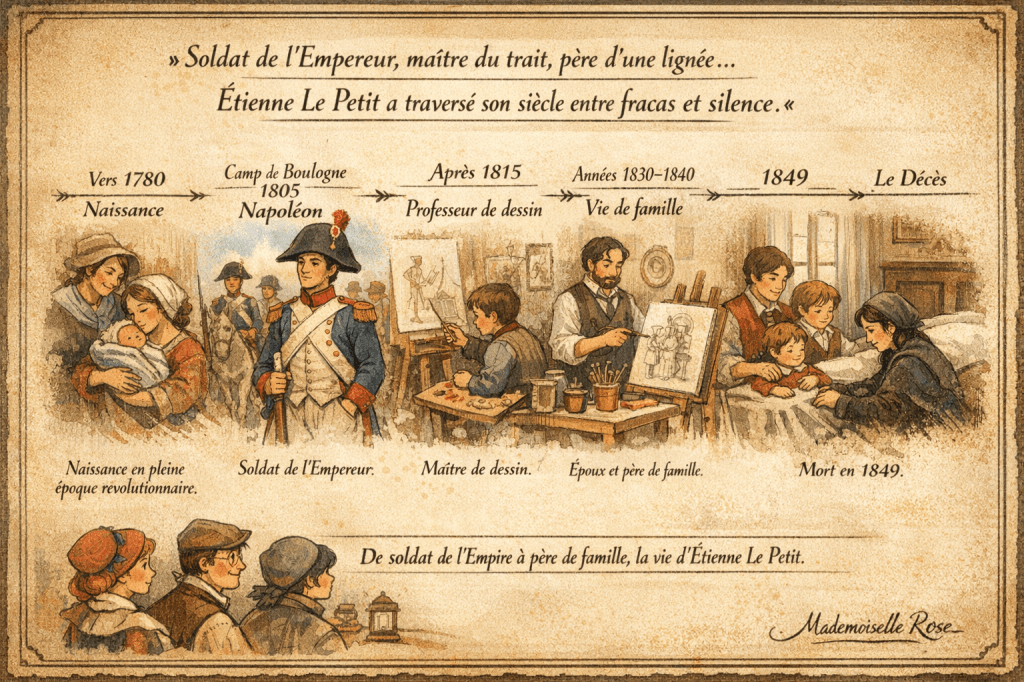
With determined steps, I make my way toward the last barracks of the camp of Boulogne-sur-Mer. It has been fifteen days since the Emperor departed. Étienne LE PETIT has been discharged from service and is preparing his belongings. I am to meet him at the very place where the Emperor decorated his most deserving soldiers with the Legion of Honour.
He stands a few yards away from me, upright and silent, gazing upon the place where he has spent the past two years. The crunch of my footsteps on the gravel path makes him turn around. He welcomes me with a faint smile.
— Good morning, citizen.
— Good morning, citizen. You are about to leave and return to civilian life. Do you intend to go back to your native Normandy?
— No. I like this region. I can practise my trade here and build a family.
— May we speak again of the last two years spent with Bonaparte? Tell me why the Consul became interested in the Opal Coast. I have read articles about these events, but I would rather hear them from someone who truly lived through them.
— Certainly, citizen. On May 16, 1803, the British seized nearly one hundred French and Batavian ships. Napoleon, who was still First Consul at the time, declared war on Britain and stationed his troops in Boulogne-sur-Mer and the surrounding towns to prepare for the invasion of Great Britain.
— But the port of Boulogne-sur-Mer was only a small fishing harbour.
— Indeed, which is why the harbour had to be enlarged to allow the mooring of two thousand vessels. We were an immense army of soldiers, as many as two hundred thousand men, including engineers and labourers. Every profession was represented there. As a draftsman, I was responsible for maps and the plans of the flat-bottomed boats. The English attempted another attack, but it failed.
— What moment marked you the most?
— August 16, 1804, when our Emperor presided over the presentation of the first Legion of Honour medals to his most deserving soldiers. The ceremony lasted seven hours, something I shall never forget. Unanimously, we decided to erect a commemorative monument: a column fifty-four metres high, crowned by a statue of our Emperor. For now, it is only a proposal; we shall see what our leaders decide.
— Where and when was the foundation stone laid?
— In the town of Wimille, on the 18th of Brumaire. Marshal Soult had the honour of laying the first stone.
— Why did our Emperor abandon the invasion of England after two years?
— The coalition between Austria and Russia on the eastern front greatly concerned the High Command. At sea, another battle was being fought between Admiral Villeneuve and Admiral Nelson. Despite Spain’s support, the Battle of Trafalgar proved to be a terrible disaster. Having lost many ships, Napoleon abandoned the idea of conquering England and marched eastward to conquer other lands.
— Do you believe you served your country well?
— Certainly, through my skills and my knowledge. But now the Emperor needs soldiers, true warriors, which I am not.
— Are you happy to have stood beside such a great man, a man who always knows what he wants and how to obtain it?
— I witnessed many things, both admirable and terrible, which I shall never forget. I am proud to have known men of great worth. Now I long for a quieter life in this beautiful town of Boulogne-sur-Mer.
After exchanging the customary courtesies, we each go our separate ways.
The wind grows colder and colder. Gusts of sand whip against our faces. Winter promises to be harsh this year. I turn one last time to look at him. He walks away with steady steps. He will turn twenty on September 25. His whole life lies before him.
I had not seen the harbour in many years, so I climb to the highest point to take in the full view. Astonished, I contemplate the extent of the works: two new basins have been dug. I return to town and hail a coachman to take me to Wimereux. The upper section of the river known as the Wimereux has been channelled to the sea; a lock and a channel lined with low jetties complete the project. On the right bank, a basin capable of receiving entire armadas and flotillas waits for ships and vessels.
I gaze as far as the horizon allows, but a thick mist prevents me from seeing the English coast. For one final moment, I watch the seagulls in flight.
I signal to the coachman. He helps me into the carriage. It is already nearly cold.
I return home to write my article.
Étienne LE PETIT was my fourth great-grandfather.
Batavia was a republic that existed from 1795 to 1806 and covered most of what is now the Netherlands. Though theoretically independent, it was in reality under French control and was the longest-lasting of the sister republics created during the French Revolution.

