
It is the end of August, 1889. The heat is unbearable, and I fan myself frantically with my parasol. I left Calais early this morning to avoid the crowds. Invited by Eugène LE PETIT, I am to attend the tribute paid by his peers to his brother-in-law, Ernest DESEILLE.
I find myself at 52 Rue du Bras d’Or in Boulogne-sur-Mer. A building as ordinary as can be, yet within its walls gathers a most distinguished assembly: the city’s Academic Society. I quietly take a seat in the back rows so as not to disturb these gentlemen.
Everyone exchanges greetings. Everyone speaks of the deceased with a knowing expression and weary faces. The murmur of voices fills this grand hall, usually so solemn, but today transformed into an antechamber of deep and sincere sorrow.
Monsieur Louis BENARD, resident member of the Society, rises to speak:
« Gentlemen and dear colleagues, on the 26th of August, standing at the very edge of the grave into which our regretted annual secretary Ernest DESEILLE had been taken far too soon, I made a promise to offer, within another setting, a fuller tribute to the hardworking writer who had just disappeared… »
« Miss… Miss… »
« That other setting, as you have understood, my dear colleagues, was ours — our Academic Society, where for nearly a quarter of a century we had the opportunity to appreciate and esteem the friend we have now lost… »
« Miss… psst, psst… »
I spin around in surprise.
Someone is calling me?!! But… but! It is Ernest in flesh and blood! No… it is his ghoooost! No! I am a rational woman, NO!
I quickly turn back toward the speaker.
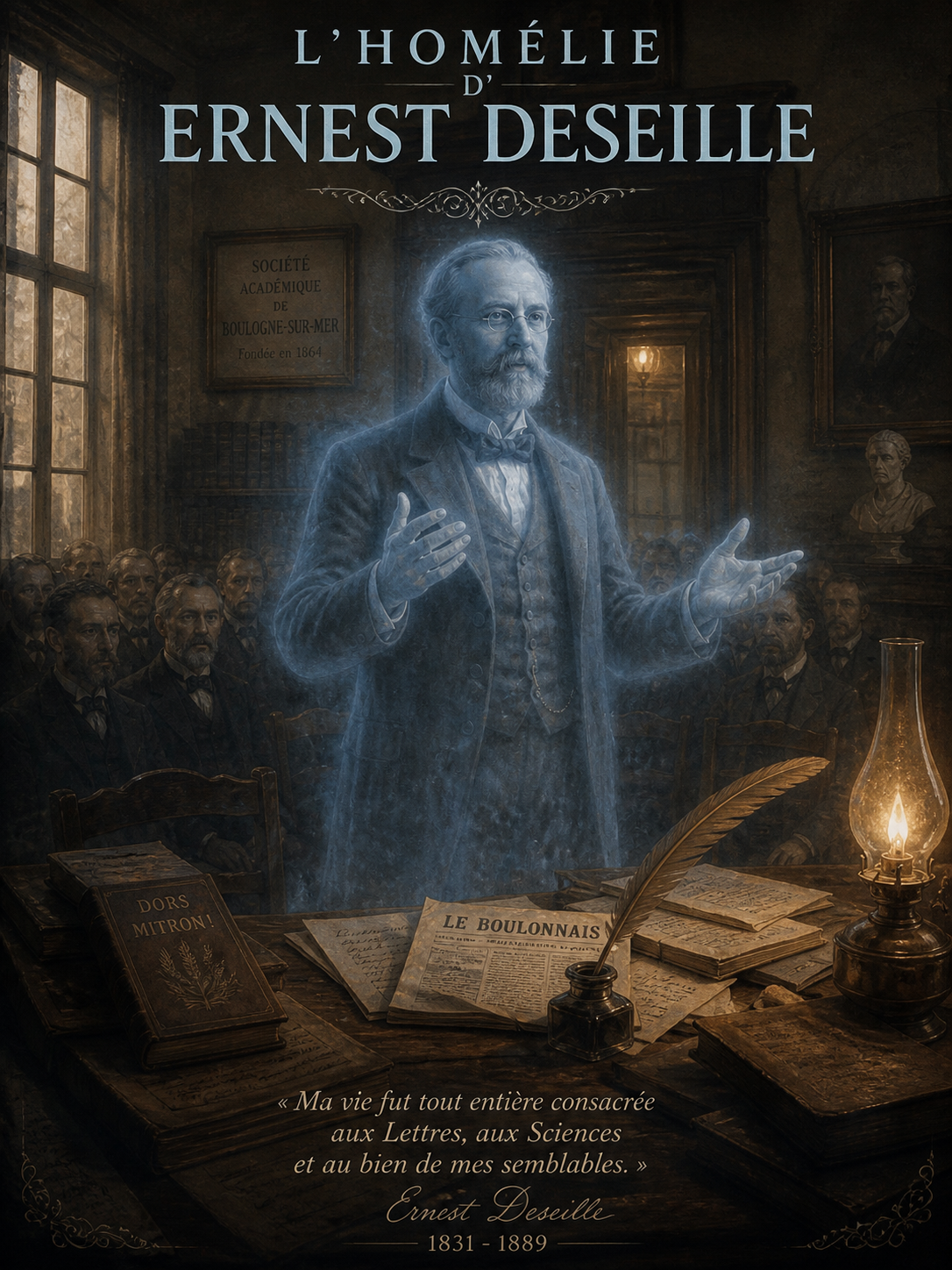
« Psst, psst, Miss, don’t be afraid! You don’t seem entirely human yourself! Come. »
He is not entirely wrong. I am Miss Rose, the timeless journalist.
I follow him.
He leads me into a room that must once have been his office.
« Good day, Miss Rose. I have been expecting you. »
« Expecting me? What do you mean?!!! »
« My dear brother-in-law Joseph LE PETIT warned me. »
« But he died in 1873?!! »
« Exactly. »
Ernest stands before me, a mischievous little smile on his lips, freed at last from all suffering.
« My dear friend Louis BENARD prepared a speech capable of boring even the strongest man to death. So I shall instead tell you about my family, my journey, and my work in a less formal way. And you may ask questions as well. »
“With great pleasure! Could you tell me where you fit within the DESEILLE family?”
“I was the ninth and last child of Jean François DESEILLE and Marie Gabrielle MOIREAU. My father was a baker. He died in 1839 at the age of fifty-three from the same illness that eventually carried me away. Two of my sisters married into the LE PETIT family. Célina married Joseph, and Geneviève married Eugène, sons of our illustrious Etienne LE PETIT.
From 1840 to 1848 I was a curious and diligent student at the public school. But I was only thirteen when my mother withdrew me from my beloved school to help her with the family business. Out of duty and love for my mother, I conscientiously learned the trade of baker.”
“I have the impression that you longed for higher studies, that you loved learning.”
“Indeed. I have always loved studying, whether literature, science — everything interested me. But I never abandoned my dream. After my working day, I devoted myself to writing.
In 1851, once I had become a recognized baker and no longer merely an apprentice, I was able to build my own oven and put my name above the shop front. I practiced that profession diligently, despite the little interest I had in it.”
“Did you still have enough time to devote yourself to poetry?”
“I made time to write, and Eugène LE PETIT, already a respected poet, encouraged me to learn the rules of verse composition. I had already written a few texts, but the first piece I wrote after my studies was called Sleep, Baker’s Boy!”
“Did you continue balancing the professions of baker and writer for long?”
“In 1859, with the agreement of my young wife Marie Françoise, I abandoned baking. To provide for our needs, I joined a contractor’s business as a clerk.
Then, in 1862, the mayor of Boulogne-sur-Mer brought me into his municipal team. This change gave me enough time to devote myself to my writing.
I held several other positions, some of which I combined: accountant and collector for the casino, assistant office manager…”
“When did you join this noble institution in which we now stand?”
“At its creation in 1864, and in 1866 I was elected annual secretary. I worked relentlessly, without counting the hours.
In 1867 I was appointed Administrator-Director of the Fish Market, secretary of the Publicity Committee, and secretary of the Charity Society.
In 1869, I accepted the role of committee member of the Public Library.
In 1871 I became city archivist — a blessing for me. I had books and documents at my fingertips to satisfy my thirst for knowledge and to share it with my fellow men.
On July 16th, 1882, I received from Monsieur DEVAUX, Under-Secretary of State for Public Education, my Silver Palms.
That purple ribbon was the crowning achievement of a life devoted to literature and science.”
“I am sorry to ask such a question, but I want my article to be as true to life as possible: when did the illness begin to take hold?”
“I was aging prematurely, and in January 1888 the illness knocked at my door. But my spirit and my heart remained strong.
Between each relapse I had periods of recovery that allowed me to continue writing, but the illness always returned, as stubborn as the death that awaited me.
My dear friend Louis BENARD continued to visit me. In his eyes I could see both his sadness and the nearness of my end.”
A blink of an eye — and no one remained.
He had returned to the kingdom of the dead for some, the kingdom of God for others.
I gathered my belongings and quietly slipped away.
It was my first encounter with a ghost.
I made my way toward the harbor. The boats were tossed by the swell, while the sun gazed at itself upon the ever-shifting waters under the rule of the tide.
I breathed deeply.
I was alive.
I thought of Ernest, of his family, of his wife.
I would pay tribute to them — but in my own way.
I would take the omnibus home. It followed the coastline, allowing me all along the journey to admire the sea and its thousand reflections.

