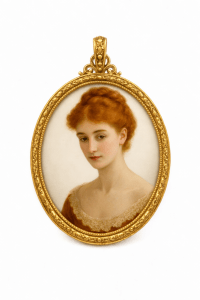
I truly was courageous this morning. I brought out the brush, bucket, black soap, and scrubbed the wooden floors. I took down the heavy velvet curtains and will carry them to Mrs Jeanne, the laundress — she is the most careful in all of Calais. I cleaned ornaments, vases, and lamps. Catherine calls this “spring cleaning.”
Now I shall rest for a while.
I feel my heart slowing, my thoughts dissolving into the veils of sleep.
I did not have to search long for the beginning. It was there, beside the water, as so often happens in old stories — where families do not begin in books, but in gestures repeated so often that they become memory.
I saw Simon COURAGEUX standing on the riverbank, attentive to the flow of the water, his body shaped by labour, his eyes accustomed to the deceptive reflections of the river.
He was a fisherman in Sens, and around him the world made no unnecessary noise. One had to live, feed one’s family, know the seasons, understand the currents, and accept that the river gives one day and takes away the next.
Around him, a family took shape, then another, then others still, as though life, once begun, had refused to stop.
Sons were born, daughters too. Some lived long lives, others barely long enough to be given a name.
It is always the same when one travels back through the centuries: life moves forward, but death walks beside it, familiar, almost settled.
And yet the line endured.
It bent, it suffered, it buried its dead, and then carried on.
Among the COURAGEUX family, there was first the water.
The water and the nets. The water and the boats. The water and that silent patience which teaches men to watch carefully before acting.
Several after Simon became fishermen in their turn, as though the profession were not merely a means of survival, but a way of inhabiting the world.
Children were born beside the Yonne carrying, in their eyes, something already prepared to read the currents.
Perhaps the father did not speak much, but the son watched. And that was enough.
Knowledge passed less through words than through presence. A hand upon an oar. A net cast without haste. A silence shared at dawn. That is how children were taught.
But no family remains forever in the same place through time.
Little by little, I saw the riverbanks recede. Not suddenly, not through some brutal rupture, but through gradual shifts, almost imperceptible.
One man became a labourer. Another was no longer a fisherman but an artisan. Another worked metal, forging, adjusting, repairing.
The river never disappeared entirely. It remained in the gestures, in the perseverance, in that stubborn way of enduring. But the family itself was beginning to enter another world.
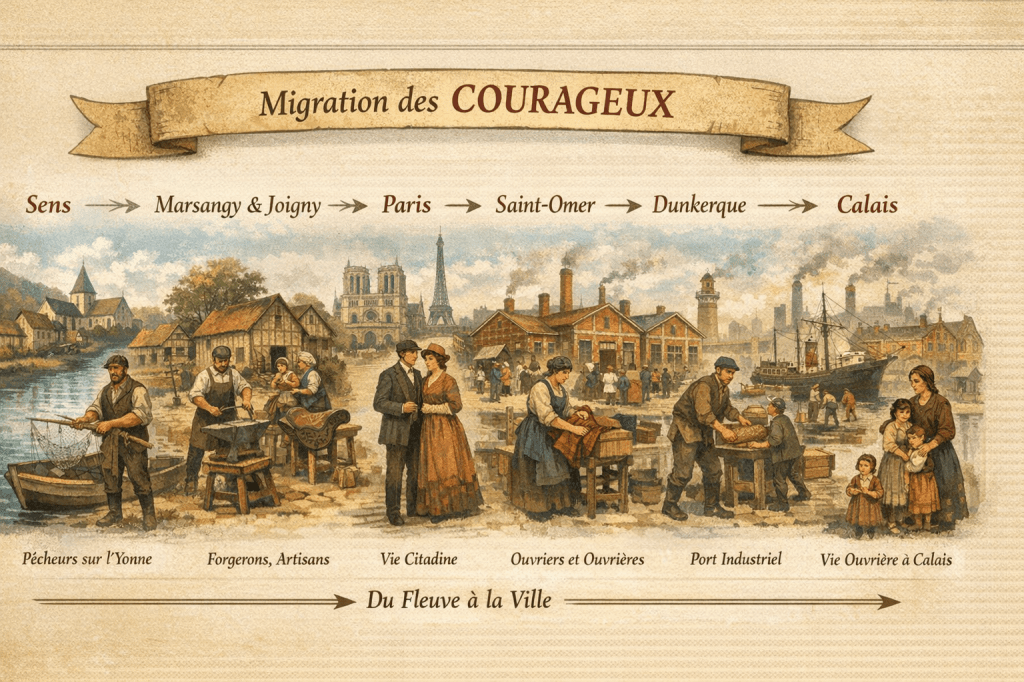
Then the places changed. Sens remained for a long time the ancient heart, the nourishing land of the lineage, but already branches were spreading outward. Marsangy. Joigny. Paris. Dunkirk. Saint-Omer. Calais.
As I followed them, I felt as though I were watching a family slowly leave behind the landscape of boats and enter instead that of roads, workshops, larger towns, crowded rooftops, and perhaps harsher lives too.
I saw the COURAGEUX become locksmiths, manufacturers, saddlers, labourers, employees, shopkeepers, municipal workers.
I saw hands once familiar with the damp chill of mornings upon the oars learn instead the heat of forges, the dust of workshops, the weight of tools, the weariness of days lived far from the horizon of the river.
The scenery had changed, but the courage remained the same.
And while the men changed professions, the women continued to hold the thread.
For within these long lines of descent there are men’s names moving proudly at the front, but behind them — or rather all around them — stand the women: countless, discreet, determined.
They carry. They care. They mend. They keep watch. They bury children, sometimes several, and still rise again.
The archives rarely speak of them. Their professions are seldom recorded. But without them, nothing lasts, nothing survives, nothing is passed on.
I saw them.
I saw one standing at the doorway of a house, waiting for someone’s return. I saw another bent over a cradle while outside the labour of life wore the men down. I saw women following husbands to another town, changing streets, neighbourhoods, entire worlds without ever truly choosing, yet beginning again each time.
I saw women carrying grief quietly because meals still had to be prepared, laundry washed, and the living comforted.
In great family lines, it is often the women who prevent memory from breaking.
As I continued my journey through the generations, I felt the North drawing closer. Saint-Omer first, then Calais.
There, the family entered another rhythm. No longer the slowness of the river, but the movement of the town: labour, travel, working-class lives, increasingly specialised trades, houses where families lived more closely together, children ever more numerous, grief still present, but also new hopes, new unions, new roots.
The COURAGEUX were no longer only those of Sens. They became those who crossed distances, changed horizons, and faced new necessities without abandoning what they carried within themselves.
And this is where your story, Catherine, begins to beat closer to the heart.
For at the end of these centuries — at the end of Simon the fisherman, of those who hauled nets, struck metal, wore out wooden clogs upon country roads and leather shoes in the streets of the North, at the end of those women who remained standing despite every loss, at the end of those children who themselves became fathers, mothers, grandparents, at the end of this patient multitude — there is you.
You are not beside them. You are their continuation.
You carry something different, of course. You are neither upon Simon’s boat, nor inside the locksmith’s workshop, nor in a narrow street of nineteenth-century Saint-Omer.
And yet, when I watch you writing, when I see you preserving names, places, dates, professions, when I see you returning again and again to the departed so as to restore their presence, I understand that transmission has never ceased. It has merely changed form.
Once, people passed on nets, tools, gestures, endurance. You pass on memory.
You do with words what others once did with their hands.
Where they built lives day after day, you gather the traces. You restore substance to faded silhouettes. You prevent them from sinking entirely into that great silence where so many families eventually disappear.
And truly, I believe this is no lesser task.
For courage is required to live. But courage is also required to turn back, look behind oneself, name the absent, and say:
“You are not lost. I am here. I remember.”
Simon COURAGEUX could never have known, while lifting his fishing nets upon the Yonne, that one day one of his descendants, in another century and upon another land, would continue the work of transmission in a different way.
He could not have imagined Calais, nor the workshops, nor the wars, nor the grief, nor the renewals, nor this woman bent over certificates and photographs, restoring faces to those whom time had scattered.
And yet I am certain he would recognise you.
Not because of your clothes, nor your century, nor even your life so different from his own. But because of that one thing which crosses the centuries unchanged: that stubborn loyalty to one’s own.
Perhaps he would look at you silently, as those river men did who never needed grand speeches. Then he would look upon all those who came after him — that crowd of descendants, those countless branches, those modest or shattered lives, those joys, those deaths that came too soon, those departures, those settlements, those endless beginnings again.
And he would understand that none of it had been in vain, because from all of it there still remains a voice willing to tell the story.
So from Simon to you, from Sens to Calais, from the riverbank to the town, from the working hand to the writing hand, it is in truth one single story.
A story of perseverance. A story of transmission. A story of family. A story of courage.
And that name they bore so well — COURAGEUX — did not merely survive within the registers. It survived through the generations.
I laugh softly to myself in my armchair. I had found myself courageous this morning, and my dreams carried me towards this family whose name reveals so much.
 A rebrousse temps généalogie