
I am going to take an interest in the life of Charles François POINTEZ Jr. Quietly, I shall follow him and share with you the important events that marked his life, the life of one of Catherine’s fifth-generation ancestors. Charles was born at a time when Saint-Pierre-lès-Calais was still little more than countryside. Farms and market gardens were still extremely numerous at the beginning of the nineteenth century, though the town would change greatly during that century. Charles had three older sisters : Françoise, born in 1794 ; Geneviève, born in 1796 ; and Marie Marguerite, born in 1798. It is not difficult to imagine that he was treated like a little prince, surrounded by girls eager to care for and love him. Like his father, Charles became a gardener, and in 1826 he married seventeen-year-old Marie Antoinette LECOCQ, herself a gardener. Tragically, the poor young woman died only four months later, leaving her husband utterly devastated. It took him nearly three years before he could bring himself to remarry. In December 1828, he married Geneviève DUBOIS.
It is the 10th of April 1840. Pierre Louis, the couple’s fourth child, has just been born, and I am going to visit them at 56 Rue des Hautes Communes in Saint-Pierre-lès-Calais. I had intended to walk part of the way, but great dark clouds suddenly covered the sky. For several days now, the weather has been unpredictable. The air is mild and announces the arrival of spring, yet within moments violent gusts of wind, torrents of rain, and hailstorms drench us to the bone and leave us shivering. Wisely, I decide to take the omnibus instead. Rue Jacquard and Rue Lafayette pass by to the rhythm of the horses’ hooves. I get off in Rue de l’Égalité, only a few metres from their home. They live in a small house where one or two bedrooms have been added beneath the roof. Recently repainted and decorated with flower boxes overflowing with daffodils and tulips, the little household reflects its inhabitants : peaceful and happy. They are all standing at the doorway : François, Charles, Marie Charlotte, Louis, Geneviève, and little Pierre, tightly wrapped in blankets in his mother’s arms.
“Good afternoon, Monsieur POINTEZ, good afternoon, Madame.”
“No ceremony between us! Call us François and Geneviève, and come in.”
“Please accept this small gift in honour of Pierre Louis.”
“You shouldn’t have, Mademoiselle! Thank you.”
“Rose! No ceremony! I came not only to see your adorable little boy, but also so that you might tell me about your life and your work in this town that never stops changing.”
“Yes indeed, my dear young lady, many things have changed. I began working with my father at the age of twelve. For a few coins, we maintained vegetable gardens and flower gardens for elderly people, a few notaries, and doctors, but nothing that brought in enough money. The English who arrived with their machines needed a few years before they earned enough to build large beautiful houses surrounded by land. That was when we finally gained respectable clients — but imagine the amount of work we had to do! My in-laws, my brothers-in-law, and my brothers are all gardeners too. Whenever we must design an entire estate, we work together. These gentlemen are demanding ; they want to recreate England in their gardens. I can read and write, and I learned how to understand a plan. Oh yes, a proper plan, because those English certainly know how to draw : trees here, flowers there, a fountain in the centre, the vegetable garden near the kitchen door, and a rose garden with benches for the ladies.”
“You truly love your profession ; it can be heard in the way you speak about it. Would you like your children to follow in your footsteps?”
“I do not wish to force them. They will help me with my work and learn the trade, then they may decide for themselves. Though, when I think about it, I doubt they will choose this life. The tulle factories offer so many new professions indoors and sheltered from the weather. We shall see. It has stopped raining now ; let me show you the seedlings I have prepared in the greenhouse at the end of the garden.”
I follow François. Geneviève is singing a lullaby to soothe the newborn to sleep, while the three older children sit upon the floor, listening reverently to the sweet voice of their mother. The greenhouse occupies half the garden. Upon trestles, shelves made from reclaimed wood, and even directly on the ground, pots of every size contain precious seedlings. François has carefully labelled and arranged everything : brilliantly coloured flowers, vegetables, aromatic herbs, medicinal plants, watering cans, tools, and several ornamental plants of various ages complete the collection. François is as happy as a lark ; he is deeply proud of his work. We return indoors, and he offers me a drink, which I politely refuse so as not to wake little Pierre. Geneviève is exhausted, yet her eyes and smile thank me silently.
I have just enjoyed a delightful conversation. The gentle rays of the sun caress my face. For a moment, I remain motionless with my eyes closed, breathing deeply. The delicate fragrance of spring flowers, fertile earth, and the straw that protected the seedlings still lingers in my nostrils. The weather is beautiful ; I decide to walk part of the way home.
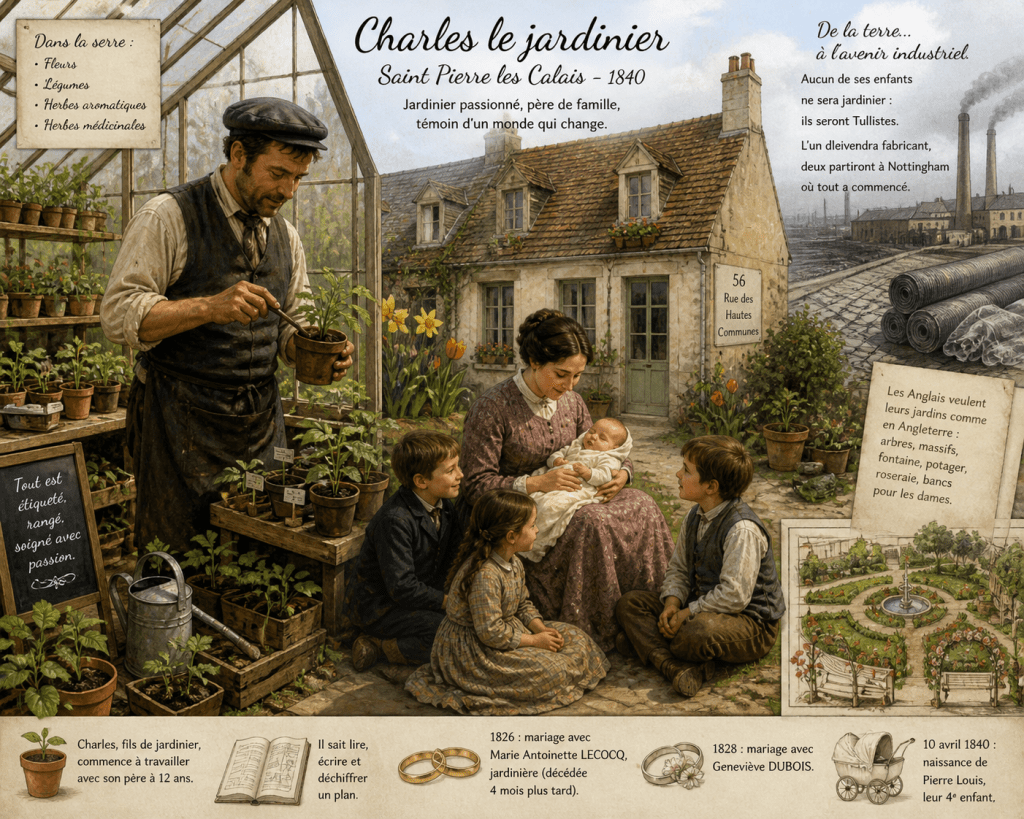
Little Marie Charlotte would not live to see her fifteenth birthday. Charles would be born in 1844 and Marie Julie in 1847. Charles had been right : none of his children would become gardeners. They would all work in the tulle industry. One of them would even become a manufacturer, while two others would travel to Nottingham to practise the trade where it had all begun.
 A rebrousse temps généalogie