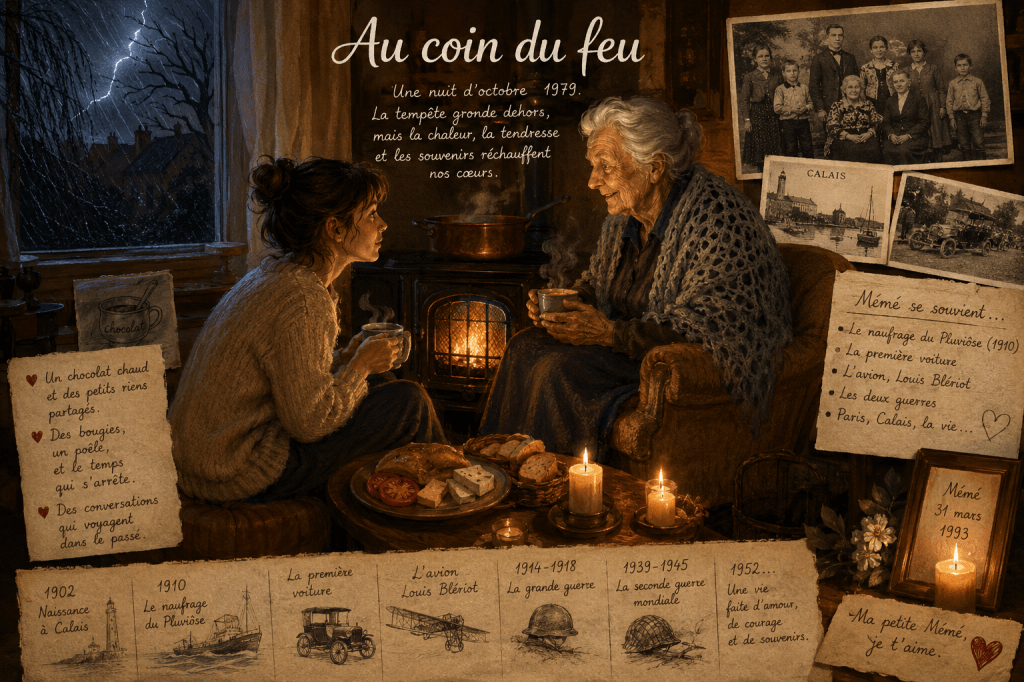
Day had just faded away on that October evening in 1979. I came home from work soaked from head to toe. The rain and wind had made a mockery of my raincoat and umbrella. The weather forecast had announced a risk of a storm that night. My grandmother had been living with me for a few months while waiting for a place to become available in a nursing home. She was beginning to lose her grip on things: eating and sleeping at regular hours, turning off the gas—these were becoming unfamiliar habits to her. The present was slowly unraveling hour by hour, but the illness had not yet touched her memories.
I took off my coat and shoes.
“Hello Grandma, did you have a good day?”
“But Cathy, you’re completely soaked! Here!”
She fetched a towel and my dressing gown from the cupboard. Vigorously, she rubbed my hair dry. Smaller than me, she had to stand on tiptoe. My clothes were drenched and she undressed me. I was twenty-three years old and being undressed like a child! On the coal stove, a saucepan filled the room with the delicious smell of hot chocolate.
“Grandma, what if we drank your hot chocolate?”
“What chocolate? You hide the matches, I can’t do anything!”
“On the stove! In the saucepan!”
She shrugged and went into the other room. I was used to her sudden changes of mood. I brought out a tray and two cups and poured the steaming nectar.
“Thank you, my darling, such lovely chocolate. Ah! This damp weather makes me ache all over!”
Delighted, she greeted me with a broad smile.
Neptune unleashed his fury. Under the force of the wind, the water raced like a galloping horse before crashing against the courtyard wall. The branches of the weeping willow twisted and lashed against each other at the whim of divine anger.
I closed the shutters.
Suddenly, total darkness.
Had the circuit breaker tripped? By the light of a flashlight I went to check, but no—it was a power outage. Grandma grumbled; I had left her in the dark. I knew where the candles were and placed several in the kitchen. I moved her armchair in front of the fire.
It was dinner time, but what could we do? We opened the refrigerator and quickly pulled out some leftover chicken, cheese, two tomatoes, and bread bought earlier that day. I prepared a plate for each of us.
Grandma settled back into her armchair. I sat at her feet on a large pouf. I had placed candles nearby. The warmth of the stove and the dim light made us forget the noise and the fury outside.
“So Grandma, who came to visit you this afternoon?”
“No one! You leave me alone for hours!”
“Think carefully! Your daughter and son-in-law came to see you.”
“No! Michelle is in Paris and she’s divorced!”
“I mean your other daughter Marguerite, my mother.”
“I don’t remember anymore.”
“Look! She brought your sweets and Dad filled the coal box.”
“No, I’ve had those for ages! Yes, ‘Mimile’ is a good man, but no, I didn’t see him.”
There was no point insisting. The evening was likely to be a long one. She no longer remembered her day, but the past was still very much alive.
“Tell me Grandma, you were born on July 27, 1902, in Calais. You witnessed all the changes and all the events of the twentieth century. What do you remember?”
“Yes, Cathy, I saw so many good things and so many terrible things.”
“So Grandma, who came to visit you this afternoon?”
“No one! You leave me all alone for hours!”
“Think carefully! Your daughter and son-in-law came to see you.”
“No! Michelle is in Paris and she’s divorced!”
“I’m talking about your other daughter, Marguerite, my mother.”
“I don’t remember anymore.”
“Look! She brought you your sweets and Dad filled the coal box.”
“No, I’ve had those for ages! Yes, ‘Mimile’ is a good man, but no, I didn’t see him.”
There was no point insisting. The evening was likely to be a long one. She no longer remembered her day, but the past was still very much alive.
“Tell me, Grandma, you were born on July 27th, 1902, in Calais, at the beginning of the twentieth century. You witnessed so many changes, so many events. What do you remember?”
“Yes, my Cathy, I saw so many good things and so many terrible things.”
“What are your very first memories?”
“The sinking of the Pluviôse in 1910. I was eight years old. My parents, my brothers and sisters talked about it. All those poor sailors, dead at the bottom of that sardine tin. They were given a national funeral. Even the President of the Republic attended the ceremonies.”
“Were you among the crowd watching the procession?”
“Yes, but I saw nothing. I was far too small.”
“Grandma, I saw that you had family photographs in…”
“You went through my things?!”
“No, Grandma, you showed them to me.”
“Oh, having your portrait taken was something special! We had to put on our finest dress and wait for hours before the photographer finally released us.”
“There’s one that was taken in your parents’ garden.”
“Yes, I was sitting between my father and mother. Standing behind us were Nini, Alice, Berthe, and a cousin, though I can no longer remember her or her name.”
“Your brothers Fernand and Gaston are missing from that photograph.”
“My sisters could work at home a few hours a week, but the boys worked on machines at the factory; they could not be there during the photographer’s hours.”
“When was it taken?”
“Around 1910, I think. When I remember that Berthe had only four years left to live… Poor thing.”
“I’ve seen old postcards of Calais. Do you remember the first car?”
“No, but I remember the fright it gave me! Oh yes! It made a terrible noise, and the horn! I still laugh when I think about it.”
“There have been so many technological advances!”
“Yes, my Cathy, I’ve seen many things, and the speed of progress frightens me. Before, we had time. Now, everyone always has to go faster.”
“The airplane, Grandma. Did you see Louis Blériot?”
“No, my parents wouldn’t let my brothers take me; I was too young. But people still talk about the crossing of the Channel. Just think—we went from a plane built with bits and pieces to the Concorde in less than seventy years!”
“Yes, my dear Grandma. I can’t even begin to imagine it. It’s too abstract for me.”
“You’re lucky, my little girl. Don’t forget that I lived through two wars. In 1914, I was twelve years old. I understood very well what was happening. My brothers Fernand and Gaston left for the front. I could feel Mother’s anxiety. And Berthe came back to Calais to die beside her family. In 1939, I had just lost your grandfather when the conflict began. Your Uncle André was born in November. I never had enough milk, so I could never nurse my children. André needed a special milk that was unavailable, and he died in July 1940.”
“My dear Grandma, I love you.”
“I love you too.”
Dead leaves, already fading, lifted into the air and were carried away by the rain. I was not afraid. I knew that tomorrow, weather permitting, my father would come and check the condition of the roof.
Grandma looked at me and smiled.
“Back in August, I took my children to Paris where I thought we would be safe. Nini, then Alice, came to join me.”
“Mum has very fond memories of her childhood in Paris. But why did you come back to Calais in 1952?”
“Those are my reasons. I never spoke of them to my children, so I won’t speak of them to you.”
“Alright, Grandma! But you still went back to the Paris region with Pierre, my godfather.”
“Yes, and I came back after his death so I could stay close to all of you.”
Her son, her little Pierrot, who never married, had gone to join the stars at only thirty-four years old. He had been injured on a country road, suffering a skull fracture caused by a horse’s hoof. The helmet had kept a round hole, just above the earpiece. She had always kept her grief to herself.
It was getting late. Grandma placed a big kiss on each of my cheeks to wish me good night. She was finding it harder and harder to climb the stairs.
“You polished the steps again! You want to kill me! I’m going to tell Georges!”
“I don’t polish the stairs, Grandma. They’re narrow and you’re finding them harder and harder to climb.”
“So now you’re calling me a liar!”
I did not insist. I went back to my room and waited until she had gone to bed. I knocked on her door, walked over to her, and returned her kisses. She cuddled me and smiled. She had already forgotten what she had just said.
Some months were harder than others. There were phone calls from my uncle asking for news of her. We often laughed at the dreadful things she claimed I was making her endure.
Grandma obtained a place at the Pierre de Coubertin nursing home in April or May of 1980. Little by little, both her present and her past disappeared. Our faces slowly faded from her memory.
She passed away on March 31st, 1993.