A travel bag in hand, I hurry toward the omnibus station. That dear Mr DEVAUX, a butcher by trade and, above all, endlessly curious by nature, stopped me in the street. He wondered where I could possibly be going so early on a December morning in the year 1872. After the usual greetings, I leave him unsatisfied. The omnibus bound for Saint-Omer is about to depart.
I climb aboard, place my luggage beside me, and end up sitting sideways, almost sprawled across my neighbour. I had not anticipated such a sudden departure. Straightening myself, I apologise and bury my nose in my reading.
I do not look at the landscape.
Thanks to the actions of Louis Faidherbe, the North of France was spared invasion, but I have no desire to see the final scars left by the war.
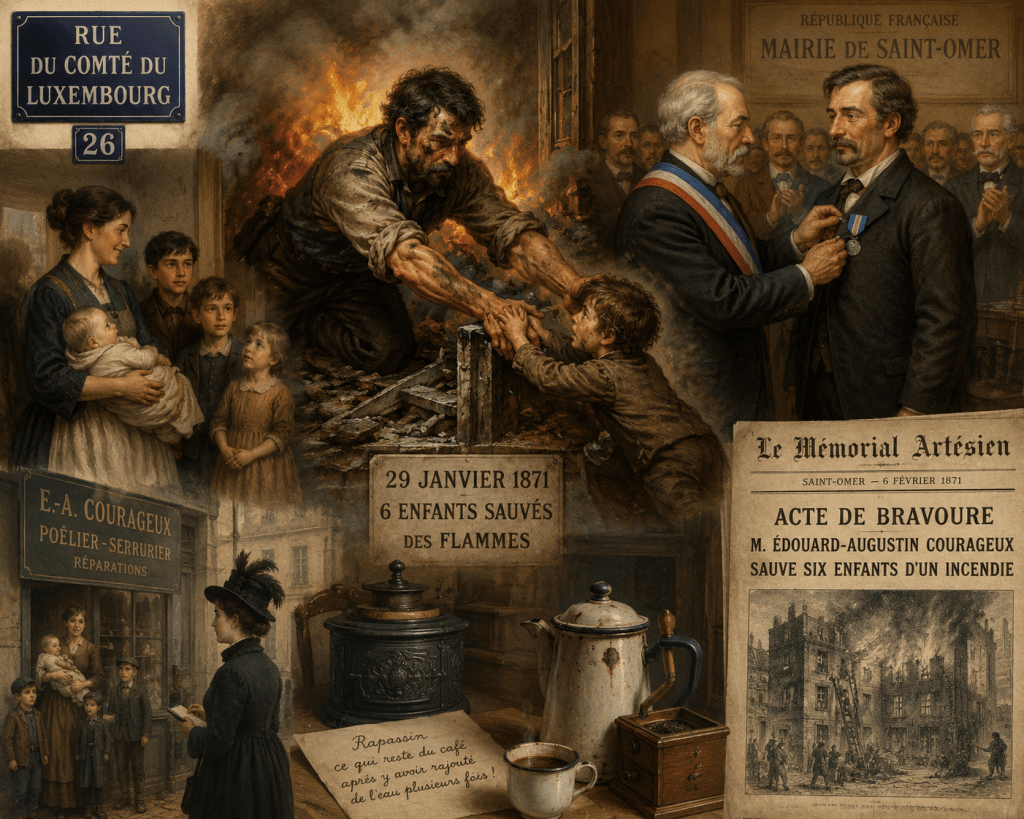
Upon arriving in Saint-Omer, I ask for directions. I must go to 26 Rue du Comté du Luxembourg to meet Edouard-Augustin COURAGEUX, a stove-maker and locksmith by trade.
On January 29, 1871, Mr COURAGEUX rescued six children from a fire.
How can one possess such courage?
Yes, I can already imagine your mocking smiles — the joke is an easy one.
I stand before a tall townhouse. On the ground floor are the shop and repair workshop; upstairs, the family living quarters. I hear noise coming from the shed, yet no one appears. A small bell sits upon the counter. I ring it vigorously.
A woman and four children appear in the doorway. Augustine COURAGEUX, née LEROY, welcomes me. In her arms she carries Anna, a newborn only a few days old. Clinging to her skirts are Eugène and little Augustine, while Edouard, at eight years old, stands quietly beside them.
In a few words, I explain the reason for my visit.
She blushes with pride.
Her husband is known for fifty kilometres around.
“Edouard! Edouard! Someone is asking for you!”
She raises her voice, but her husband cannot hear her; he is hammering away at the metal with all his strength.
“EDOUARD-AUGUSTIN!”
“Forgive me, Miss!
Edouard, go fetch your father.”
A few moments later, father and son return. Like the blacksmiths, Edouard-Augustin has broad shoulders and a powerful chest. Of average height, he possesses blue eyes like those of his ancestors — and of the descendants yet to come.
He looks at me with a broad smile.
“So then, Miss, people are taking an interest in ordinary folk now?”
“But Monsieur COURAGEUX, bravery is not reserved for the wealthy — quite the opposite. I have heard that you have just received the silver medal at the town hall. Could you tell me about it?”
“We shall not remain standing in the shop. Follow my good Augustine; we shall talk over a cup of coffee.”
Like in every working-class house, the staircase is steep, almost like a miller’s ladder. We enter a room where a beautifully crafted stove, made by my host’s own skilled hands, occupies the place of honour.
After putting little Anna to bed, Augustine pours coffee beans into the grinder, sits down, wedges it between her knees, and with a steady motion turns the beans into powder. She places the grounds and a generous amount of chicory into the upper compartment of the enamel coffee pot. Then she pours in simmering water, which soaks through every particle and releases its rich aroma. She repeats the process several times until the pot is full.
Edouard takes the cups from the cupboard. For the sugar and milk, he must call upon his father; he is too small to reach the upper shelves.
Augustine solemnly fills the cups and places the coffee pot on the corner of the stove. The brew is strong; the milk and sugar soften its bitterness. Augustine and Edouard-Augustin drink with delight.
By tomorrow, she will already begin adding water to it until it becomes “rapassin” — the weak coffee left after repeatedly watering it down.
Augustine leads the children into the next room so that we may speak freely.
“This presentation of the medal must have made you proud all the same.”
“Proud? Yes, now perhaps. But at the time, I did not think at all. The fire was devouring the upper floors. I stood there like everyone else until I heard the children screaming in the cellar.
There was indeed a small window, but it was far too high for the little ones to open. Using a makeshift tool, I smashed the glass and the frame. I lay flat upon the ground, pushed my arms through the opening, and pulled the children out one by one.
The older ones helped the younger ones reach my hands.
That is all.”
“That is all!? No, sir, that is an act that honours you! And this ceremony at the town hall — tell me about it.”
“What a business it was! My Augustine wanted me to look distinguished — me, distinguished! She found an old suit belonging to a deceased uncle, but I looked like a sack of potatoes in it. She complained about it while shopping at the market.
A seamstress who had heard my story insisted on altering it free of charge.
‘It could have been one of her own children in that fire,’ people said.
Word spread quickly.
One morning I found a pair of shoes in my size outside my door. The next day, the barber himself came to see me.
On the appointed day, I went to the town hall. My sister-in-law took care of the children so my wife could accompany me. She was proud of her husband and grateful to all the people who had transformed me into a dandy.
Ha! Ha! Ha! Let us remain serious.
It was in the marriage hall that the mayor presented me with my medal. After the ceremony, a glass of wine and a bread roll were served.
So much preparation for less than three-quarters of an hour… but it remains a fine memory, one that the children — especially my eldest — will one day tell to their own children.”
“Bravo, Monsieur COURAGEUX! In these still-chaotic times, it is heartening to recount your story. Thank you for granting me your time. Please convey my warmest regards to your wife and compliment her on her coffee.
Goodbye, Monsieur COURAGEUX.”
“I shall indeed! Goodbye, Miss Rose.”
The cold remains bitter. I raise my collar and quicken my pace despite the slippery ground. I shall now go to the town hall and the local newspaper office to obtain documents concerning that January 6, 1871.
“Rapassin” — the weak coffee left after repeatedly adding water to the same grounds.