
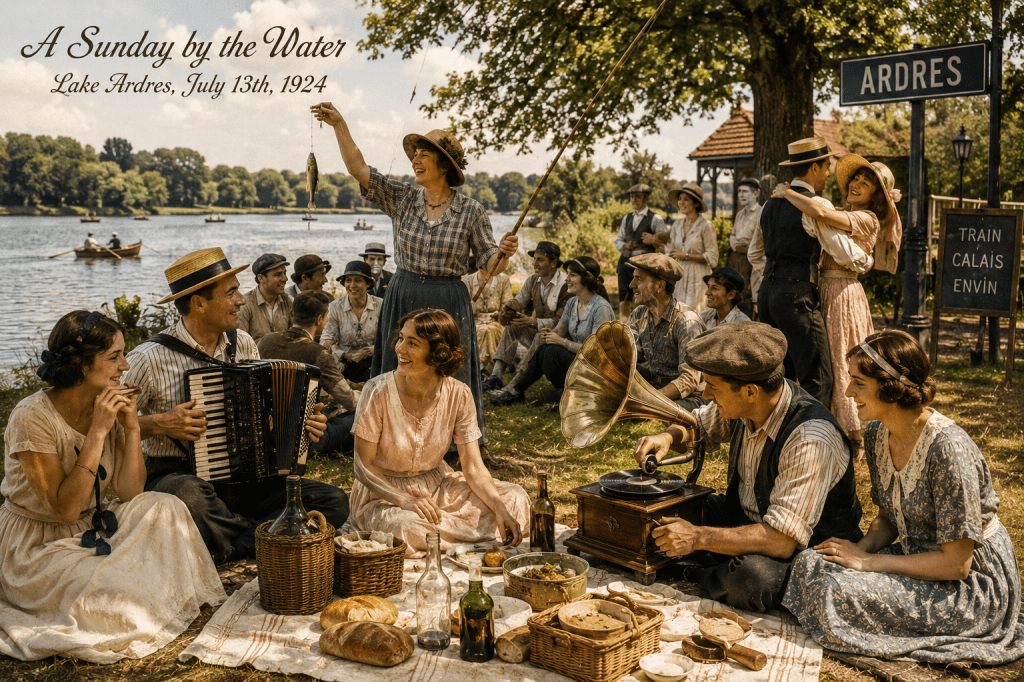
Sunday, July 13th, 1924. Marguerite BOURGEOIS and all the nimble hands from the finishing workshop were spending the day at Lake Ardres, a few miles from Calais. They had taken the Calais–Envin train and got off at the little Ardres station. A few gentlemen had slipped into the carriages as well. Everyone had brought food and drinks.
Léon, the handyman who could fix just about anything, had brought along his gramophone and a few records. Jules, the foreman of the repair workers, had taken his accordion.
What would these gentlemen not do to charm the ladies!
Once they arrived, they still had a few hundred yards to walk. The merry group set off together. The weather was magnificent. A light breeze rippled the shimmering surface of the lake and stirred the branches of the trees. Only a few innocent clouds streaked the sky. The birds were singing, though not for much longer. Laughter and songs would soon send them searching for somewhere quieter.
Little Eugénie had a crush on Léon. He was not much to look at, Léon, but he was kind-hearted and always wore a smile. Jules, on the other hand, was a notorious ladies’ man, hoping to find a girl who was not too shy. Raymond, Edouard, and Hyppolite were also part of the outing.
Marguerite, Léonie, and Raymonde spread large blankets on the grass. Food was placed in the middle and everyone found themselves a spot.
With a turn of the crank, Léon set the gramophone in motion. Jules grabbed his accordion, and Marie-Catherine, a tiny, quiet and timid little woman, pulled a harmonica from her pocket and amazed everyone with her talent.
“And what if we made ourselves a little fish fry?” suggested tall Sidonie.
She must have been related to my neighbor. In the shipping department she packed, carried, and worked as hard as any man. Today, from beneath her skirt, she produced a small fishing rod that unfolded, along with a little box full of worms. No sooner said than done, our Sidonie caught her very first fish.
The gramophone filled the air with music. Some couples danced, the ladies twirling their skirts in rhythm, while the gentlemen, their straw hats tilted to one side, swept their partners away and sent them spinning to the sound of a lively fox-trot.
Lunchtime arrived and everyone settled as comfortably as they could.
Bread, sausages, salads, and sandwiches were shared, accompanied by a good glass of wine. Jokes made some roar with laughter and caused the younger girls to blush. Nobody spoke of lace today, even though these elegant women all wore dresses, blouses, or handkerchiefs embroidered with the very fabric that earned them their living.
Gradually the laughter faded, and the birdsong returned. Weariness had gently cast this little world into the arms of Morpheus.
The rustling of leaves in the wind, the sweet scent of the water, the soft splash of oars against the lake…
Marguerite slowly drifted to sleep.
She saw herself again as a child upon these same shores with her brothers, sisters, sisters-in-law, and brother-in-law. A Sunday like this one, one year before the war, one year before the death of her beloved Berthe.
Shouts of joy woke her.
Quickly! Boats had been made available and everyone had to climb aboard. The strongest men and women rowed while the others enjoyed the scenery and the warmth of the day.
Time passed far too quickly.
It was already time to pack everything away; the train would not wait.
The remaining food, bottles, and musical instruments were packed back into baskets. The blankets were folded away, and Sidonie’s fishing rod found its place again beneath her skirts. Jules walked around the meadow one last time, just to make sure nothing had been forgotten and nothing had been left behind to spoil nature.
The whole group retraced their steps, chatting and laughing loudly enough to make the local folk turn around and stare.
The train was waiting at the station.
It was time to return home.
Back in Calais, “Good evening, see you tomorrow!” echoed all around, along with kisses between friends — and perhaps a mischievous little kiss between Eugénie and Léon?!
I walked over to Marguerite. In just a few days she would be celebrating her twenty-second birthday. She greeted me with a broad smile. I had blended into their cheerful company throughout the day, and she had clearly been sizing me up.
She took hold of my arm and led me into the station café. Looking around before sitting down, we ordered a refreshing lemonade.
“Are you worried, Marguerite?”
“Not really. But my older sister Léonie, guardian of good morals, allows me nothing at all. She is afraid I might lose my virtue because of a single lingering glance!”
She burst out laughing and struggled to regain her composure.
Her laughter was contagious, and more and more smiles appeared around us.
A few days earlier she had cut her hair short, and she explained in great detail how her mother, Léonie, and Alice had descended upon her like a storm. Hair, after all, was a woman’s treasure and was not to be spoiled.
With a wave of his hand, her father ended the argument. He forgave everything his youngest daughter did.
Hardly had we finished our lemonade when she ran back to join her family.
She was a young woman full of life.
She ran, jumped onto the tram, waved at me, and disappeared.
I truly enjoyed this day spent among these men and women — the good humor of these workers, their simple pleasures, and their warmth.
Marguerite, Catherine’s grandmother, particularly charmed me with her honesty and joyful spirit.
I shall never forget that Sunday by the water.
 A rebrousse temps généalogie