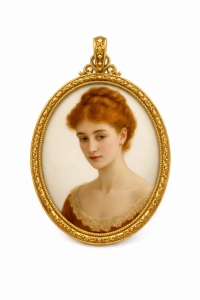
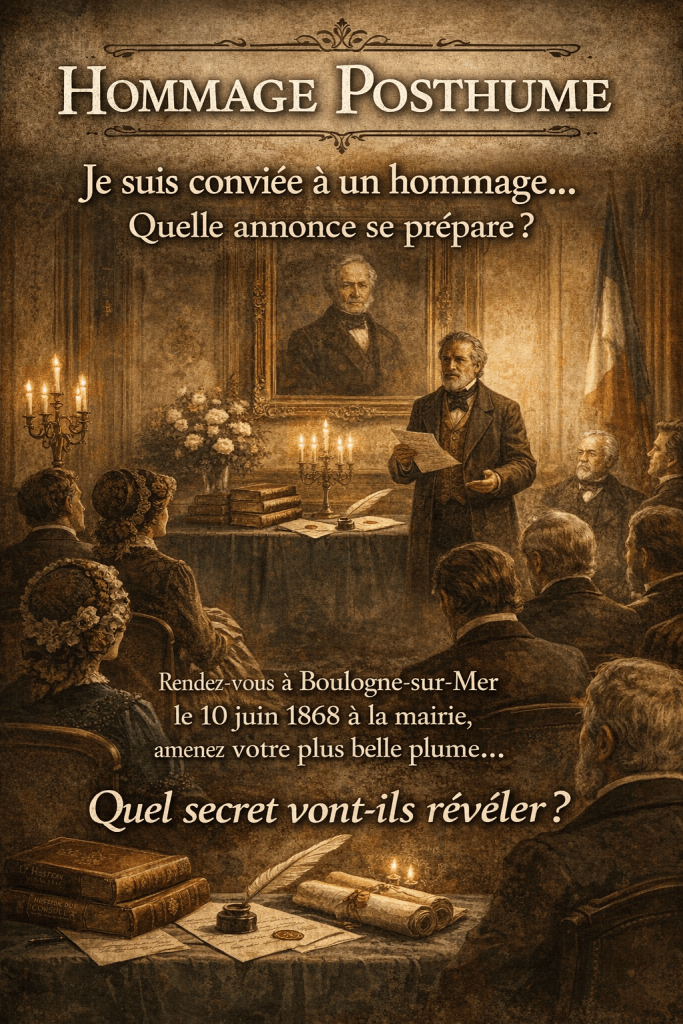
I have just received a letter from Monsieur Ernest Desseille, brother-in-law to the sons of the late Etienne Le Petit. I am invited to attend an event to be held at the Town Hall of Boulogne-sur-Mer on the 10th of June 1868 at two o’clock in the afternoon. I am instructed to bring my finest pen. I am left wondering — what are they going to announce to me? My finest pen! As though I were in the habit of neglecting my work! Still… I have three days to prepare for my journey. I hurry towards my room and open my wardrobe. What shall I wear for such an occasion? Dresses pile up upon my bed until I finally settle upon an almond-green gown, though perhaps a little too low-cut for the event. Never mind ; Monsieur Bourgeois, my regular tailor, will quickly remedy the matter with a lace plastron.
As is my habit, I have taken a seat aboard the stagecoach travelling from Calais to Boulogne along the coast. Célina Le Petit has invited me to stay with her the day before the reception. It is still early ; the sun barely brushes the fields opposite the sea. There is very little wind, the waves are calm, and a few boats glide peacefully across the water. The villages we pass through are alive with fishmongers crying out their wares. The children are at school, though a few rebels still wander the streets in pursuit of some legendary pirate. I lean my head out of the window and fill my lungs with the invigorating air. Only a few more kilometres now and I shall arrive. The omnibus stops at the gate of the old town, barely a hundred metres from the Le Petit residence. Célina and her sister-in-law Joséphine await me beneath the shelter, accompanied by a servant who takes charge of my luggage. Arm in arm, we make our way towards the house.
The three brothers, their wives, and their children all contribute to the cheerful commotion. The youngest children have been entrusted to a nursemaid. Joseph, Eugène, Hector, and their sons come forward to greet me. Célina joins her sister Geneviève in the small sitting room, where Laure, the wife of Gustave, along with Eugénie, Julia, Blanche, and Angélina are already gathered. The servant escorts me to my room and helps me unpack my suitcase. I soon return downstairs to join the ladies. Marie Françoise, Ernest Desseille’s wife and a distant cousin of the sisters, greets me with a broad smile. She informs me that around five o’clock her husband will come to see me, for he has matters to discuss.
For luncheon, a large table has been set in the courtyard. A young girl of about fifteen has come to assist the maid. A variety of dishes are served to us, and the atmosphere is warm and festive. To calm our spirits and enjoy the fresh air, the entire family goes for a walk around the ramparts. I move from one group to another, smiling while keeping my ears attentive. The church bells strike five o’clock, and I hasten back home. Ernest is waiting for me in the small sitting room. He extinguishes his cigar and closes the window latch. He invites me to sit down, draws a chair opposite mine, and begins to speak.
Letter from Monsieur Alphonse Thiers to Monsieur Etienne Le Petit in 1842
“In 1842, Alphonse Thiers, the brilliant lawyer and statesman, requested by letter that Etienne Le Petit lend him the documents in his possession concerning the development of the harbour of Boulogne-sur-Mer. You are no doubt aware that our dear Etienne arrived in the region alongside Napoleon Bonaparte and contributed to the preparations for the war against England — a war which, as you know, never took place. The Emperor departed to conquer other territories, while Etienne settled among us.”
Questions burn upon my lips, yet I allow him to continue.
“Etienne therefore sent him everything he possessed. The years passed, and nothing was ever returned. A few weeks ago, while speaking with Monsieur Félix Ribeyre, the biographer of Cham, he reminded me that Monsieur Thiers had never returned the papers to the family. I therefore wrote to Monsieur Jules Goshler, secretary to Monsieur Thiers. A few weeks later, I received a reply : Monsieur Thiers offers each of Etienne’s sons a copy of the books he has written — The History of the Consulate in three volumes. The publishing house Lheureux, publisher of Thiers’ works, has sent three copies to the Town Hall, and it is these books that we shall present to these gentlemen tomorrow at the Hôtel de Ville. Mademoiselle Rose, I thought you more talkative than this!”
Letter written by Monsieur Thiers’ secretary but signed by Thiers himself
“But Monsieur Desseille, I was hanging upon your every word! Yes, I do have several questions. Why did Etienne never ask for the papers back?”
“He was a discreet man who, I imagine, did not wish to trouble such an important gentleman.”
“And what did the shipment contain?”
“Plans for the development of the ports of Boulogne and Wimereux, paintings of those same places created by our dear Etienne, and, I believe, documents concerning the flotilla then under construction.”
“What a pity he was not associated with this project during his lifetime.”
“Indeed, but I believe it shall be a great honour for his children.”
“Do you not think Monsieur Thiers, or someone close to him, ought to be present?”
“The powerful do not mingle with ordinary people, even honourable ones.”
“You are right, Monsieur Desseille. Tomorrow shall be a great day.”
I rejoined the ladies in the small salon while Ernest departed towards the domain of the men.
The morning of the 10th of June passed swiftly. A quick meal was served to us before we all returned to our rooms to prepare ourselves. The two servants no longer knew where to turn ; so many ladies required assistance dressing. In order to be ready on time, we were obliged to help one another. By half past one, we were all gathered before the Town Hall. Messieurs Desseille and Ribeyre, acting as masters of ceremonies, led our little procession into one of the great reception rooms. Upon a table prepared for the occasion, the books were proudly displayed. A copy of Monsieur Thiers’ letter to Monsieur Le Petit and various other objects from the period completed the display. Monsieur Eugène Livois, mayor of the city, had graciously made himself available.
Ernest Desseille called each of his brothers-in-law and friends forward one by one, solemnly presenting them with these works which reminded the people of Boulogne of their father’s contribution to the greatness of the town. The mayor then invited the family into another room where drinks and petits fours awaited them.
The children of Etienne Le Petit (1785–1849) and Joséphine Bernard (1796–1878)
Joseph (1816–1875)
Joséphine (1818–1871)
Eugène (1820–1901)
Hector (1838–1907)
The children of Joseph Le Petit and Célina Desseille
Gustave (1841–1905)
Eugénie (1842–1919)
Julia (1844–1906)
Georges (1846–1904), ancestor of Catherine
Blanche (1856–1944)
The children of Eugène Le Petit and Geneviève Desseille
Edgar (1849–1918)
Louise, known as Angélina (1853–1929)
Only the children still living in 1868 are mentioned. The great-grandchildren were too young to take part in this story.
Let us return to reality. The books were actually delivered to them by post at their homes.
Link to Geneanet : Monsieur Félix Ribeyre, biographer of Cham
Amédée de Noé, known as Cham, was born in Paris on the 26th of January 1818 and died there on the 6th of September 1879. A highly talented illustrator and caricaturist, he collaborated for many years with Le Charivari and L’Illustration. Possessing a cheerful and comic personality, extraordinary energy for work, and an exceptionally fertile imagination, he integrated easily into Parisian life between the 1840s and 1870s. He associated with the greatest artists and leading personalities of that half-century. To this day, no complete bibliography of Cham’s works exists. His artistic activity was so prolific that even a volume of five hundred pages would not suffice to catalogue the thousands of drawings he produced. How could such a prodigy have been so thoroughly forgotten? The only serious biography ever written about him is this one. Félix Ribeyre first published it in serial form in Le Figaro shortly after Cham’s death, before Plon issued it as a volume in 1884. Since then, it has never been republished. This edition is illustrated with around twenty plates and facsimiles of handwritten letters. The portrait upon the cover, a photograph by Ferdinand Mulnier, comes from the Galerie contemporaine des illustrations.I have just received a letter from Monsieur Ernest Desseille, brother-in-law to the sons of the late Etienne Le Petit. I am invited to attend an event to be held at the Town Hall of Boulogne-sur-Mer on the 10th of June 1868 at two o’clock in the afternoon. I am instructed to bring my finest pen. I am left wondering — what are they going to announce to me? My finest pen! As though I were in the habit of neglecting my work! Still… I have three days to prepare for my journey. I hurry towards my room and open my wardrobe. What shall I wear for such an occasion? Dresses pile up upon my bed until I finally settle upon an almond-green gown, though perhaps a little too low-cut for the event. Never mind ; Monsieur Bourgeois, my regular tailor, will quickly remedy the matter with a lace plastron.
As is my habit, I have taken a seat aboard the stagecoach travelling from Calais to Boulogne along the coast. Célina Le Petit has invited me to stay with her the day before the reception. It is still early ; the sun barely brushes the fields opposite the sea. There is very little wind, the waves are calm, and a few boats glide peacefully across the water. The villages we pass through are alive with fishmongers crying out their wares. The children are at school, though a few rebels still wander the streets in pursuit of some legendary pirate. I lean my head out of the window and fill my lungs with the invigorating air. Only a few more kilometres now and I shall arrive. The omnibus stops at the gate of the old town, barely a hundred metres from the Le Petit residence. Célina and her sister-in-law Joséphine await me beneath the shelter, accompanied by a servant who takes charge of my luggage. Arm in arm, we make our way towards the house.
The three brothers, their wives, and their children all contribute to the cheerful commotion. The youngest children have been entrusted to a nursemaid. Joseph, Eugène, Hector, and their sons come forward to greet me. Célina joins her sister Geneviève in the small sitting room, where Laure, the wife of Gustave, along with Eugénie, Julia, Blanche, and Angélina are already gathered. The servant escorts me to my room and helps me unpack my suitcase. I soon return downstairs to join the ladies. Marie Françoise, Ernest Desseille’s wife and a distant cousin of the sisters, greets me with a broad smile. She informs me that around five o’clock her husband will come to see me, for he has matters to discuss.
For luncheon, a large table has been set in the courtyard. A young girl of about fifteen has come to assist the maid. A variety of dishes are served to us, and the atmosphere is warm and festive. To calm our spirits and enjoy the fresh air, the entire family goes for a walk around the ramparts. I move from one group to another, smiling while keeping my ears attentive. The church bells strike five o’clock, and I hasten back home. Ernest is waiting for me in the small sitting room. He extinguishes his cigar and closes the window latch. He invites me to sit down, draws a chair opposite mine, and begins to speak.
Letter from Monsieur Alphonse Thiers to Monsieur Etienne Le Petit in 1842
“In 1842, Alphonse Thiers, the brilliant lawyer and statesman, requested by letter that Etienne Le Petit lend him the documents in his possession concerning the development of the harbour of Boulogne-sur-Mer. You are no doubt aware that our dear Etienne arrived in the region alongside Napoleon Bonaparte and contributed to the preparations for the war against England — a war which, as you know, never took place. The Emperor departed to conquer other territories, while Etienne settled among us.”
Questions burn upon my lips, yet I allow him to continue.
“Etienne therefore sent him everything he possessed. The years passed, and nothing was ever returned. A few weeks ago, while speaking with Monsieur Félix Ribeyre, the biographer of Cham, he reminded me that Monsieur Thiers had never returned the papers to the family. I therefore wrote to Monsieur Jules Goshler, secretary to Monsieur Thiers. A few weeks later, I received a reply : Monsieur Thiers offers each of Etienne’s sons a copy of the books he has written — The History of the Consulate in three volumes. The publishing house Lheureux, publisher of Thiers’ works, has sent three copies to the Town Hall, and it is these books that we shall present to these gentlemen tomorrow at the Hôtel de Ville. Mademoiselle Rose, I thought you more talkative than this!”
Letter written by Monsieur Thiers’ secretary but signed by Thiers himself
“But Monsieur Desseille, I was hanging upon your every word! Yes, I do have several questions. Why did Etienne never ask for the papers back?”
“He was a discreet man who, I imagine, did not wish to trouble such an important gentleman.”
“And what did the shipment contain?”
“Plans for the development of the ports of Boulogne and Wimereux, paintings of those same places created by our dear Etienne, and, I believe, documents concerning the flotilla then under construction.”
“What a pity he was not associated with this project during his lifetime.”
“Indeed, but I believe it shall be a great honour for his children.”
“Do you not think Monsieur Thiers, or someone close to him, ought to be present?”
“The powerful do not mingle with ordinary people, even honourable ones.”
“You are right, Monsieur Desseille. Tomorrow shall be a great day.”
I rejoined the ladies in the small salon while Ernest departed towards the domain of the men.
The morning of the 10th of June passed swiftly. A quick meal was served to us before we all returned to our rooms to prepare ourselves. The two servants no longer knew where to turn ; so many ladies required assistance dressing. In order to be ready on time, we were obliged to help one another. By half past one, we were all gathered before the Town Hall. Messieurs Desseille and Ribeyre, acting as masters of ceremonies, led our little procession into one of the great reception rooms. Upon a table prepared for the occasion, the books were proudly displayed. A copy of Monsieur Thiers’ letter to Monsieur Le Petit and various other objects from the period completed the display. Monsieur Eugène Livois, mayor of the city, had graciously made himself available.
Ernest Desseille called each of his brothers-in-law and friends forward one by one, solemnly presenting them with these works which reminded the people of Boulogne of their father’s contribution to the greatness of the town. The mayor then invited the family into another room where drinks and petits fours awaited them.
The children of Etienne Le Petit (1785–1849) and Joséphine Bernard (1796–1878)
Joseph (1816–1875)
Joséphine (1818–1871)
Eugène (1820–1901)
Hector (1838–1907)
The children of Joseph Le Petit and Célina Desseille
Gustave (1841–1905)
Eugénie (1842–1919)
Julia (1844–1906)
Georges (1846–1904), ancestor of Catherine
Blanche (1856–1944)
The children of Eugène Le Petit and Geneviève Desseille
Edgar (1849–1918)
Louise, known as Angélina (1853–1929)
Only the children still living in 1868 are mentioned. The great-grandchildren were too young to take part in this story.
Let us return to reality. The books were actually delivered to them by post at their homes.
Link to Geneanet
Monsieur Félix Ribeyre, biographer of Cham
Amédée de Noé, known as Cham, was born in Paris on the 26th of January 1818 and died there on the 6th of September 1879. A highly talented illustrator and caricaturist, he collaborated for many years with Le Charivari and L’Illustration. Possessing a cheerful and comic personality, extraordinary energy for work, and an exceptionally fertile imagination, he integrated easily into Parisian life between the 1840s and 1870s. He associated with the greatest artists and leading personalities of that half-century. To this day, no complete bibliography of Cham’s works exists. His artistic activity was so prolific that even a volume of five hundred pages would not suffice to catalogue the thousands of drawings he produced. How could such a prodigy have been so thoroughly forgotten? The only serious biography ever written about him is this one. Félix Ribeyre first published it in serial form in Le Figaro shortly after Cham’s death, before Plon issued it as a volume in 1884. Since then, it has never been republished. This edition is illustrated with around twenty plates and facsimiles of handwritten letters. The portrait upon the cover, a photograph by Ferdinand Mulnier, comes from the Galerie contemporaine des illustrations.
 A rebrousse temps généalogie