
A dull rumble wakes me with a start. It is only four o’clock in the morning. What is happening?
Suddenly, the first explosion. It tears through the silence, brutal. A second follows, then another. The walls shake, the windows rattle. I sit up and listen, still unable to understand. Clumsily, I pull on a thick dressing gown and rush outside.
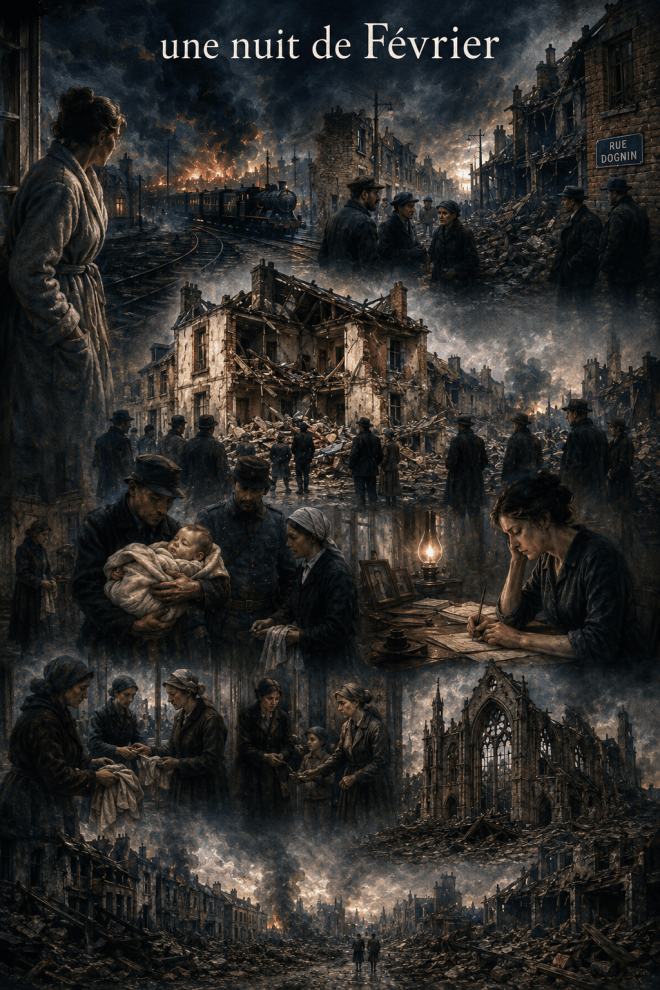
The houses have been spared, but the station and the railway tracks have been hit. In the street, voices overlap. People speak quickly, interrupting one another, each repeating what they think they know. Faces are tense, eyes filled with worry. Very quickly, one place is mentioned: Dognin Street. A house there has apparently taken a direct hit.
I cannot stay there doing nothing. I hurry back upstairs, dress as quickly as I can, and come back down almost immediately. Without hesitation, I head toward Dognin Street.
When I arrive, all I can do is stare. The shattered house exposes the broken intimacy of a family’s life. Around it, a few figures stand motionless while others move silently among the ruins.
The infant, the only survivor, is pulled from the debris and taken to the hospital. He barely cries. That silence troubles the onlookers even more. I remain there for a while, useless, my hands empty. Nothing to do. Nothing to say. Helpless, I finally walk away and make my way home.
Since that night, nothing in Calais has ever felt quite the same. Curfew has fallen over the city like a veil. The streets empty earlier, footsteps become quieter, and eyes lift toward the sky despite themselves. But fear alone cannot protect anyone. More bombings follow.
The days pass, and the attacks return. We almost grow accustomed to the worst, which may be the most disturbing thing of all. But the memory of Dognin Street does not fade. A house opened like a wound. Silence after the crash. And that child, alive and almost untouched, among what is no more.
Yet the city does not remain still. It is not something visible, nor a burst of voices, but something deeper, heavier. A new gravity seems to settle over Calais. People speak more softly. They walk more slowly. Behind drawn curtains, people stay awake longer. In the streets, everyone feels that something has broken, and that even silence itself has changed.
In the days that follow, something shifts in Calais. First restraint, then slowly, gestures. People talk more. They stop and ask for news. Those who saw speak in hushed voices while others listen in silence. Then, without being asked, without anyone announcing it, everyone simply does what they can.
A coin slipped into someone’s hand. A few clothes given away. Time offered freely. Nothing spectacular, nothing official. Just simple acts of kindness.
For the child above all. No one knows him, and yet he becomes everyone’s child. As though, through him, something had to be saved. Something greater than any one person.
I watch these quiet acts. I take little part in them, if any at all. But I see them. I understand them. Amid the thunder of bombs, among shattered homes and broken lives, this remains: Solidarity.
I am at home, sitting at my desk, my heart heavy as I write. But it is not only that night I carry within me. Other days already haunt me, as if time itself has opened before me without leaving me any choice.
I think of grieving families, of women who will wait in vain, of all the men who have gone to fight the enemy. I know, even before they fall, that many will never return—or will return broken. That certainty crushes me.
I sit there, motionless, suspended between what has just happened and what already seems destined to come.
I am devastated.
On March 18, 1915, once again the night is torn apart. Near Fort Nieulay, then along the railway lines and all the way to Gambetta Boulevard. Even Notre-Dame Church is struck. Its stained-glass windows, once filled with light, are now nothing but dust.

