
Today, I need nature and wide open spaces. I take the omnibus to Ardres. Once there, I shall hire a carriage to travel along the country lanes. At this late springtime, the weather is perfect : neither too warm nor too cool, and the days are wonderfully long.
The journey passes without incident. The carriage owner, a red-haired man with jade-green eyes, is somewhat reluctant ; to him, a woman does not possess enough strength to master the spirited horse. In the end, he decides I shall enjoy the scenery far more if I allow myself to be driven. The price for the carriage and its driver is perfectly reasonable. My companion disappears towards the stables. A few minutes later, he returns accompanied by his double. Raymond and Roger are true twins — mirror twins. One is left-handed, the other right-handed ; the birthmark on one’s left cheek appears on the other’s right cheek. They have wonderful smiles, and their bond is unmistakable.
Raymond helps me into the carriage while Roger takes the reins. We head towards the lake for a picnic. Ever gallant, Roger quickly spreads out the contents of my basket upon the blanket. A piece of bread and an onion are all he has brought for his own meal. Absolutely not — I have more than enough for two. He blushes deeply, his freckles disappearing into the crimson of his face. At first he refuses most vehemently, then finally accepts my invitation. In return, he offers me a piece of bread baked the day before by his elderly mother. Delicious, I must admit!
After half an hour of idleness beside the water, we resume our journey towards Autingues. A few kilometres away stands a baker renowned throughout the Pas-de-Calais. News of my excursion into the Ardres countryside has spread through my neighbourhood, and many of my neighbours asked me to bring back this divine bread.
The shop is small and poorly lit. The baker, somehow warned of my arrival by some miracle, approaches smiling, his arms laden with loaves. I pay him, we exchange a few pleasantries, and he accompanies me outside to place his precious goods upon the seat of the carriage. He has thoughtfully wrapped each loaf in cloth.
“Give my linens to Fernand the market gardener when you see him at the market ; he will return them to me. Enjoy your outing, Mademoiselle Rose!”
Roger speaks to me about the organ inside the church of Nielles-lès-Ardres.
“It is well worth seeing.”
He cracks his whip high above the flanks of Trompette, his mare. Accustomed to her master’s theatrics, the beautiful creature sets off at her own pace. Roger was quite right : the organ is magnificent. It was built in 1686 by Guillaume Van Belle of Ypres. Originally intended for the church of Sainte-Aldegonde in Saint-Omer, it was sold to the church of Nielles in 1789 but only reassembled there in 1795. The Romanesque nave and the baptismal font are equally worthy of admiration. I notice Roger’s triumphant smile ; he is delighted.
Now we head towards Louches. It is nearly six o’clock in the evening, and an unusual agitation reigns in this village of barely two hundred souls. What has happened? A little girl of six has disappeared. She had been quietly playing with her doll in front of the house. By the time her mother crossed from one room to another, she had vanished.
Jean-Baptiste FONTAINE, the village constable, has gathered all the volunteers to search for the child. Even the mayor himself is present. The constable gives a precise description of little Rose : long light-brown hair, blue-grey eyes, a blue flowered dress, lace-less shoes — she dislikes laces — and a lovely doll dressed in the same blue fabric.
Then, upon the ground, he draws the outline of the village and divides it into four sections. The mayor, the schoolmaster, the grocer, and he himself will each lead a search party. Every group leader carries a whistle to alert the others if they discover anything, even the smallest clue. Roger joins the schoolmaster’s group. I volunteer as well, but the constable firmly refuses.
“Come now, my dear lady, with that skirt? Can you imagine yourself searching through fields? Leave that to us. Help the women instead.”
The men will return to the square every half hour to shade in the areas already searched upon the map drawn on the ground. We must prepare food and drink for them. The women busy themselves with the task, and I offer them one of the loaves from the baker of Autingues.
And the parents? Where are they?
The father searches for his daughter in the fallow field behind the house. Tall, thick grass has invaded the land. His little princess is nowhere to be seen. He calls her name, his voice trembling with fear. His wife has remained inside with their three older children — after all, perhaps little Rose may return home on her own.
The groups come and go, crossing out searched areas upon the map, swallowing a slice of bread, drinking quickly, and heading out again. Thirteen square kilometres! Why have we still not found her?
Without wishing to alarm anyone, the constable decides to extend the search towards Landrethun, Nielles-lès-Ardres, and Zouafques. He enlarges his drawing upon the ground. Some children bring candles and place them around the map so it remains visible in the darkness.
I shall miss the last train, but I cannot leave.
Who is this little girl?
The grocer’s wife returns carrying a basket of provisions. One must show solidarity. Her heart aches at the thought of the smiling and polite little child. The family is not originally from this village, but they are good people.
A man approaches us, struggling to remain standing. Someone quickly brings him a chair, and he collapses into it. I move closer and suddenly realise — it is Georges LE PETIT. The missing child is his youngest daughter.
He does not know me yet, but I know them. I have read every document concerning his wife, his children, and their future. My heart breaks for them. What can I possibly do?
It is half past nine. Night is beginning to fall. The farm labourer from the OUDART farm approaches us carrying something in his hand. He seems terribly uneasy and hesitates to come closer. Slowly, he raises his arm.
Georges cries out — he has recognised the blue dress of Rose’s doll.
He rushes towards the young man.
“Where? Where did you find it? Answer me!”
The constable separates them and leads young Ernest away to question him calmly. Two men escort Georges back home.
The doll had been caught upon the bank of the River Nielles at the entrance to Nielles-lès-Ardres. It was the blue colour of the dress that allowed Ernest to notice it.
A shrill whistle summons all the men back to the square. They must search the river from its source to Nielles-lès-Ardres. Once again, the area is divided into sections. Villagers bring oil lamps and disappear into the darkness. Every inch is examined. Great Jacques wades through the water on foot, scanning the banks carefully.
Is she dead?
The thought grows stronger in everyone’s mind as time passes.
What should I do? Go comfort the parents? They do not know me. And what could I possibly say? Ellen is well surrounded. The mayor’s wife, the schoolmaster’s wife, and Madame OUDART are all there to support her and care for the children. I remain where I am, trying to make myself useful.
It is close to eleven o’clock when another whistle tears through the silence of the night.
Not a sound remains.
Everyone holds their breath.
Time itself seems suspended.
Jacques appears, drenched from head to toe. His eyes are red. He tries to speak, but the great fellow bursts into tears. Beneath the moonlight, just as with the doll, it was the pale blue of her dress that guided Jacques towards Rose’s tiny body.
The little girl is carried back to her parents’ home by the mayor and the constable. The women prepare her for burial. The old priest, exhausted from having followed his flock across fields and meadows, gives the final sacraments to this little angel taken far too soon.
The entire village has gathered : old and young, men and women alike, all standing beside this family wounded in the deepest part of their souls.
I can only imagine the despair of the parents. I shall wait for the right moment to visit them. Time softens suffering — and I possess plenty of time.
As I expected, I was able to sleep at the twins’ mother’s house. At dawn, Roger drove me to the station. I returned to Calais with a heavy heart. Even the weather seemed in mourning ; great dark clouds announced the coming rain.
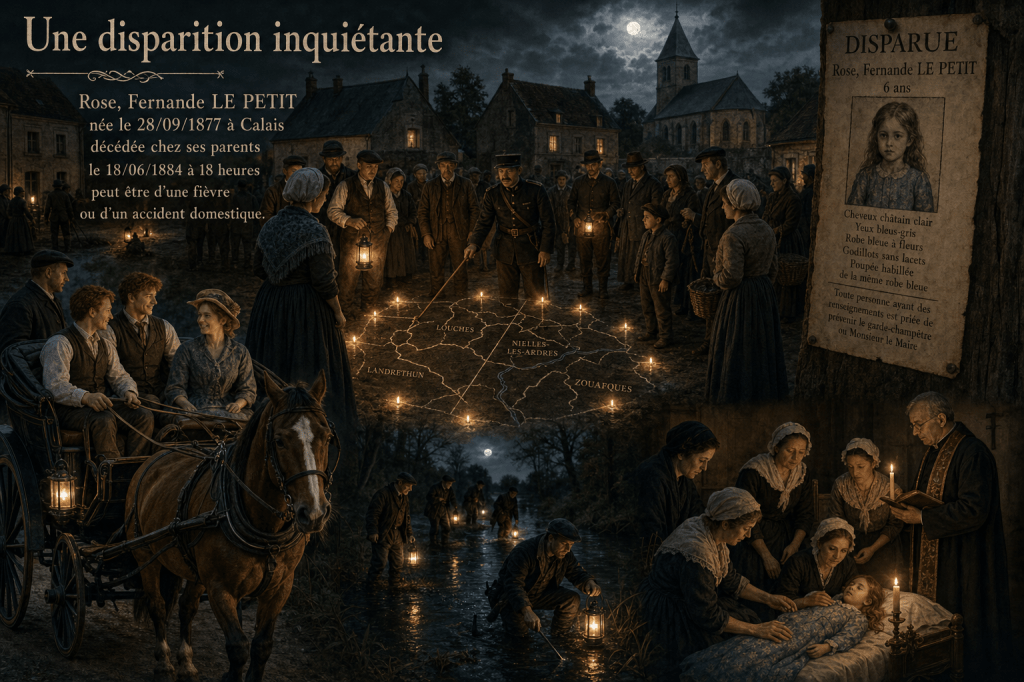
Postscript: Rose Fernande LE PETIT was born on the 28th of September 1877 in Calais. She died at her parents’ home on the 18th of June 1884 at six o’clock in the evening, perhaps from a fever or a household accident.

