
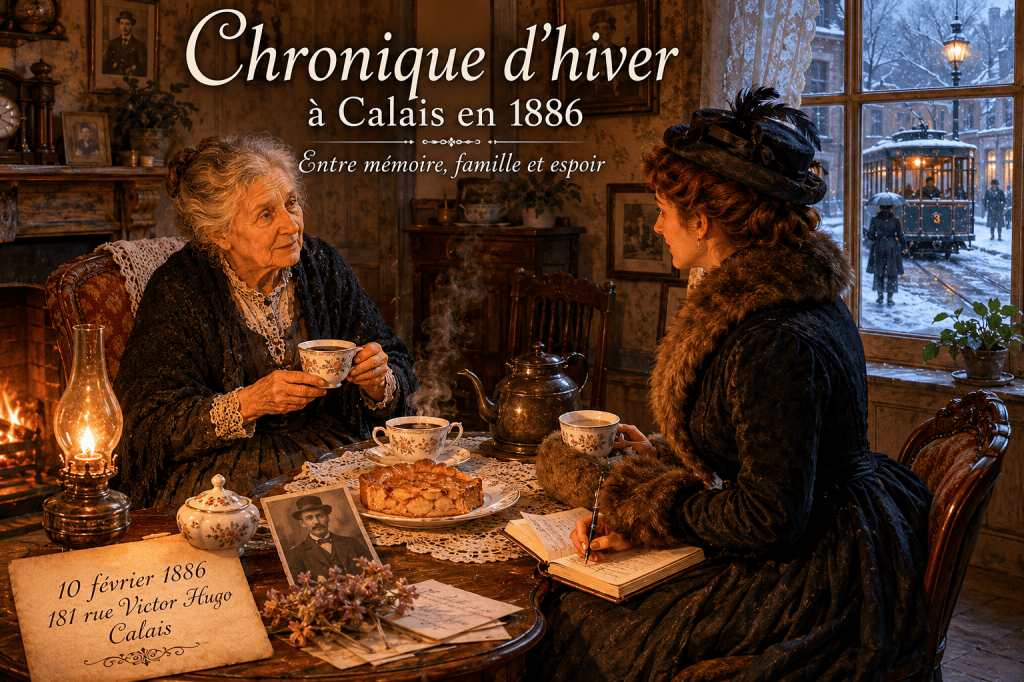
No snow this winter, yet a bitter cold has gripped the town since mid-October. The fountain in the park lies trapped beneath the ice. The water, frozen in its fall like stalactites, seems desperately to seek its way back to the basin glistening beneath the pale winter sun. I have received troubling news from Geneviève, the wife of Charles the gardener. Since her husband’s death, she has merely existed, longing to join him. I arranged to visit her this 10th of February 1886 at her home, 181 Rue Victor Hugo in Calais. The tram tracks must surely have been cleared by now ; I can finally set off. Despite my heavy coat, fur muff, and ankle boots, I am freezing. Every step is a challenge against gravity itself.
I climb aboard the tram and settle inside. I smile at the woman standing upon the platform ; despite her mittens, her fingers are blue from the cold. She punches tickets all day long. Street after street, the same scene repeats itself. Mounds of blackened ice line the roadsides. Hunched against the cold, the few passers-by hurry through the storm. Rue Jacquard, Rue Lafayette, Place de la Nation, and finally Rue Victor Hugo — I have arrived.
I knock. A young woman of about thirty opens the door. From the back of the room, I hear :
“Come in, Mademoiselle Rose.”
Geneviève is waiting for me. With difficulty, she rises from her armchair and comes towards me, smiling warmly. She vaguely remembers having met a certain Mademoiselle Rose many years ago, though surely it cannot be me. She quickly dismisses the thought.
“It was my youngest daughter, Marie-Julie, who opened the door to you. She lives only a few houses away with her husband, Edouard VANDENBROUCQUE, and their thirteen children. They take very good care of me, you know! She has plenty to do with all those little ones ; I do pity her. Please sit down, Mademoiselle Rose.”
Two steaming cups of coffee await us, along with an apple tart baked by her daughter. What has become of the lively young woman who welcomed me so many years ago? Time has left its marks upon her body, her heart, and her soul. Her face stiffens ; she sinks deeper into her armchair, raises her eyes towards me, forces a smile, and says softly :
“You know, I have lost children… and my dear Charles François. My daughter Marie-Charlotte died in 1845. She was only fourteen, poor child. Then my eldest son, Charles François, left us in 1876 at the age of forty-six. My daughter-in-law raised her children alone after that ; she showed great courage. And in November, it will already be five years since my Charles François died. He was a good and hardworking man. Every summer, I received my bouquet of flowers. Not always cultivated flowers, but always a magnificent arrangement. To tease me, he pretended he had forgotten, and I pretended to be angry. It was our little ritual. He is so terribly missed. We were two old souls, two inseparable companions who still knew how to love one another.”
Great tears roll down her cheeks. I let her regain her composure.
“You have beautiful children and, it seems, an entire army of grandchildren!”
“Indeed! My eldest son and his wife Catherine had seven children ; Louis and Henriette had seven as well ; Pierre and his Irish companion Catherine had five ; Charles, for his part, had three children who did not survive with his Irish wife Mary Ann. He later had six more with Eugénie Hamblot. Mary Ann disappeared — gone, no one knows where, perhaps back to her own country — but my Charles cannot marry his companion until he receives news of Mary Ann. And my youngest daughter with her thirteen children… can you imagine it? Forty-one grandchildren! And four great-grandchildren!”
“You must feel fulfilled ; your descendants are assured.”
“And we are going to populate England! Pierre and Charles have gone to live in Nottingham. Charles left with his wife and children. For Pierre, it is different. He lodges with a family, while his two sons are in boarding school. Without a wife, life is difficult.”
“No more dark thoughts, Geneviève. You must live for your family and cherish the memory of the happy moments shared with your dear Charles François.”
We continue speaking for quite some time. The apple tart is delicious. Marie-Julie absolutely must give me the recipe! Geneviève promises she will send it to me. She smiles, gazes at the photograph of her beloved husband, sighs deeply, then looks at me and says :
“You are right, Rose. I must live for my family. Thank you.”
The cold has intensified beneath a polar wind. I cling to the wall and move forward metre by metre. I struggle against the gusts ; my coat is pressed tightly against my body, and my hat threatens to blow away at any moment. I shelter in the doorway of a building, waiting for transport that never comes. Tired of waiting, I walk a little farther and step into the post office. I ask them to send for a carriage. About ten minutes later, a coachman opens the door :
“Is this where I am meant to collect someone?”
“Yes, that would be me.”
The kind man helps me into the carriage. More than once, the horses slip upon the ice, but they hold firm and bring me safely home. I pay the fare, climb upstairs, and prepare myself a scalding cup of tea. A poke of the fire iron stirs the embers back to life, another dry log for the flames, and finally my dear armchair.
As promised, Marie-Julie came to visit me. She was overjoyed : her mother had found peace again. She asked to see her grandchildren and had even begun humming to herself once more. The visits continued until that 22nd of February, when Marie-Julie came to tell me that her mother, Geneviève DUBOIS, widow of POINTEZ, had gone to join her father. She passed away gently and peacefully, surrounded by her children and grandchildren.

