The rain settled in for the entire day, fine and persistent. It tapped gently against the windows and accompanied the silence of the house ; at my writing desk, I am surrounded by papers that I leaf through without truly reading, for they all seem to say the same thing without ever telling me what truly matters.
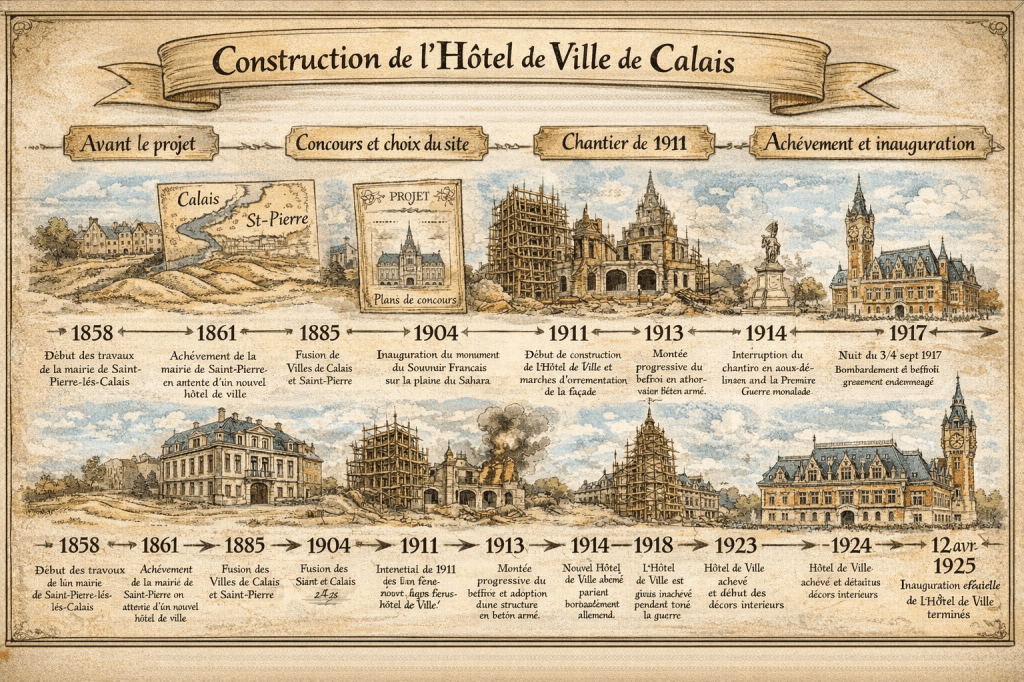
They speak of the Town Hall of Calais, of that idea born from the desire to unite what had until then lived separately ; as the pages pass before me, I see two towns being brought together, gathered into one, almost forced to become a single entity, and already the need for a common place appears, an administrative heart capable of embodying this new union. The documents speak of projects, competitions, carefully drawn plans, ambitious façades, towers, and grand perspectives ; behind those lines of ink, I sense the pride of a town searching for its place, eager to assert itself, yet I also feel hesitation, expectation, as though nothing were quite ready to be born.
Then comes the choice of the site ; an empty, almost hostile space situated between the two communities, a stretch of sandy land known, perhaps with a touch of irony, as the Sahara Plain. The name alone stops me ; it evokes silence, emptiness, a blank page upon which everything remains to be written.
I continue, striving to follow the thread of those passing years without ever lifting myself from the paper ; an architect appears, his intentions become clearer, the lines grow surer, the project finally seems to take shape, and yet nothing truly lives ; everything is precise, everything recorded, everything exactly where it should be, yet nothing breathes, nothing pulses with life.
I let the sheet fall back onto the desk, weary ; “No,” I whisper, “this is not how one tells the story of a birth,” and already the room feels too narrow, too crowded with frozen words refusing to become a true story. I need air, movement, perhaps even time itself.
I rise, take my shawl, and step outside ; the damp air greets me at once, the rain has stopped, yet it has left behind a grey, diffused light, almost unreal. The cobblestones glisten, silhouettes pass one another without exchanging glances, and I walk on without thinking, as though guided by something I no longer even try to understand.
I know now that I did not come here by chance.
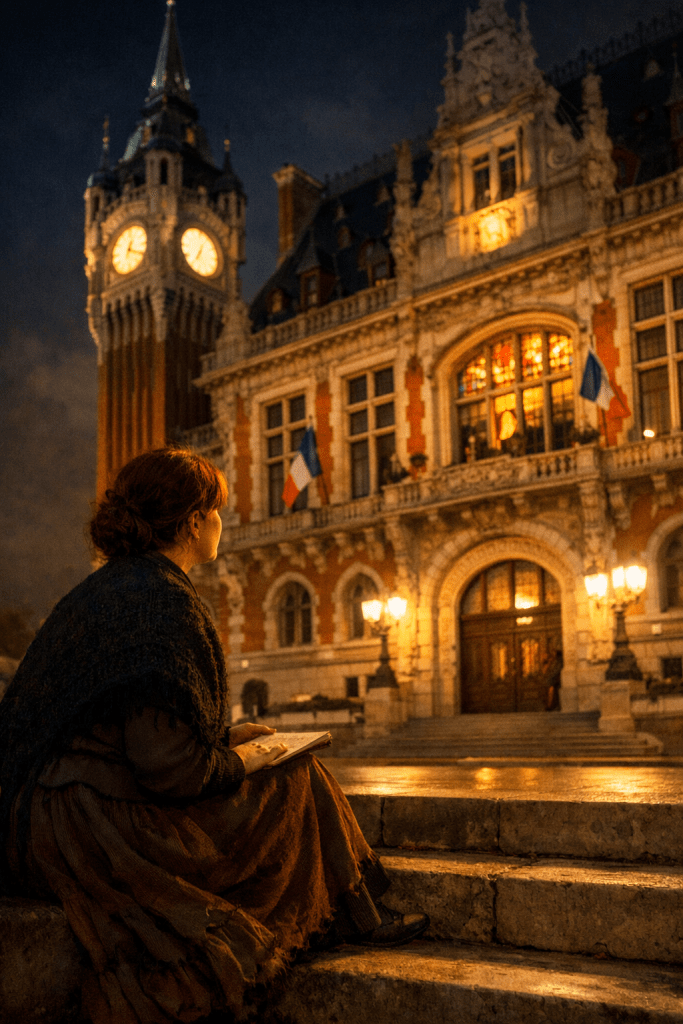
I walk slowly beneath the great façade of red bricks. The glow of the streetlamps slides across the stone and makes the shadows of the Flemish gables dance.
I stop.
There is something strange tonight, almost like a whisper.
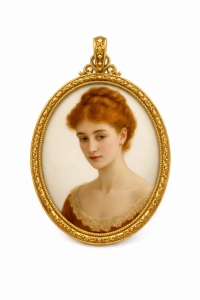
“Mademoiselle Rose!”
I turn abruptly. No one. Perhaps the wind?
“Mademoiselle Rose! Do not look behind you — I am in front of you.”
I raise my eyes. The belfry stands against the dark sky, immense and silent.
“Who… who is speaking?”
“I am.”
A silence. Then the voice returns, deep yet gentle at once.
“I am the house of this town, of these two towns. I am the Town Hall of Calais.”
I remain still. After all, during my journeys backwards through time, I have already heard ghosts speak, memories whisper, and even old stones murmur. So why not a town hall?
“What do you wish to tell me?”
The wind glides along the façade.
“I simply wish to tell my story, for very few people truly know it.”
I sit upon the steps leading to the square, my notebook ready.
“I am listening.”
“My story begins in 1885. That year, two towns decided to become one : Calais and Saint-Pierre-lès-Calais.”
“Yes, I know.”
“But they did not yet possess a common home. So I was imagined. I was drawn. Architects sketched my first forms upon sheets of paper. Yet I remained shut away inside boxes for many years. Time passed, and still I did not exist. Until at last an architect gave you life?”
“Yes. Louis Debrouwer. He imagined my red bricks, my Flemish gables, and my belfry.”
I lift my eyes towards the great tower.
“You are proud of him?”
“Very.”
A faint breeze crosses the square.
“Then one morning in 1911, I heard the first blows of the pickaxes. They were digging my foundations into the sands of the Sahara Plain.”
I close my eyes and picture the workers, the carts, the scaffolding.
“But my story was not a simple one.”
The voice grows deeper.
“In 1914, the hammers fell silent. War came. For years I remained there unfinished, like a sleeping giant. And one night in 1917, a bomb fell near my belfry…”
Silence stretches for a moment.
“Were you afraid?”
“Stones do not fear, Mademoiselle Rose… but they remember.”
The wind makes the flags tremble.
“When peace returned, the workers returned as well. They repaired my wounds and completed what they had begun.”
I smile softly.
“And then came 1925.”
“Yes.”
The voice now seems almost happy.
“On the 12th of April 1925, crowds gathered before me. Music played, speeches echoed beneath my glass roof. That was the day I was truly born.”
I close my notebook. The square has fallen silent once more.
“Thank you for entrusting me with your story.”
The wind blows one final time against the façade.
“And thank you, Mademoiselle Rose, for being one of the few who still listens to old stones.”
I rise. Before leaving, I cast one last glance towards the belfry watching over the town. And I wonder how many other stories still sleep within its red bricks.
The wind passed softly between the stones. I lifted my head.
“I have something to tell you.”
The silence deepened, attentive.
“I am listening, Mademoiselle Rose.”
Slowly, I unfolded the paper ; suddenly it seemed strange to read aloud what, for her, still belonged to the unknown.
“In one hundred years… in one hundred years, they will celebrate you.”
A faint tremor passed across the façade, almost imperceptible, like a held breath.
“They will celebrate your inauguration, the one from 1925 ; they will speak of you as a symbol, a landmark, a witness to the history of the town. The inhabitants will come, and visitors too ; they will pass through your doors, climb your great staircase, raise their eyes towards your belfry… and they will say that you are beautiful.”
The wind stopped.
“They will cast lights upon your walls, images will dance across your façade, as though telling the story of what you have become ; they will open your halls, guide visitors through them, explain your history.”
I paused for a moment.
“And then?”
I smiled faintly.
“At last, they will engrave upon your pediment the words that had never been inscribed there before : Liberty, Equality, Fraternity ; one hundred years later, they will complete what had remained unfinished.”
The silence that followed felt different, denser, almost filled with emotion.
Then the voice returned, softer still :
“In one hundred years!”
Within those words, I sensed a slow understanding, as though time itself were unfolding before her.
“So… I shall still exist?”
“Yes.”
“And they will remember me?”
“Yes.”
A breath of wind passed along the façade, deeper now, almost like breathing.
“They will see my stones, but will they know what I once was before?”
I lowered my eyes.
“Perhaps not all of them. But some will listen.”
A silence, then :
“And you… will you still be there to remind them?”
I smiled.
“Perhaps. In another way.”
The wind rose gently once more, making the flags tremble.
“Then I shall wait for them.”
I remained there a moment longer, facing her.
“You know, they will not celebrate only what you are ; they will celebrate what you have endured, and what you represent for the people of Calais.”
Slowly, I folded the document once more.
Night now wrapped itself around the square, yet it no longer seemed dark to me.
Before leaving, I lifted my eyes one last time towards the belfry.
“Until one hundred years from now!”
And within the silence that followed, I felt certain she had understood.