For the past two days, I have been enjoying the return of fine weather by taking long walks. It is springtime. The air is mild, though the wind still carries a lingering chill. I breathe deeply, ignoring the smell of horse manure. The scent of iodine, the earth awakening back to life, the first leaves unfolding, the flowers still shyly opening their delicate collars.
I walk briskly towards the beach. The bridge leading to the Sea Gate creaks beneath the footsteps of countless passers-by. At last I reach the shore and continue all the way to the end of the pier. The wind is far stronger here. My hat is swept away and disappears into the sea.
I gaze at the vast expanse shaded in green, blue, and grey. The sun, as always, plays upon the waves. One moment crossed with golden light, the next plunged into darkness.
“Mademoiselle! Mademoiselle!”
I turn around. A man with a crimson face, sparkling eyes, and a broad smile is calling out to me.
“This hat belongs to you. I saw it fall. It is in rather poor condition, but a milliner will surely be able to repair it.”
“Thank you, sir. Please wait — your effort deserves a reward!”
“No, no, Mademoiselle! It was my pleasure to help such a charming young lady.”
“Thank you, my good man.”
He spoke French, yet I recognised the trace of an accent, softened by two generations spent in France.
Tired, I take the omnibus home. I collapse into my armchair.
I fall asleep.
Where am I?
I have consulted no documents, why?
I gather my senses. The place is enormous. The fading daylight enters through immense glass roofs that form the ceiling. I move forward slowly. Vast shadows unsettle me, yet I continue step by step.
I am inside a sculptor’s studio.
Human-sized sculptures wait for the hand of their master. I approach a table. Fragments lie scattered there: an enlarged hand, disproportionate, its fingers clenched; a head with hollow eyes; a bare torso still marked by the grooves of the sculptor’s tools.
That head with eyes hollowed by exhaustion or fear… that hand!
I move towards the statues.
I know!
I am in Auguste Rodin’s studio!
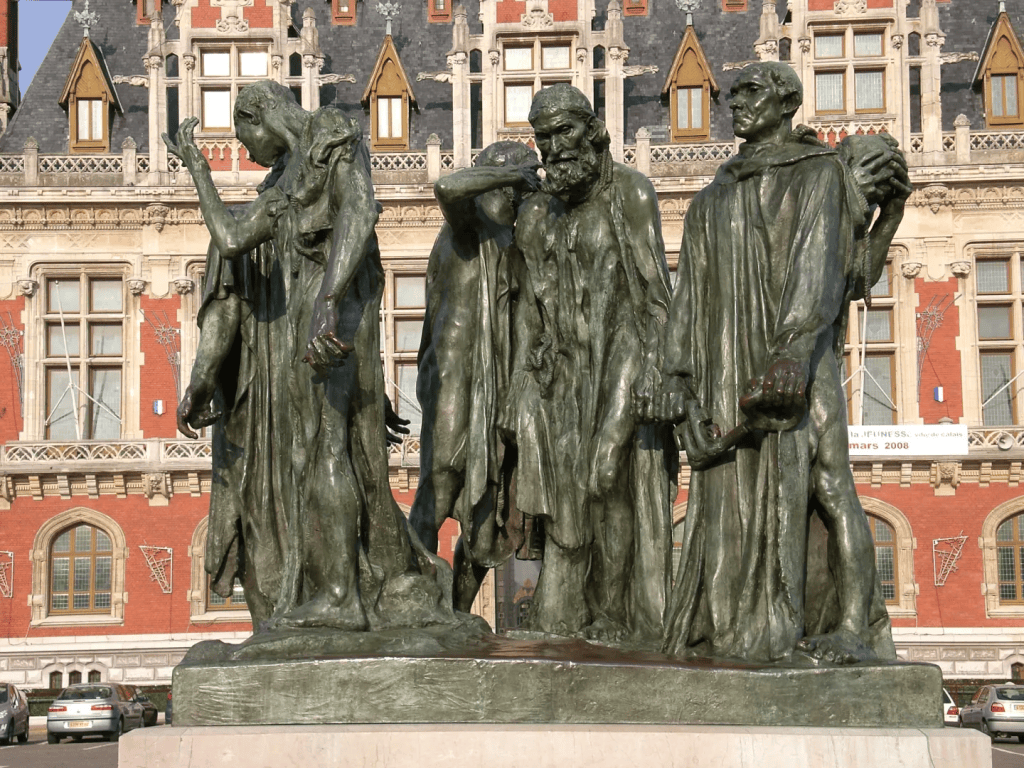
The Burghers of Calais!
Eustache de Saint-Pierre, Jean d’Aire, Jacques de Wissant, Pierre de Wissant, Jean de Fiennes, and Andrieu d’Andres.
I remove one glove. My hand gently follows the outline of a face, a shoulder, the rope of execution, the key.
Footsteps approach me.
He is tall and powerfully built, yet his face is calm. He looks at me as though I were an old acquaintance.
“Good evening, Monsieur Rodin. Please forgive me…”
“No, Mademoiselle Rose, certainly not! We share the same gaze, the same feelings towards these men.”
“Yes. They needed immense courage to walk towards death in nothing but their shirts, barefoot, stripped of all dignity.”
“Thank you, Mademoiselle Rose. You give me the courage to persevere.”
“May I ask how this work came into being?”
“With pleasure. Follow me. My office will be more comfortable.”
A small room. A table cluttered with papers of every kind. Chairs. A small side table holding an oil lamp. He gestures towards a seat beside the cabinet and settles near me.
“The story of this commission is far more complicated than most people imagine. In September 1884, the municipal council of Calais first envisioned a monument dedicated mainly to Eustache de Saint-Pierre. Then, in January 1885, I was chosen. I refused to reduce the episode to a single hero. I decided to represent all six men together, inspired by Froissart’s account. That choice itself was already a break from what many of the commissioners expected. They imagined something far more traditional, centred upon one dominant figure.”
“I can well imagine the discussions between you and those gentlemen! To achieve such a result, you must have created several models.”
“Indeed. The first small model showed a group more in keeping with what a municipal committee might expect. The figures advanced more as a united group, with Eustache at the front, within a composition still recognisable according to the conventions of nineteenth-century public monuments.”
“I have the feeling that was not enough!”
“Indeed not, Mademoiselle Rose! My contract required me to present a second model before the final execution. Yet meanwhile I had profoundly reworked the entire project. In this second version of 1885, each figure became far more individualised. I abandoned the simple heroic reading and gave each man his own relationship with fear, courage, despair, or resignation.”
“The reaction of those gentlemen must have been extraordinary!”
“The commissioners found the men too burdened, too defeated, not glorious enough. According to them, this was not how they imagined their ‘glorious citizens’ marching towards the camp of the King of England.”
“You did not give in. And afterwards?”
“The officials did not want the six figures to stand at the same level, at human height. Then the pedestal became another source of disagreement. It was far too high for my liking. I wanted them to be seen by everyone, for the people of Calais to identify with them, to walk beside them. The negotiations lasted ten years — yes, ten full years: financial difficulties, and always that endless discussion about each figure’s place. During all that time, I continued working. I studied them, refined them one by one before finally bringing them together.”
“And in the end, you prevailed!”
“Not entirely. The pedestal was designed by Ernest Decroix, higher than I had wished. My work was finally installed in 1895.”
“I am honoured to have met you, and I thank you for the precious time you have granted me.”
“And I thank you for this equally precious interlude. You have restored my faith in myself. Like me, you see the human being imprisoned within the bronze. Travel safely home, Mademoiselle Rose…”
I never introduced myself, and yet this suspended moment between present and future brought us together.
I awoke slumped in the armchair that has witnessed so many of my journeys.
I make my way towards the kitchen. I am hungry!