
The fire crackles softly in the hearth. I have just closed my notebook when I sense, before seeing her, a presence in the room. It is not the first time.
The armchair opposite mine creaks ever so slightly, as if someone had carefully sat down in it. I lift my eyes. A woman is there. Slender, upright despite the weariness that seems to weigh upon her shoulders. Her simple black dress reveals the passing years more than mourning itself.
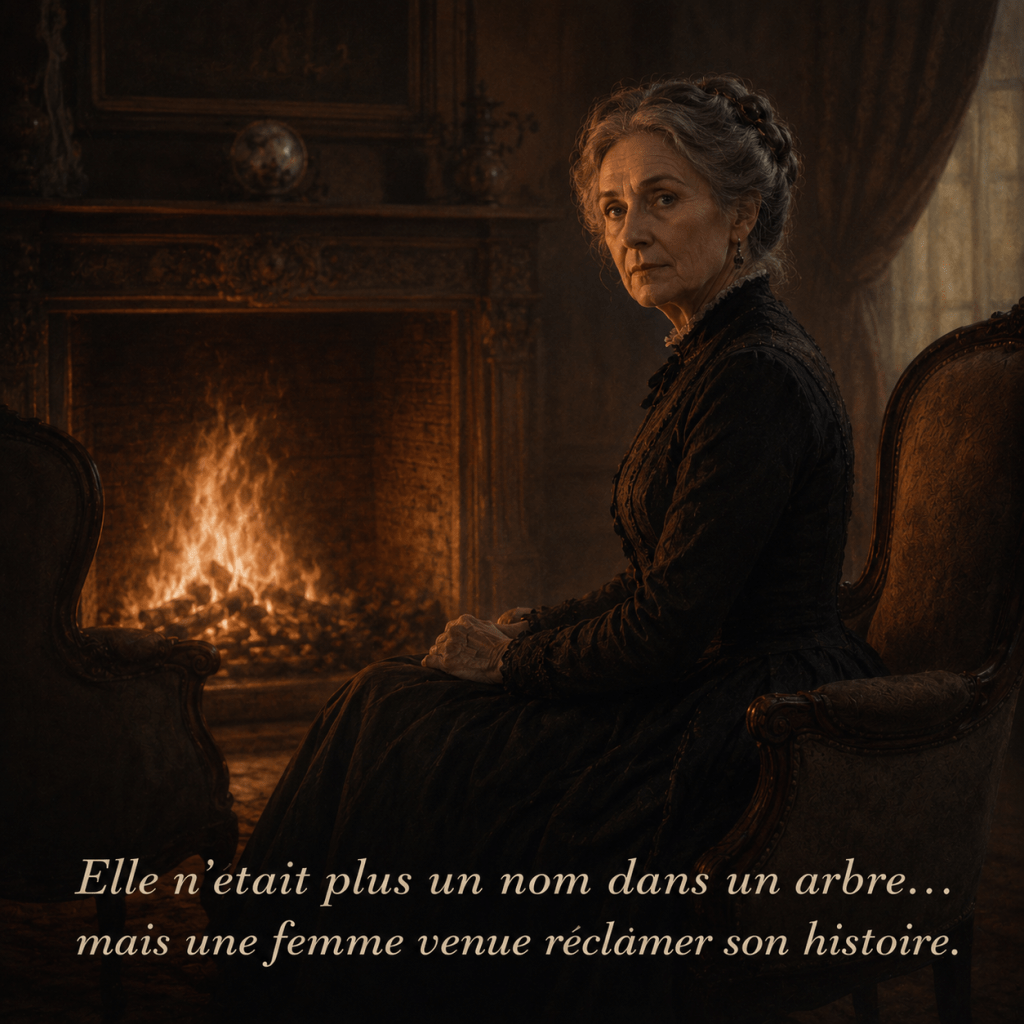
“Are you Miss Rose?”
Her voice is soft, tinged with an accent I recognize immediately.
“And you are Ellen Wint.”
A faint smile lights up her face.
“I was afraid you would not recognize me.”
I study her in silence for a moment. There is something deeply unsettling about her. As though several lives had been layered upon one another without ever truly blending together.
“People say many things about you,” I finally tell her. “London salons, fox hunts…”
“Oh! Stories travel much better than truth.”
She turns her head slightly, as if looking at a past I cannot see.
“I was a well-born young woman, yes. But that protects one from nothing.”
Silence settles between us, warm, almost companionable.
“Tell me about him,” I dare ask. “Your first husband, Patrick Beckett Bellew.”
A shadow passes across her face.
“Patrick belonged to that shifting world of the sea, made of departures and absences. We buried a coffin; the sea became his shroud.”
I do not interrupt.
Her fingers tighten slightly on the fabric of her dress.
“He gave me my children. And for that, I cannot regret him entirely.”
The fire casts moving shadows upon the walls.
“And Georges?”
This time, her face brightens differently. With a softer light.
“Georges!”
A sincere smile, almost fragile.
“He was love. True love. We believed… we believed America would offer us a new life.”
“And?”
She lowers her eyes.
“It mainly taught us that hope is not enough.”
I rise and take a few steps. I see her differently now. No longer as an heiress, but as a woman who endured.
“You worked in Calais.”
She nods.
“A tullière. For hours I checked the work of the tullists. Centimeter by centimeter I examined that beautiful fabric, searching for a hole, a broken thread.”
A discreet smile.
“Can you imagine? Me…”
“Yes! I can imagine you very well.”
She looks at me, surprised.
“It was not a fall,” I continue. “It was strength.”
Her eyes shine slightly.
“I was afraid,” she whispers.
“Of what?”
“Of not succeeding. Of losing him, of losing everything.”
I understand.
“You begged for him to be treated.”
She closes her eyes for a moment.
“Love makes us humble, you know. Medicine could do very little. He left me far too soon. Fifty-seven years old! Can you imagine? Five years passed before I could join him.”
The fire slowly dies down; quickly, I add another log.
I feel the moment coming to an end.
“Your children?” I ask softly. “They refused your inheritance?”
She nods.
“There was nothing left to pass on. Perhaps only debts.”
Then, after a silence:
“But that is not true, is it?”
I smile.
“No. Your story remains.”
She rises.
Her figure becomes lighter, almost transparent.
“Then write it properly.”
“I promise.”
The armchair is empty once again. But this time, the room is not.
Ellen Wint is no longer a shadow in a family tree. She is a voice, a presence, a woman.
Ellen Wint (1840–1909) — Patrick Beckett Bellew (1831–1869) — Georges Le Petit (1846–1904)

