The dawn, clothed entirely in silver, draws gaunt shapes with elongated arms out of the mist. Then morning comes, and the pale silver slowly turns to gold. The fog lifts, the trees recover their outlines, and the landscape reveals itself. We have been travelling towards Paris for nearly two hours now. Hours and miles follow one another endlessly.
To my right sits a couple in their fifties travelling to the capital for their daughter’s wedding. They sit pressed close together, slightly embarrassed to find themselves among people dressed so elegantly. They have put on their Sunday best for the occasion. They speak softly and exchange knowing smiles.
Across from them, the atmosphere is quite different : a married couple united more by interest than affection, and another gentleman besides. The men speak of lace, trade, and money. From time to time, the younger man turns towards his wife and compliments her, yet the exchange remains cold and impersonal.
At this time of year, the cold grows sharp. I rest my face once more against the windowpane ; the conversations become murmurs, and the steady rhythm of the train draws me back into drowsiness.
The train slows. Hamlets, villages, and small towns become more frequent. We are approaching the capital.
“Paris! Paris! All passengers are requested to disembark!”
I obey, and an employee takes charge of my luggage. It is with great pleasure that I shall stay with Eugène and Geneviève Le Petit, though it is not they who greet me but their son Edgar, waiting upon the platform. Years pass ; time wrinkles faces and wears down bodies.
I have a great many pieces of luggage : one contains my personal belongings, another holds lace samples I must deliver to a merchant, and the third is filled with an entire assortment made from Calais lace : gown, veil, gloves, and more, all intended for Le Bon Marché. I had warned Geneviève beforehand ; a small storeroom has been placed at my disposal. Edgar hails a carriage. An extra coin is discreetly slipped into the driver’s hand.
As always, the welcome is warm. The servants take care of my trunks. The day passes peacefully while news from Boulogne is exchanged. The death of Joséphine, Eugène’s mother, earlier that year brings tears to Angélina and Geneviève’s eyes, while Eugène and Edgar clear their throats awkwardly.
I explain to my hosts that I must go to Le Bon Marché to deliver their order of lace garments and accessories. I must also bring the samples to one of the merchants, and afterwards I intend to visit the Mont-de-Piété in search of a beautiful chatelaine.
Morning has barely broken when I leave the Le Petit household. My trunk waits for me in the courtyard. Enormous. Almost disproportionate.
The servant helps lift it onto a fiacre. The wood creaks beneath its weight. Inside rest the delicate wonders of Calais lace, fragile masterpieces enclosed within a shell far too rough for them. I climb aboard in turn.
“To Le Bon Marché, if you please.”
The driver nods, and soon the wheels begin to move. Paris unfolds before me. The streets slowly awaken. Shopkeepers open their shutters ; merchants arrange their stalls. The scent of warm bread drifts through the fresh morning air. Women hurry along, while men are already discussing business.
At last, the carriage stops. I step down and lift my eyes.
Le Bon Marché rises before me, imposing, almost proud. Its windows capture the light and scatter it in a thousand reflections. Inside, an elegant bustle already reigns. My trunk is unloaded at once by two employees, with a mixture of respect and curiosity.
“This way, Mademoiselle Rose.”
I am led towards an office slightly removed from the activity. The man inside quickly raises his eyes towards me. The head of sales. Everything about him breathes precision : immaculate suit, sharp gaze, measured gestures.
“Mademoiselle, we have been expecting you.”
I incline my head slightly. The trunk is placed upon the floor. It is opened. The lace appears.
Even he cannot entirely conceal his reaction.
He steps forward, barely brushing the fabrics with his fingertips.
“Calais?!”
I do not answer.
He already knows.
The pieces are examined one by one. Nothing escapes his gaze : neither the delicacy of the patterns nor the perfect regularity of the threads.
“Your reputation is well deserved.”
A compliment, though delivered more as a fact.
Once everything is complete, the order is accepted. Approved.
I leave the store without my trunk. It remains there now.
I am taken to my next appointment. Paris is louder now. Denser. More alive.
I go to visit Monsieur Bertoux, a tulle merchant. Fever has confined him to his bed, so I bring him the samples myself. He is young — perhaps too young for the business he is trying to build. A certain hesitation accompanies his gestures, and though his clothes are carefully maintained, they still bear the marks of a modest life. He lives in a small attic room that he has arranged as best he can.
I had informed him of my visit by telegram. Proper etiquette requires that he wait for me at the entrance of his building. He invites me to take tea only a few steps away. The conversation is pleasant ; he is charming and full of humour.
We part company. He thanks me once again.
I return home.
That evening, we gather together in the sitting room. The fire crackles softly in the hearth. Its light dances across the faces. Shadows stretch along the walls. Geneviève embroiders. Angélina listens quietly. Eugène and Edgar speak in low voices.
“Did everything go well?” Eugène asks.
I lift my head.
“Yes. The order and the samples were delivered ; everything went perfectly. Thank you for your kindness.”
A comfortable silence settles around us.
Then, without truly thinking, I continue :
“I must go tomorrow to the Mont-de-Piété.”
Several heads rise at once. Geneviève frowns slightly.
“The Mont-de-Piété? For what reason?”
I gaze into the flames.
“To acquire a chatelaine.”
The word lingers for a moment in the air.
“One sometimes finds very beautiful pieces there,” I add calmly.
Eugène nods without pressing further.
The fire continues to crackle. Conversation resumes. I take my leave of my hosts and retire upstairs.
The following day, I make my way to the Mont-de-Piété.
At first glance, the place possesses nothing attractive. The walls are severe, the voices low, the faces closed. Everyone who comes here carries a story one can sense without it ever being spoken aloud.
And yet, I move forward with confidence.
I have not come here to surrender something, but to choose.
I am guided towards the display cases. Very quickly, my attention settles upon two chatelaines standing side by side, as though waiting for me.
The first is delicate, refined, almost discreet. A supple chain with elegant little instruments attached to it : scissors, a case, a hook — nothing unnecessary.
The second is bolder. The patterns are more intricate, almost daring. It captures the light, holds it, and brings it to life.
I take both of them in hand. Their weight feels perfectly balanced.
“I shall take these.”
The employee makes note of the purchase without comment.
A little farther away, another object catches my eye.
A vase.
Desvres earthenware.
Its colours are soft, slightly faded, as though time itself had left a delicate patina upon it. Floral motifs still dance across its surface despite the passing years.
I think immediately of Geneviève.
Of her hands. Her gaze. Her careful way of placing objects.
“And this one as well.”
I am about to leave when something stops me.
A silent call.
I turn my head slightly.
And I see it.
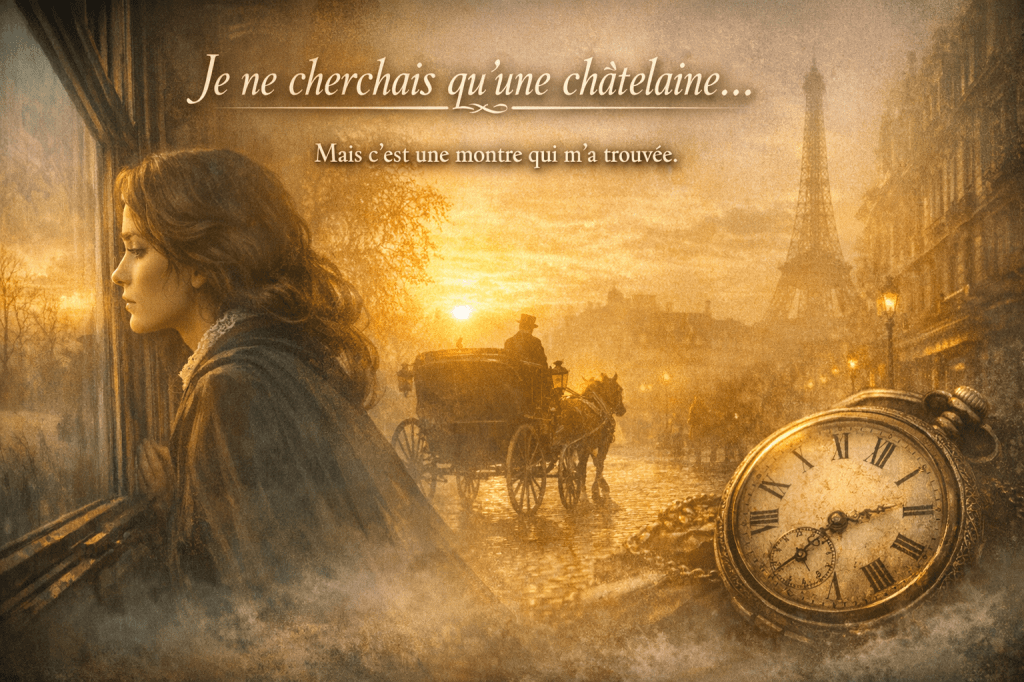
A watch.
It is not displayed prominently. Almost hidden away from the other objects. Yet it imposes itself immediately, like an undeniable certainty.
As though it had been waiting for me.
I move closer.
The sounds of the room slowly fade. Voices become distant. Even my own footsteps seem muffled. I stop before the glass case.
The casing is finely worked — too finely worked, too rich to be lying there.
And yet… I know.
I do not know how, but I know.
I did not come here for the chatelaines.
Nor for the vase.
I came for it.
“Does it interest you, Madame?”
The voice suddenly sounds behind me.
I start slightly. The employee stands there. I had not heard him approach.
“Yes. Very much. Is it for sale?”
A silence.
He glances around to make certain no one is listening, then answers in a lowered voice :
“No, Mademoiselle.”
His answer is firm. Final.
Yet his gaze is not.
“It is not meant to be displayed. Even less to be sold.”
I frown almost imperceptibly.
“Then why is it here?”
He hesitates. His fingers slide nervously along the edge of the counter.
“Because no one has yet known… what to do with it.”
A shiver runs through me.
Almost despite myself, I reach towards the glass, but he gently places his fingers upon it, stopping me.
“I beg you… do not touch it.”
This time, I look at him directly.
There is an unexpected gravity upon his face. Not fear… something deeper. Respect mixed with unease.
Silence settles between us, heavy and almost tangible.
Then, very softly, he leans towards me.
“If you wish to understand… meet me.”
“Where?”
“At the tea room on the corner of Rue des Saints-Pères. At half past six.”
He pauses.
“I shall tell you its story.”
My heart begins to beat faster.
“Why me?”
A faint smile appears.
“Because you saw it.”
At once, he straightens again, resuming his professional composure as though nothing unusual had happened.
“I wish you a pleasant day, Madame.”
I leave the Mont-de-Piété, but my steps no longer feel entirely my own.
Amid the turmoil of Paris, only one thought remains within me now.
That watch.
And the story it still refuses to surrender.
At the appointed hour, I push open the door of the tea room.
A gentle warmth immediately surrounds me. The air is filled with the scents of infused leaves and freshly baked pastries. Several ladies converse quietly, their gestures measured, their laughter discreet.
I see him immediately.
Seated in a corner slightly apart from the others, the employee from the Mont-de-Piété waits for me.
He rises as I approach, inclines his head, and invites me to sit.
“Thank you for coming, Mademoiselle Rose.”
I do not answer immediately. My eyes search his.
“That watch…”
He nods slowly.
“Yes. It is time that someone listened.”
A silence.
Then he begins.
“In 1858, a young boy named Jasper walked through the door of a watchmaker’s shop.”
He spoke softly, yet each word seemed carefully weighed.
“He carried a pocket watch in his hands. His father’s watch. It no longer worked. The child had saved coin by coin to have it repaired. He wished to return it to his father, like a recovered treasure.”
“His fingers clutched tightly around the chain. His eyes full of hope.”
“A few days later, he returned to collect it.”
The man pauses.
“But on his way home, a policeman stopped him.”
“How could a child dressed so poorly possess such a fine watch? The conclusion was reached quickly. Far too quickly.”
“They accused him of theft. He was taken to the station.”
The tea room seems to drift farther away. Voices become distant.
“The interrogation began. The child denied everything. Again and again.”
“Then came a slap.”
“One slap too hard.”
“Jasper never stood up again.”
I close my eyes for a moment.
“Behind the police station there was a construction site. That very night… the policeman buried the child there. As one buries a mistake.”
The ticking of a clock somewhere within the room suddenly feels unbearable.
“For years, his father searched for him without ever understanding what had happened.”
He resumes, even more slowly.
“In 1875, building works uncovered a small body. The investigation was reopened. The archives were examined once more. A missing child notice. The arrest of a young boy. The connection was quickly made. They found the policeman. One of their own.”
Nearby, a teacup is placed down with a faint clink. The world continues as though nothing had happened.
“In his room… hidden at the back of a cupboard… they found the watch.”
I whisper almost involuntarily :
“Jasper’s watch?”
“Yes.”
He leans slightly closer.
“His father recognised it immediately. He still possessed the documents. The watch had belonged to the family for years.”
He pauses again.
“In 1814, Jasper’s grandfather had saved an officer during the Battle of Arcis-sur-Aube. In gratitude, the officer had given him the watch.”
“Inside was an engraving : ‘To Jules, the hero who saved my life.’”
A long silence stretches between us.
“The murderer was tried. And guillotined.”
I remain motionless. The tea before me has grown cold.
“And the watch?”
He looks at me for a long moment.
“It never left Paris. Some say it stops from time to time.”
I slowly raise my head.
“At what hour?”
He hesitates.
“At the hour when Jasper joined other heavens.”
When I leave the tea room, night has fallen. Lanterns cast faint light upon the streets. Paris murmurs softly.
Yet deep within me, something remains unsettled.
Like the ticking of a clock that does not belong to the present.
Night is already well advanced when I return to the Le Petit house. The streets of Paris still glisten with the dampness left by the day. Lanterns cast trembling, uncertain light upon them.
I climb quietly to my room. Silence greets me. I remove my gloves, lay down my coat, yet cannot rid myself of the strange sensation lingering within me — as though some presence had followed me from the Mont-de-Piété.
I approach the window. Paris breathes slowly beneath my gaze.
Then a sound.
Barely perceptible.
Tick.
I freeze.
Another.
Tock.
I turn abruptly.
Nothing.
My room lies in peaceful darkness. Everything remains exactly in its place.
And yet…
The sound returns.
Tick… tock… tick… tock…
My eyes move slowly across the room until they stop upon my trunk.
No.
It cannot be.
I move towards it almost despite myself. Each step echoes too loudly within the silence. The sound grows clearer. Stronger.
I place my hand upon the lid, hesitate, then slowly open it.
The lace rests neatly inside, white and fragile.
But the ticking does not come from the lace.
It comes from beneath.
Carefully, I lift the fabrics.
And my breath catches.
It is there.
The watch.
The same watch.
The one from the display case.
I step backwards.
No.
I did not take it.
I am certain of it.
I touched nothing.
And yet there it lies before me, as though it had always belonged there.
The ticking grows faster.
Or perhaps it is only my heart.
I extend my hand.
This time, nothing stops me.
The metal feels cold, yet not lifeless. A subtle vibration runs through my fingers, like restrained life itself.
I open it.
The mechanism beats steadily. Relentlessly.
Then suddenly
The second hand stops dead.
Silence falls.
And within that silence, an image.
Brief. Violent.
A dark room. A child. A frightened gaze.
A voice denying everything.
A hand rising
I drop the watch.
It snaps shut by itself with a sharp click.
I step backwards, breathless.
“Jasper?”
The name escapes my lips without my understanding why.
The ticking resumes.
Slower now.
Deeper.
As though it no longer measured time itself, but merely waited.
I do not sleep that night.
At dawn, one certainty remains.
The watch did not return by chance.
It does not wish to be kept.
It wishes to be heard.
“Trust me… I shall tell your story. I shall turn it into a new tale. I shall have it printed and carry it with me throughout my travels. No one will ever forget little Jasper… nor his heart of gold.”
Silence falls once more.
When I open my eyes again, the watch is gone.
Vanished.
As suddenly as it had appeared.
I do not try to understand.
I shall keep my promise.
My heart has grown calmer. Life resumes its course… yet I now know that certain objects do not belong entirely to the world of the living.
And that this one will always find its way back to me, should its story ever be forgotten.
The following two days are devoted entirely to my hosts. A visit to the Louvre, a meal at a restaurant, a walk along the Seine. I offer one chatelaine to Angélina… and the vase to Geneviève.
Then I board the train once more towards home, my heart lighter, yet forever marked by the ticking of a past that refuses to fall silent.
The parents : Eugène Théodore Florent Le Petit (1820–1901) & Geneviève Deseille (1819–1900)
The children : Edgar Ferdinand Adolphe Le Petit (1845–1918) & Louise Eve Angeline Le Petit, known as Angélina (1853–1929)
All other characters are products of Catherine’s imagination.

