
The night had been short. I had been tossing and turning for quite some time now; Morpheus had deserted my bed. I got up. It was barely seven o’clock.
I stirred the fire and lifted my head. A thin layer of dust covered the mantelpiece. After enjoying a hearty breakfast, I swept the floors, dusted the furniture and ornaments of the fine particles left by the fire, and polished the wooden floors. I scrubbed the bathroom, washed and dressed, put on warm clothes, and decided to take a walk toward the beach.
Yes, it was December and cold, but a few degrees below freezing would certainly not stop me from enjoying my walk.
As I approached the outer harbor, I noticed something rather large floating in the water. I moved closer. The shape drifted slowly with the current.
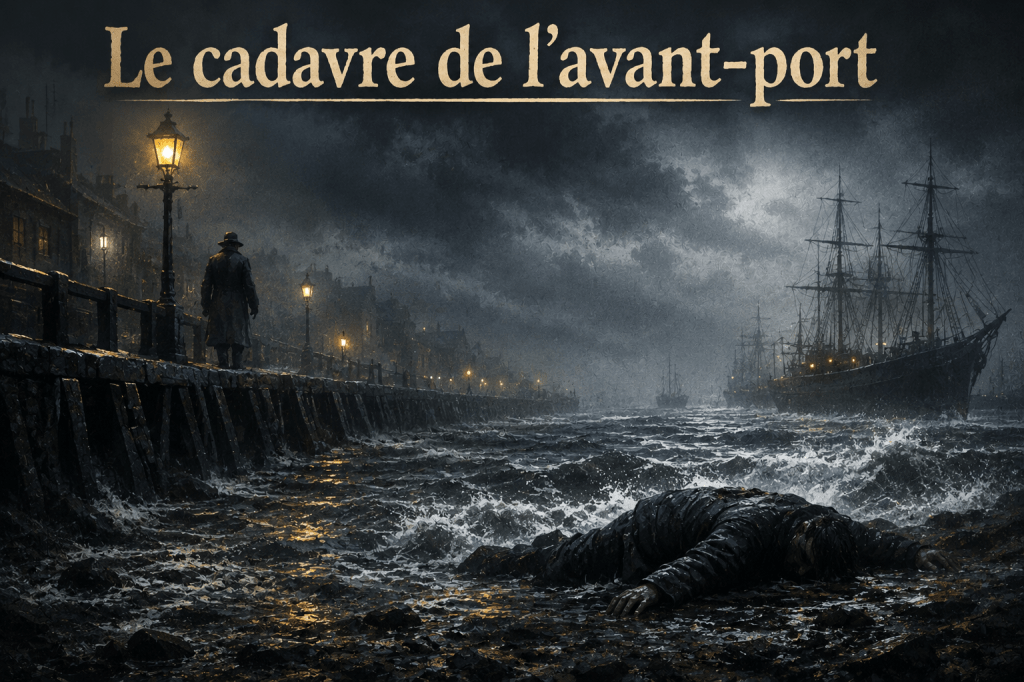
Standing near the water’s edge, my fears were confirmed. It was the body of a man. I looked around me. No one.
I ran toward the hotel, certain I would find a telephone there, and called the police.
The officers pulled the man from the basin, and a doctor was summoned for the usual examination. He stated that the body had likely remained in the water for a good month. Therefore, the man had probably died sometime in November.
Commissioner Alfred COUILLU brusquely sent me home. A woman involved in a police investigation? Certainly not! Women belonged in the home!
I did not even attempt to argue, but instead made my way toward the harbor office. If someone had been reported missing at sea, it would surely have been there.
The clerk consulted the registers.
There had been around twenty disappearances during the past two months. Fishermen, passengers, and even crew members had vanished at sea.
The official handed me the list and promised not to mention a word of it to the police.
With the documents tucked under my arm, I returned home.
The pleasant smell of soap and cleanliness delighted my senses. I put away my coat, bag, and shoes, slipped into my slippers, adjusted a shawl over my shoulders, prepared some tea, and settled beside the fire.
I allowed the warmth to envelop me, sipped my drink slowly, and granted myself a few moments of rest.
I examined my list, crossing off the women, children, elderly men, and anyone bearing distinctive features.
Our unknown man could not have been more than thirty-five years old. He worked, certainly, but his hands were not rough enough for manual labor.
Seven names remained.
Reluctantly, I ventured outside again and headed to the post office to send a telegram to the harbor of Folkestone.
No one asked unnecessary questions. They knew my interest in England and its people.
After running a few errands, I returned home.
The rest of the day would drag on, but I had no choice except to wait until tomorrow.
Early the next morning, an idiot rang my bell as though his life depended on it.
Old Sidonie, my tenant, opened the door and fiercely scolded the intruder.
It was Commissioner COUILLU.
But no matter! He had no right to wake the whole house.
He stormed up the stairs four at a time, shoved me aside, and entered my apartment.
He questioned me, scolded me, and forbade me from taking any interest in his investigation.
I knew men like him all too well — arrogant chauvinists, convinced women had no brains.
So I played the obedient little woman.
I complimented him, promised with a smile to behave myself and stay out of trouble.
He left, reassured in his self-importance.
Two hours later, the post office clerk knocked gently at my door. He brought me the reply from England.
Of the seven missing men, three matched the description given by the doctor. The addresses of their families and employers had been included.
I sat down at my writing desk and began drafting letters to the six correspondents. After so many years, I had become quite fluent in Shakespeare’s language — a skill our dear police commissioner most certainly did not possess.
I called for a courier. For a few coins, he would mail my letters and bring me both French and English newspapers.
Half an hour later, the young man returned with my precious newspapers.
I cleared the small table, laid out my periodicals, placed a record on the graphophone, prepared some tea, and settled comfortably into my chair.
Nothing in the French papers.
But in England, in Heworth, there was a story: a man employed as a stoker aboard the steamship Bronchill had disappeared at sea around November 18th, 1892.
This must be our dead man.
Nearly a month had passed between November 18th and December 20th.
Mrs. Mary Ann WHEATHEY had left the telephone number of her landlord.
I probably had a lead.
But I would have to wait until tomorrow.
Mrs. WHEATHEY sensed that her son was dead. She knew his attraction to alcohol and feared the worst.
She informed me that the Bronchill would be arriving in Calais on December 23rd — tomorrow.
I promised to visit the crew and call her back.
The day dragged by.
I went to visit little Émilie, who was heavily pregnant.
She had fallen under the spell of a handsome soldier who had come to visit his family. She had believed him when he swore he loved her for life and promised he would marry her.
At the end of his leave, he had gone away without turning back, without a glance for the child he had left behind in her womb.
Now she endured the scorn of old gossips, respectable mothers, and even the parish priest, who no longer wished to see her in his church.
Her parents had not thrown her out, but she had been forced to remain hidden at home.
When the baby was born, she would place him in an orphanage.
She walked me to the door, offered me a pale smile, and thanked me for coming.
The wind had calmed, and I made my way through the park toward my apartment.
I went to bed early, but Morpheus was slow in coming.
Tomorrow I would know.
Tomorrow.
It was nearly eleven o’clock when I headed toward the harbor.
The Bronchill was at the dock.
I announced myself and was received by the captain.
He confirmed that a man had indeed been lost at sea on November 18th.
William WHEATLEY had been drunk — as he too often was — and on that day the sea had been rough.
He had vanished after being swept away by a wave.
The captain also revealed that William had a burn scar on the left side of his back.
I thanked him for all the information and made my way to Dr. PETITPAS’s office.
I shared everything I had gathered in both France and England.
The good doctor immediately called Louis BOSSU, the Public Prosecutor, and promised to send him the file by courier the following day.
I was pleased.
He had not gone through the police.
It was on March 23rd, 1893, that the body found in the outer harbor was finally given back its identity by decision of the Court of Boulogne-sur-Mer, presided over by Mr. Aimé PETIT, President of the Court.
Pas-de-Calais Departmental Archives: 5 MIR 193/61, pages 1593–1594
 A rebrousse temps généalogie