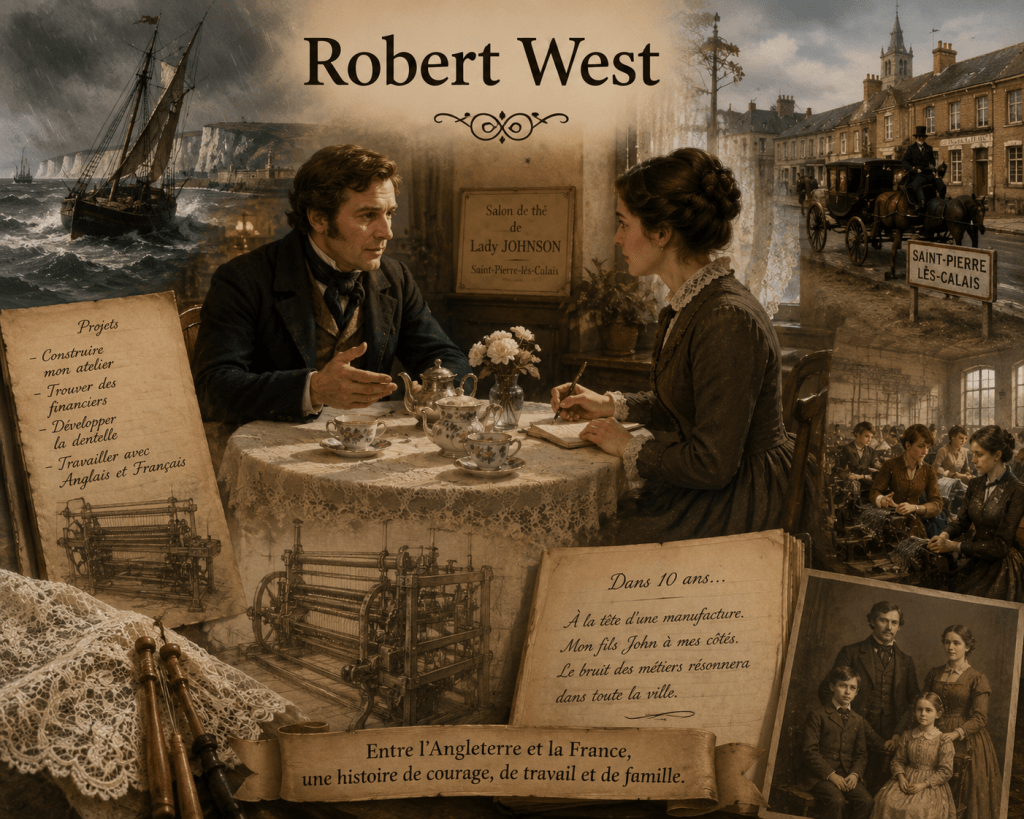
Appointment with a Relative by Marriage

Like Robert Webster, Robert WEST took every risk to come and work in Calais. He too crossed secretly from England to Calais and brought machinery and raw materials with him. For now, he works for WEBSTER, CLARK and BONINGTON.
On this Thursday evening, a carriage waits for me in front of Miss BONNET’s shop. In only a few words, the coachman explains that he must take me to Lady JOHNSON’s tea room in Saint-Pierre-lès-Calais. It is the end of October; bent beneath the gusts of an icy northern wind, both people and animals hurry to reach their homes or find shelter as quickly as possible. This morning the weather had been pleasant, but we are in the North, where the weather is always uncertain.
I shiver beneath my small riding coat. Quickly, I climb into the carriage. A blanket awaits me; I wrap myself in it and reflect upon my interview. Farmers are being driven out of Saint-Pierre-lès-Calais. More and more houses replace the fields, and the town grows larger every day.
Robert WEST helps me down from the carriage and apologises for having summoned me so unexpectedly. I stop him immediately; it is already very generous of him to devote his time to me.
We enter the tea room. A gentle warmth surrounds us. Lady JOHNSON seats us while an employee takes our order. I take the opportunity to ask for paper and pencils. I admire the delicacy and refinement of the English china cups. The delicious tea warms us pleasantly.
I am ready.
— Sir, may I begin asking you a few questions?
— With pleasure, Miss.
— Mr WEBSTER explained to me that you endured the same hardships and dangers as he did in order to settle here. How did the journey unfold? I should rather say, this adventure.
— Although spring had already arrived, we encountered a memorable storm. I lost part of my cargo and, several times, nearly went overboard. Fortunately for us, the fishing master handled his boat wonderfully.
— Fortune smiles upon you, and I am truly glad of it. You are currently working for Mr WEBSTER. What are your plans?
— I am looking for investors to build my first loom and establish a small workshop to begin with. I have far more contacts in England than in France; the French are still cautious about this novelty. My wife has joined me with our children and works in finishing. We live in a boarding house for the time being. I believe my brothers will come and help me for a while.
— Do you intend to use the same looms as Mr WEBSTER?
— Yes, for now. But I constantly keep myself informed about the latest patents in order to improve both the machinery and the quality of the lace. I have already contacted a dyer established in Guînes and a laundress in Marck. Labour is plentiful on both sides of the Channel. I am not worried; the future lies ahead of us.
— And in ten years’ time?
— In ten years, I shall be at the head of a manufacturing company. My son John will learn the trade at my side. The sound of the looms will echo throughout the entire town. Englishmen and Frenchmen will work together to preserve this lace-making tradition.
— Thank you, Mr WEST. Do not hesitate to renew this unexpected invitation once you are settled.
— You are most welcome, Miss. It will be with great pleasure.
He escorts me back to my carriage and helps me climb inside. One final wave of the hand, and the carriage jolts back toward Calais.
Night has fallen. The sky is heavy as lead. Beneath the force of the wind, the leafless trees seem to howl in pain, while the dust, usually so discreet, rises along the roads and creeps into everything.
Half an hour later, the coachman opens the carriage door for me. After a few words of thanks and encouragement to the gentleman, I hurry into the entrance hall of my building.
The fireplace gives off only a pale glow. I add another log, and soon the crackling fire and gentle warmth return. I warm a bowl of soup, adding crisp croutons, and eat my supper. Afterwards, I clear the table, remove the notes from my muff, and begin to write.
What Robert cannot possibly know is that his grandson James will one day marry a certain Marie Joséphine LAPOTRE. Her sister, Ursule LAPOTRE, will marry Charles BOUTROY. Their son Eugène will marry Blanche LE PETIT, the sister of my grandfather.
Blanche’s mother, Ellen WINT épouse LE PETIT, would remain very close to the English community of Calais.