It is half past seven in the evening when the doorbell pulls me from my reverie. I hurry downstairs. Sidonie, my tenant, unlatches her door, sees me, and retreats inside. I open the door : Ernest, the postman, has brought me a telegram. At this hour?!! He lives in the neighbourhood, so making a small detour does not trouble him, and besides, “it must be serious,” he tells me. I thank him warmly and go back upstairs. Anxiety tightens within me ; telegrams rarely bring good news. I carefully unfold the paper, fearful of tearing it. Joseph and Célina Le Petit are asking me to come as quickly as possible ; their little Pauline is gravely ill and calling for me. It is too late now — the last omnibus to Boulogne-sur-Mer leaves at eight o’clock.
Pauline is six years old, an adorable little girl with crystal-clear laughter and a lively intelligence. She knows who I am. I adore the tiny pout and the conspiratorial look she gives me whenever her mother questions me about my past ; she knows that I was born from the ink of a fountain pen upon the pages of a notebook. It is our secret.
What has happened to her? This summer has been particularly cold and rainy. Has she caught a chill? Cholera? No! Her parents would not have summoned me for that. The disease arrived in France in 1848 and still strikes in waves. Besides, they follow the recommendations of the English doctor John Snow : do not drink from fountains, boil water, for it spreads the illness.
I take a book and settle into my armchair. I cannot read ; my mind is too restless. I place a record upon the gramophone, that still-unknown machine I brought back from one of my journeys to the end of the century, yet the melody does nothing to calm my anxiety. The clock has just struck nine. It is still too early to go to bed. I prepare my travelling bag with enough clothes for one night. I decide to take a bath. I slip into the bathtub. My muscles slowly relax, I close my eyes, but I cannot stop thinking of my little princess, my little accomplice. I climb out, empty the tub, clean everything carefully, and go to bed.
I have slept very little. The alarm rings and I hurry to get ready. Taking my suitcase, I make my way towards the station. It is raining ; the sky hangs low, and the air feels almost cold. The stagecoach for Boulogne-sur-Mer is ready, four horses neighing impatiently. I climb aboard. A couple with a small boy, two young men, and a young girl — almost still a child herself — join me. The vehicle lurches forward : Sangatte, Wissant, Audresselles, Wimereux, and finally Boulogne.
I am only a few dozen metres from the old town. In barely ten minutes I reach 14 Rue du Château. Célina is speaking with the parish priest. She sees me, runs towards me, and collapses into my arms ; her child died this morning at half past five.
My heart shatters into a thousand pieces. My little accomplice has gone to join the angels.
We support one another. Joseph and his brother Etienne help us across the threshold and seat us down. I ask to see Pauline. She is still in her bedroom. I go upstairs.
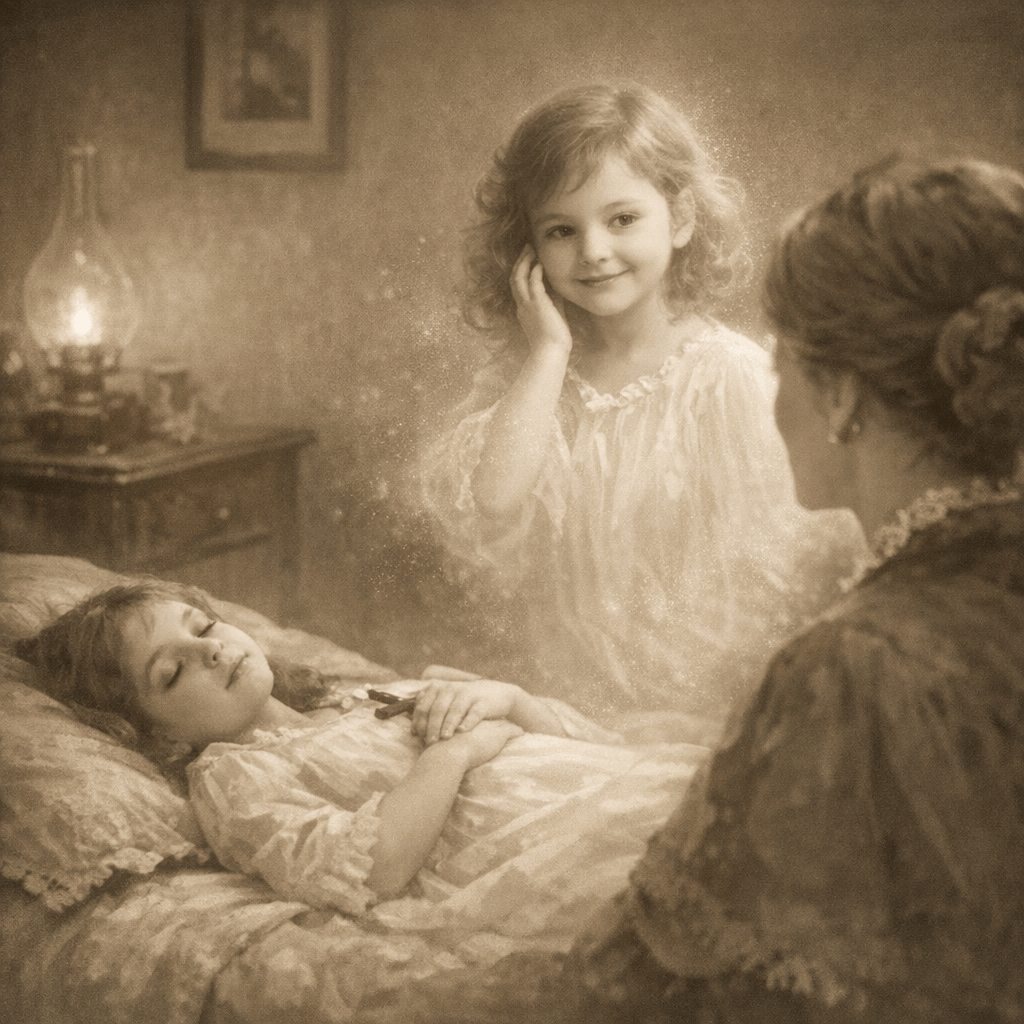
She lies there upon her bed, her hands folded upon her chest, her face peaceful. To my own surprise, I begin speaking to her :
“Good morning, my little friend.”
“Good morning, Rose.”
But…!
Pauline still lies motionless upon the bed, yet her soul has materialised in delicate wisps forming the outline of her body. Even her smile remains. A deep warmth spreads through both my heart and my body.
“Do not be afraid. I came to say goodbye.”
“I am not afraid, my dear child. If only you knew how deeply I shall miss you… and so will your parents, your entire family.”
“I know, Rose, I know. Last week my brothers and sisters and I went to the beach. As always, I refused to listen and hardly covered myself at all. I came home soaked to the bone and freezing cold. Mama dried me and rubbed my skin to warm me, but I fell ill. I had a fever — such a terrible fever. My chest burned, I struggled to breathe, and I coughed constantly. The doctor could not save me. I did not want to leave. I wanted to stay with Mama and Papa.”
“I know, my little heart. You were far too ill to recover. Accept it now ; go. You shall find your grandfather there, and many others besides.”
“I still have one favour to ask of you, my Rose.”
“Tell me, my child.”
“Tell Mama and Papa that I love them, that I am sorry for disobeying them, that I never wished to leave them nor my brothers and sisters. Rose, I must go now ; I feel myself being drawn towards another world. I love you, my dear friend.”
She moved closer to me, touched my face, and vanished.
Emotion overwhelms me. I cannot hold back my tears. They flow endlessly, easing my heart and calming me at last.
I return downstairs to Joseph and Célina in the sitting room. I remind them how deeply their little daughter loved them. I speak of her independent nature, the stubbornness that prevented her from always obeying, and the regret she must have felt for not putting on a coat. I could not possibly explain what had happened within the sanctuary of the little girl’s room.
I remained in Boulogne-sur-Mer for four days, four painful days. The townspeople feared cholera and dreaded contamination. Despite our explanations, they harassed us relentlessly. Little Pauline Lucie Le Petit was buried very early in the morning to avoid the hostile crowd.
After promising to return soon, I boarded the stagecoach once more. It is no longer raining, yet the temperature does not even reach eighteen degrees. My forehead pressed against the window, I gaze at the sea. From time to time, the sun pierces through the clouds, its rays tracing a silver path between the sky and the green-grey water. I feel as though I need only walk upon that shining road to reach my little friend once again.
Pauline Lucie Le Petit was born on the 18th of February 1846 and died on the 30th of August 1854. The world was then suffering through its third cholera epidemic. The disease had arrived from England in 1848 and devastated France, claiming thousands of lives. It would take decades before people understood that proper hygiene alone could prevent this bacillus. Even today, it still reappears sporadically in the poorer regions of the world. Now, at least, we know how to treat it.