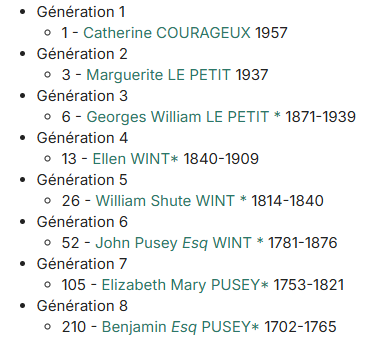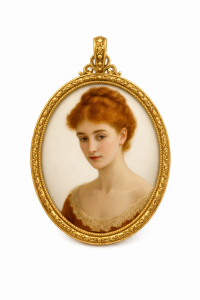
For more than two days, I have been trying to reconstruct the biography of Elizabeth Mary Pusey. Certain things trouble me, such as the fact that I cannot find her birth record, along with other small details. I have not eaten anything proper since… um! I no longer remember. The apartment is in a sorry state, but until I have solved this enigma, I will not be able to bring myself to deal with it. A quick wash, some slightly elegant clothes, and I will go have lunch at the casino restaurant. I know I will be looked down upon by those ladies and their husbands: imagine, a woman alone in a restaurant! What indecency! I sit by the window facing the sea. The dishes follow one another, each as delicious as the last. I savor! I savor the food, the comments that reach my ears, and the view over this expanse, wild today. I leave, not forgetting to greet those most vehement toward me. I return home, change into something more comfortable, and go back to my desk.
The thread has tightened slowly, as it always does when one traces time backward. At first, a reassuring certainty: a funerary inscription, in London, in the church of Holy Trinity, Brompton. It states plainly that Elizabeth Mary Pusey is the daughter of Benjamin Pusey, a planter in Jamaica. A truth carved in stone, passed on without question, repeated without doubt.
Then the archives opened.
Mary Butler appears first, clear, almost familiar. Baptized in 1712 in Jamaica, daughter of Edward and Charity Butler, she belongs to that world of planters where alliances matter as much as land. In 1730, she marries Temple Lawes, heir to one of the most powerful families on the island, son of Governor Sir Nicholas Lawes. From this union is born a first daughter, Elizabeth, baptized in 1738 in Saint Andrew. She is known, attested, acknowledged. She exists without ambiguity.
But she is not the one who appears later.
For a second child emerges in the sources, more discreet, almost erased. In the will of Temple Lawes, drawn up in January 1754 after his return to England, one phrase intrigues: he refers to “Elizabeth, the child of his wife, born, as he was informed, after his departure from Jamaica.” The words are measured. He does not say “my daughter.” Nor does he say she is not. He notes, from a distance, a birth he did not witness.
The chronology tightens. Temple leaves Jamaica at the end of 1753. The child is born after his departure, perhaps at the very end of that year, perhaps at the beginning of 1754. It is impossible to be more precise. No baptism record confirms this birth. The silence of the registers adds to the ambiguity of the words.
At the same time, another man stands nearby. Benjamin Pusey. Not a stranger, but an associate. Their names appear together in plantation accounts, in the tallies of acres and enslaved people. They share land and interests, move within the same narrow circle of the Jamaican colonial elite. In that world, families intertwine, alliances are formed, destinies merge.
And the child grows up.
Later, she bears a name: Elizabeth Mary Pusey. She marries, lives, passes on that name. And when she dies in 1831, it is that same name that is carved in stone, accompanied by a clear, unhesitating filiation: daughter of Benjamin Pusey.
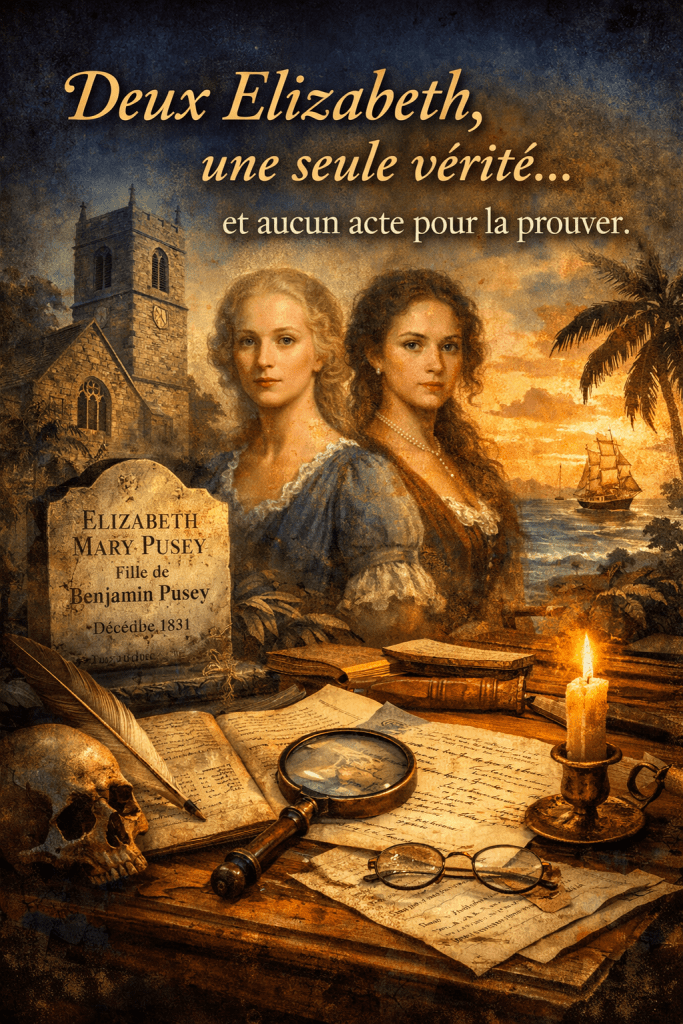
Two Elizabeths. : One, born in 1738, the acknowledged daughter of Temple Lawes. The other, born around 1753, mentioned without certainty, then later linked to Benjamin Pusey.
Between the two, the documents do not lie… but they do not tell everything. The stone asserts, the will suggests, the registers remain silent. And in that space left open, history rebuilds itself, fragile, uncertain, profoundly human.
So one question remains, suspended between words and silences:
Was Elizabeth Mary Pusey truly the daughter of Benjamin Pusey… or rather the child of a world where family ties, interests, and unspoken truths could reshape lineage?
I will therefore have no answer. The truth lies buried, lost in the twists and turns of a propriety that was, at its core, nothing more than a form of hypocrisy. A caste in which lies and concealment could reach their peak, not out of perversity… but out of social necessity. To me, she will remain the child of Jamaica. And, whatever the case, one of Catherine’s ancestors.