
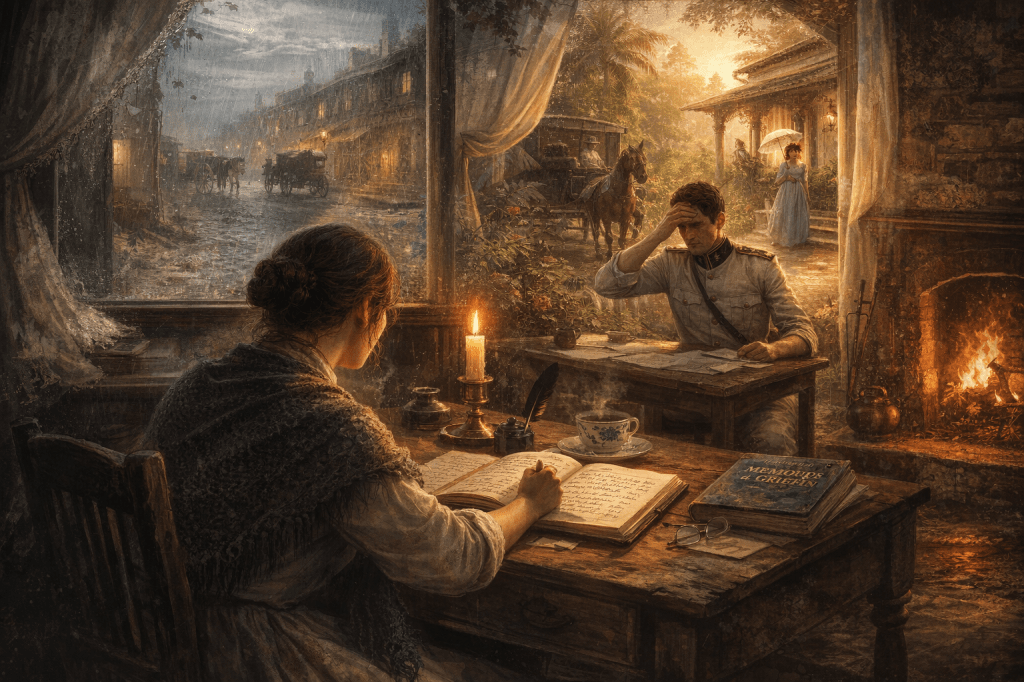
The wind rose over Calais during the night. It still whistles through the gaps in my window, making the candle flames dance upon my desk. The town still sleeps, yet already, in the distance, I hear the first carts upon the damp cobblestones. I pull my shawl more tightly around my shoulders. It is chilly this morning.
I hurry to sit before the fireplace where a good fire crackles brightly. The room is dark, but the glow of the flames is enough for me. My notebook lies open. Beside it rests a book: Memoirs of a Griffin.
Drowsiness overtakes me. I drift away.
The heat seizes me at once — heavy, crushing, humid. I am no longer in Calais.
The familiar wood of my writing desk has vanished. In its place stands a rough table. A mosquito net hangs above a narrow bed. The air vibrates with the endless song of invisible insects.
A young man sits stiffly in his uniform. Awkwardly, he wipes the sweat from his brow. He has that look I know so well now: the look of men who have travelled too far from home.
I move closer.
“You have only just arrived?”
“Yes, only a few weeks ago. They already call me a griffin.”
He smiles, almost embarrassed.
“I thought I was prepared, but I understand nothing of this country. The heat, the people, the customs — everything escapes me!”
I watch him carefully. I recognise him. Francis John Bellew.
The days pass. And I come and go. Sometimes I remain beside him in that relentless heat. Sometimes I return to Calais.
In the mornings, I hear the gulls. The harbour comes alive. The air is damp and salted by the sea. I go down to fetch still-warm bread and pass familiar faces in the streets.
And yet, the moment I return home, all I need is to open my notebook to feel that foreign heat surrounding me once more. I find him again. He is no longer quite the same man, how much time has passed? His movements are surer now. His gaze has steadied. He listens more than he speaks. He observes. He learns. He writes as well — for long hours — as though he were trying to tame this world by placing it upon paper.
One morning, everything is different. I am no longer inside a narrow room, but beneath a white veranda. The garden is dazzling, almost unreal. The colours seem too vivid to be true.
In Calais, colours are softer. Here, everything burns. He is there. Francis. But he is no longer the uncertain young man. India has left its mark upon him. He is waiting. A carriage stops. A young woman steps down. She seems almost fragile beneath the harsh light. Her parasol is held carefully, like a final shield against a world that is not her own. Ann Smoult Temple, whose very name carried the weight of great English families.
Their eyes meet. I hold my breath. Nothing overflows. Nothing betrays their emotions. And yet, within that silence, I feel a bond being born. It is not a marriage of passion. It is a marriage of their time. And yet, it is the beginning of everything.
I return to Calais.
Evening has fallen. The fire crackles softly in the hearth. I prepare my tea. Rain begins once more, light and steady. I could remain there. But no. I know he is waiting for me, over there.
I find him again within the life of an officer. Duty shapes his days. The men. The decisions. The tensions. The heat, always.
He endures. That is what it means to be a captain here: to endure without faltering!
And then, one day, the silence changes. I feel it before I even see it. The house is no longer the same. A cradle. Anne sits nearby, tired yet peaceful. In her arms she holds a newborn child. Francis stands slightly apart, watching for a long while. Then he steps forward. Very slowly. His expression trembles. I almost look away. Because what I am witnessing no longer belongs to History. It is a fragile, intimate moment. A man becoming a father.
The wind strikes my window once more. I start suddenly. The heat disappears. I am back in Calais. My candle flickers. The tea has gone cold. Daylight has come without my noticing. Upon my writing desk, the book still lies open. But it is no longer merely a book. It is a doorway. And behind it are entire lives waiting to be heard. I take up my pen. Because now I understand. I no longer simply search for names in registers. I accompany them. Across seas. Across time. Until today.
Ellen’s stepfather is no longer merely a name in a book, but a man of flesh and blood ; a man who spent part of his life serving his country. He was also a writer, the author of Memoirs of a Griffin, the story of his life in India.
Francis John Bellew (1799–1868) ; Ann Smoult TEMPLE (1792–1856) ;
Patrick Beckett Bellew (1831–1869) was their fourth child ;
Ellen Wint (1840–1909)

