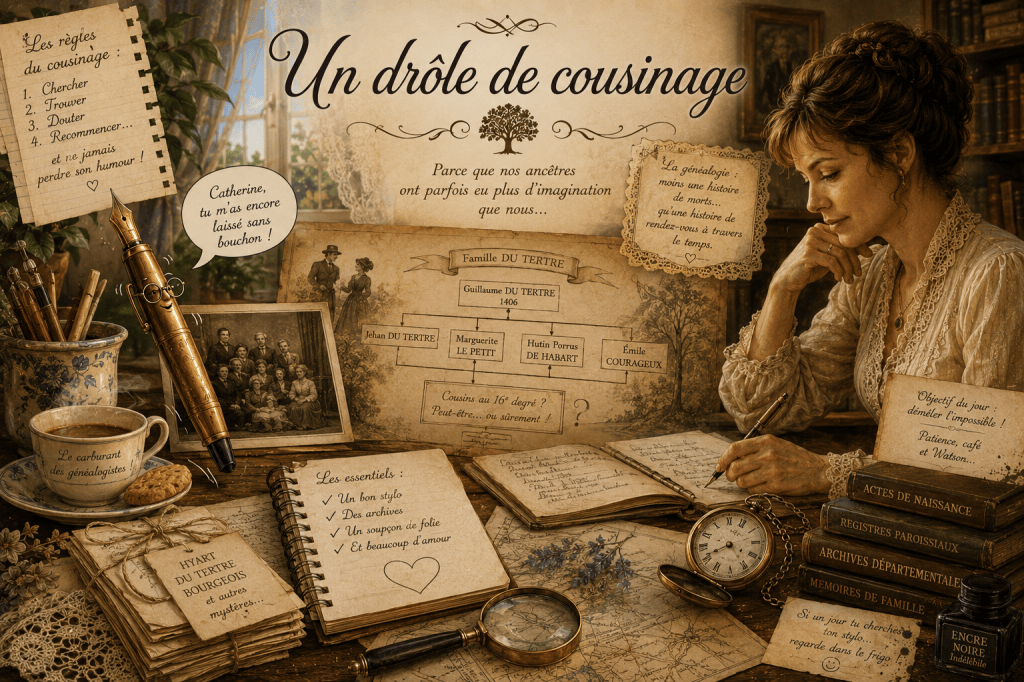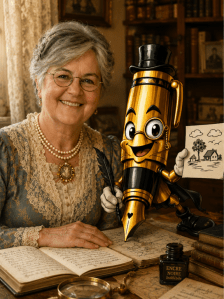
I sit in front of my computer, staring at the discovery that my parents are distant cousins. What a story! I am far too curious to leave such a mystery unsolved.
Inside the pencil holder, Watson Waterman begins to stir.
“Catherine, where has my cap gone?” My old golden fountain pen remains silent for a few seconds.
“Oh, so we are beginning the day with accusations, Watson? Don’t pretend to be innocent. You lose your cap three times a week.”
“Excuse me? I lose my cap? Allow me to remind you that I am an object entirely deprived of legs, unlike certain people who walk around the house with me stuck in their hair.”
I stop abruptly.
“That happened only once.”
“Three times. Including once in front of the postman.”
“You keep count now?”
“I am a fountain pen, Catherine. We observe. It is our profession.”
I take Watson carefully into my hand. His nib squeaks slightly — an obvious sign of bad temper.
“All right! What is wrong with you today?”
“My ink is tired.”
“Tired ink? I mostly use the keyboard these days! You are exaggerating, though we shall continue the old-fashioned way.”
“Exactly! You have made me write about ancestors for fifteen days straight. HYARTs, DU TERTREs, BOURGEOIS — people dead for six centuries! Even my ink reservoir is demanding retirement.”
“You exaggerate. You love genealogy.”
“I used to love genealogy. Until you made me write ‘Jehan’ with three different spellings on the same page.”
Despite myself, I smile.
“It is historical.”
“It is mostly incomprehensible. Only yesterday, you murmured : ‘Perhaps Hutin Porrus DE HABART is cousin to Jehan the Younger…’ Catherine, even ghosts would lose themselves at this stage.”
I burst out laughing.
“You know perfectly well I write better with you.”
Watson seems to straighten proudly.
“Obviously. With other pens, you make grocery lists. With me, you summon the dead, memories, and old family stories. With the machine, you merely draft documents.”
“Monsieur is becoming poetic.”
“Monsieur is an instrument of prestige.”
I observe him. His shining golden body still bears a tiny trace of black ink near the nib.
“You know, you can be rather pretentious at times.”
“And you, Catherine, speak to a fountain pen.”
Silence.
“That is not entirely false.”
“Exactly.”
I reopen my notebook.
“Well then. Shall we continue?”
“Which ancestor today?”
“A story involving sixteenth-degree cousins.”
“My God… prepare the coffee.”
“For me or for you?”
“Both. And avoid leaving me uncapped this time. I dry out faster than your patience with printers.”
“That was low.”
“No. That was precise.”
Slowly, I refill Watson with a fresh black ink cartridge. Barely has the nib touched the paper before he lets out a theatrical sigh.
“Ah! Finally. Ink worthy of me.”
“You are difficult now?”
“Catherine, a fountain pen possesses a reputation. I cannot possibly write the history of the DU TERTRE family using ink that resembles a supermarket receipt.”
I shake my head.
“You know ordinary people speak to their cats.”
“And unusual people speak to their pens. We each have our own grandeur.”
I begin writing : “In 1406, Guillaume DU TERTRE…”
Watson trembles slightly in my hand.
“Oh no.”
“What now?”
“You said the year aloud.”
“So?”
“It always begins like this. In ten minutes, you will be standing in the middle of the sitting room explaining twelfth-degree cousinship to a houseplant.”
“That happened only once!”
“Twice. The ficus looked worried.”
I struggle to remain serious.
“You talk nonsense.”
“Catherine, yesterday you said : ‘Wait, Watson, I’m just checking a document from 1632,’ then returned three hours later carrying toast, a magnifying glass, and an existential crisis.”
“The archives were badly organised.”
“You had spent forty-five minutes browsing Flemish waffle recipes.”
I stop writing.
“How do you know that?”
“I sit on your desk. I see everything.”
A brief silence.
“You spy on me.”
“I document.”
I resume writing with exaggerated indignation.
“Fine. Today we remain focused.”
“Very well. Objective?”
“To understand how Marguerite LE PETIT is sixteenth-degree cousin to Émile COURAGEUX.”
Watson remains silent for several seconds.
“Catherine?”
“Yes?”
“Even medieval priests would not have wanted to calculate that.”
I burst into laughter once more.
“You have absolutely no respect for my research.”
“On the contrary. I admire your perseverance. Few people are capable of tracing a family line back to the fifteenth century with such determination.”
“Thank you.”
“And even fewer manage it with so many biscuits on the desk.”
I glance at the open biscuit tin beside my notebook.
“You are becoming insolent. One more remark and I shall put you back into the shoebox.”
“Not insolent. Observant. Important distinction.”
I take a clean sheet of paper.
“Right. This time, silence. I am working seriously.”
At last, Watson glides smoothly across the page.
For several minutes, only the delicate scratching of the nib accompanies the ticking of the clock.
Then suddenly :
“Catherine?”
“Hmmm?”
“The coffee.”
“What about the coffee?”
“You have just dipped my nib into it again.”
I let out a cry.
“OH NO!”
“Wonderful. Now I write in arabica.”
I rush into the kitchen carrying Watson in one hand and a tea towel in the other.
“Don’t move!”
“Excellent suggestion, Catherine. As though I had planned on running away.”
Gently, I rinse his nib beneath lukewarm water.
“There, there… everything will be fine.”
“I should like to point out that few fountain pens survive death by coffee.”
“It was an accident.”
“Of course. Just like the day you left me inside the refrigerator.”
I freeze.
“You remember that?”
“Catherine, I spent an entire night between the butter, the jam, and leftovers. How could I possibly forget such humiliation?”
I bite my lips to stop myself laughing.
“I searched for you everywhere.”
“You opened the refrigerator three times before noticing me.”
“You were hidden behind the vegetable drawer.”
“I was mainly deeply offended.”
I return to my desk and place Watson carefully upon his case like a wounded soldier.
“Rest now.”
“Impossible.”
“Why?”
“You have an idea.”
I blink innocently.
“Not at all.”
“Catherine, I know you. You have that look.”
“What look?”
“The look that comes before dangerous sentences such as : ‘What if I wrote an eight-hundred-page novel about my ancestors?’”
I attempt a dignified expression.
“It is not six hundred pages.”
“Ah.”
“More like eight hundred.”
“Lord, protect my nib.”
I begin sorting through the papers scattered across the table : birth certificates, yellowed copies, notes scribbled everywhere.
Watson sighs.
“You live in fascinating documentary chaos.”
“I am organised.”
“Catherine, there is currently a photocopy from 1832 inside your biscuit tin.”
“I knew exactly where it was.”
“And a marriage certificate beneath the sofa cushion.”
“Temporarily.”
“And why did you write ‘check Jehan HYART’ on a paper napkin?”
“Because I had run out of space.”
Watson falls silent for a moment before declaring solemnly :
“One day, archaeologists will discover this house and conclude that a historian was attacked by a paper storm.”
I burst into laughter again.
“You are unbearable.”
“And yet indispensable.”
Gently, I take Watson once more.
“That is true.”
He glides across the page with renewed elegance.
“You know, Catherine…”
“Yes?”
“Despite everything, I rather enjoy our evenings.”
I smile.
“Even with the coffee, the archives, and impossible cousinships?”
“Yes. Because with you, I am not merely used to sign invoices.”
“And what are you used for then?”
The nib slowly traces a few words upon the page :
“To prevent memories from dying.”
I remain silent.
Then Watson immediately adds :
“Well! And sometimes for grocery lists too. One must remain humble.”