Northern France and My Roots

The Nord and Pas-de-Calais are two departments in northern France. Together with Somme, Aisne and Oise, they form the region called Hauts-de-France.
— « Catherine, t’arcommince! »
— Hey Biloute! What’s that language supposed to be?
— The one from your home in ch’Nord.
— My grandmother knew a few words and expressions, and that was all. My mother grew up in Paris, so she did not speak the local dialect. I remember one expression from my little Mémé:
« Armonte tes bas, descin d’un cotron, mouche t’in nez et dis bonjour à la dame. »
And another one:
« Ct’année j’va en vacances à gardin-cour. »
From one place to another in the region, the dialect changes, as do the accents and intonations.
— « Don’t forget the translation at the bottom of the page, » Watson reminds me.
The flat country? Yes, in the Calais and Dunkirk area. But when you take the coastal road toward Boulogne-sur-Mer, the scenery changes. Forests and hills follow one another, the sea shimmers on your right, and you breathe deeply the invigorating sea air.
Between Calais and Boulogne-sur-Mer there is a succession of charming little towns: Sangatte, Escalles, the Blanc-Nez cliffs, Wissant, the Gris-Nez cliffs, Audresselles, Ambleteuse, Wimereux and Boulogne.
There is also Lake Ardres and the Audomarois region with its marshes, national park and boat rides.
— « A real tourist guide! »
— Don’t laugh, I haven’t even talked about Calais yet.
Calais… yes, Calais! I close my eyes and walk through its streets. I struggle against the wind and breathe in the sea air that I miss so much. I know I will never live there again. My life is in Auvergne now, but I remain attached to my roots.
For me, the T in twenty is pronounced like the W in wagon, a Roubaisienne is a rolling shutter, and a wassingue cleans the floor (and above all, don’t forget the W).
— « You’re sounding very nostalgic, Catherine. Are you sure you don’t want to go back? »
— Yes, Watson. Here, wherever you stand, mountains appear at the end of a street. The climate is much drier and poverty does not seem to seep from every corner. I want a future for my children and grandchildren, and I cannot live far away from them. I miss my mother, my brothers and sisters, but we all make our own choices in life.
— « Enjoy yourself, add a few photographs and keep some in reserve for future posts! »
The Courgain Maritime district, the beach, the Town Hall, The Burghers of Calais by Rodin, the Boulonnais region and the Audomarois.
Watson returns to his pencil holder while I stand by the window and admire the majestic Puy de Dôme. The sky is a clear blue, and sunlight bathes every house and tree in a bright glow. Between two clusters of trees, the winding road appears and climbs toward the foot of the great master. A ray of light plays on the windows of the train making its way to the summit.
The air is warm and dry. Today the thermometer is likely to become overenthusiastic. With the shutters closed, I will bury myself in online records.
I turn around and look at my small apartment. I think of my children and grandchildren. Here, their future is secure.
My eyes fall upon the photo collage where all my people from Calais are gathered together. I smile at them.
I love them, and they know it.
I return to my activities in the « Middle-earth »… pardon, Auvergne-Rhône-Alpes.
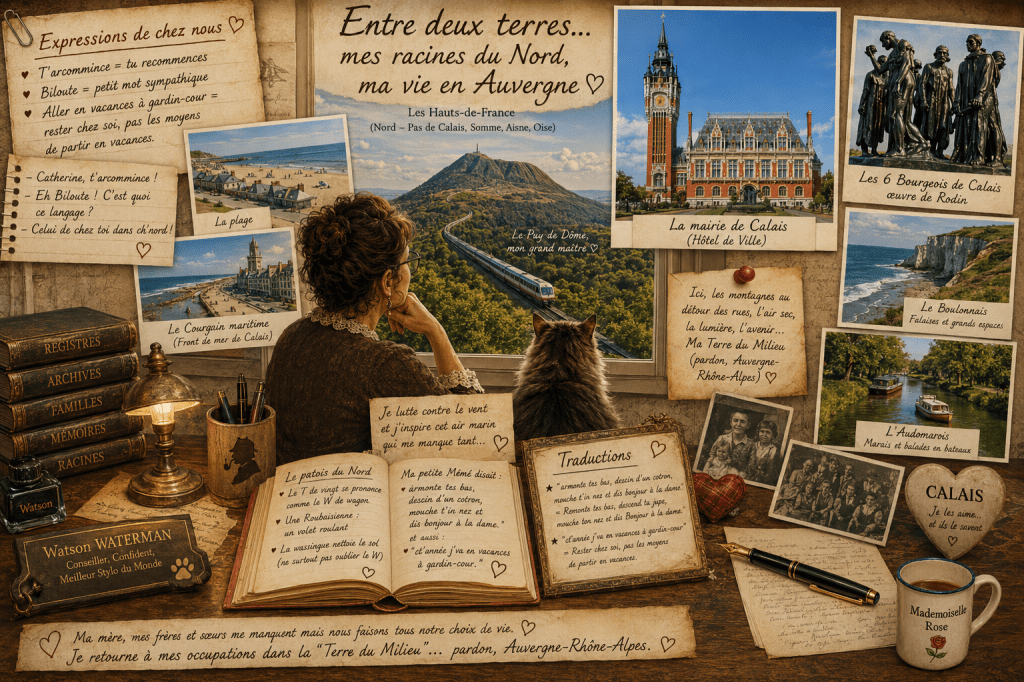
Explanations:
T’arcommince = « You’re starting again! »
A regional contraction of tu recommences. It is usually said with affection and mild exasperation, often when someone starts talking again about one of their favourite subjects or repeats a habit they are known for.
Biloute = a friendly and affectionate word from Northern France.
It can mean something like mate, pal, buddy, or my dear, depending on the situation. It is often used warmly and playfully and is strongly associated with the Nord–Pas-de-Calais region.
Going on holiday to « gardin-cour » = staying at home because there is no money for a real holiday.
This humorous expression refers to spending one’s holiday moving only between the garden and the courtyard instead of travelling. Behind the joke is the reality that many working-class families could not afford vacations away from home.

