It has now been more than five months since I began living in this era. France is slowly rebuilding itself. This year, another remarkable event is taking place in Calais. I wish to share an article I read in one of the publications purchased at the Maison de la Presse :
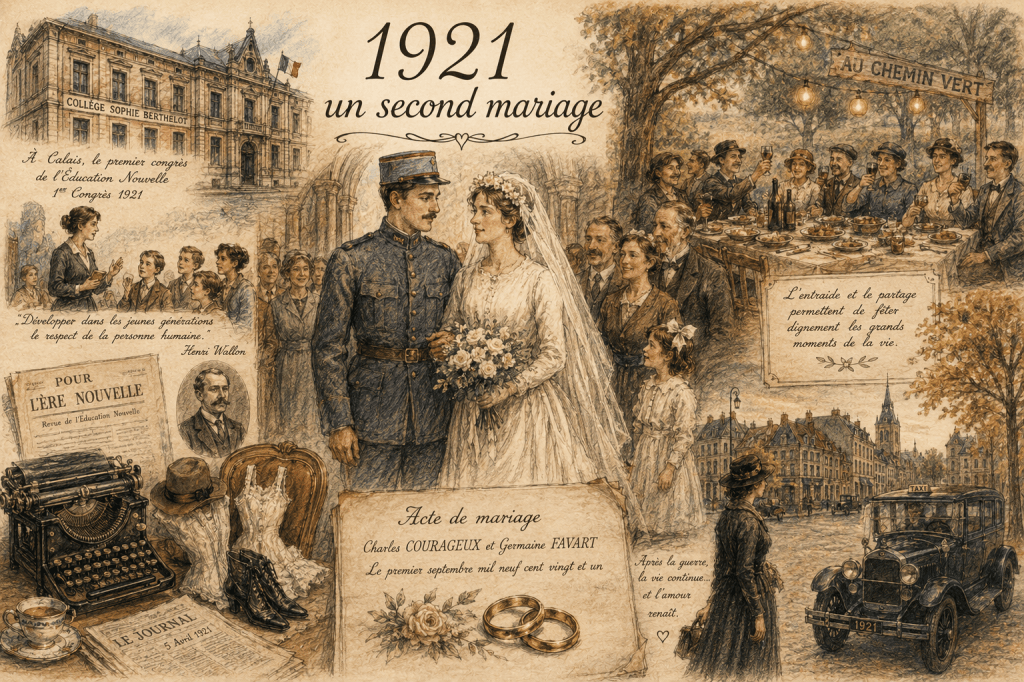
“In Calais, the International League for New Education was founded in 1921 during the first Congress of New Education held in the city.
Sophie Berthelot Secondary School
Most of the great names of progressive education attended this congress : Adolphe Ferrière, of course, but also Jean Piaget, Maria Montessori, and A. S. Neill, who would found Summerhill School only a few months later. Deeply marked by the devastation of the First World War, they sought to launch the great project of an international education movement.
Henri Wallon would later write :
‘This Congress was the result of the pacifist movement that followed the First World War. At that time, it seemed that nothing could better secure a peaceful future for the world than developing, in younger generations, respect for the human person through appropriate education. In this way, feelings of solidarity and human brotherhood — the very opposites of war and violence — could flourish.’
It was during this first congress that the journal Pour l’Ère Nouvelle was founded.”
Sophie Berthelot School was requisitioned for the occasion.
It is now the first of September. The days grow steadily shorter, and autumn is beginning to reveal itself. The weather is beautiful ; the north wind has abandoned the coast, and the sun pours down its rays. I feel content as I make my way to the wedding of Charles COURAGEUX and Germaine FAVART. Charles is still serving in the army, yet the administrative council of his regiment has authorised the marriage. The civil ceremony was held privately, so I am attending the church service. On the left side sit the groom’s father, brothers and sisters, uncles, aunts, cousins, and a few soldiers. On the right are Germaine’s family : her mother, her sisters, and even an uncle who has travelled from Belgium to celebrate the occasion.
We all gather afterwards on a field known as Le Chemin Vert, where the wedding feast has been prepared. Everyone has brought something : a dish, a bottle, or a dessert. These labouring families are not wealthy, but mutual help and generosity allow them to celebrate important occasions with dignity. After the customary congratulations, I find Charles and Germaine standing quietly apart from the crowd.
“Good afternoon, Charles. Good afternoon, Germaine. How are you both?”
“Very well,” Charles replies. “At last we have been able to marry. It is pure happiness after so much suffering. During these past years, I have seen my mother die, then my brother Édouard, and little Eugène, who was only five months old.”
“Life can bring terrible sorrow,” I answer softly, “but moments such as this restore warmth to the heart.”
“You are right, Mademoiselle Rose,” replies Germaine. “My parents had only daughters, and I am the youngest. My father was born in Belgium and came to France hoping for a better life. He knew how to drive an automobile and worked for several companies in Calais as a chauffeur.”
A little girl of about three climbs onto Germaine’s lap.
“This is our little Léona,” Charles and Germaine say together.
“She is adorable. And what are your plans for the future?”
“As soon as I am released from military service, I shall look for work. I am the only surviving son now. I want to make my mother proud — and my beloved wife as well.”
“I am very happy to have spoken with you both. I wish you every happiness in the world.”
Seated at the table beside the newlyweds, I take part in a warm-hearted celebration where laughter and wine flow freely, where simplicity reigns, and where the Belgian accent mingles with the accent of Northern France. In the eyes of this young couple, I glimpse a love so absolute that no other feeling could ever replace it.
Quietly, I slip away from the festivities. A taxi waits for me by the roadside, and I return home.
Charles and Germaine are Catherine’s paternal grandparents.

